
Blue-Green Stains in Well Water: What Causes Them
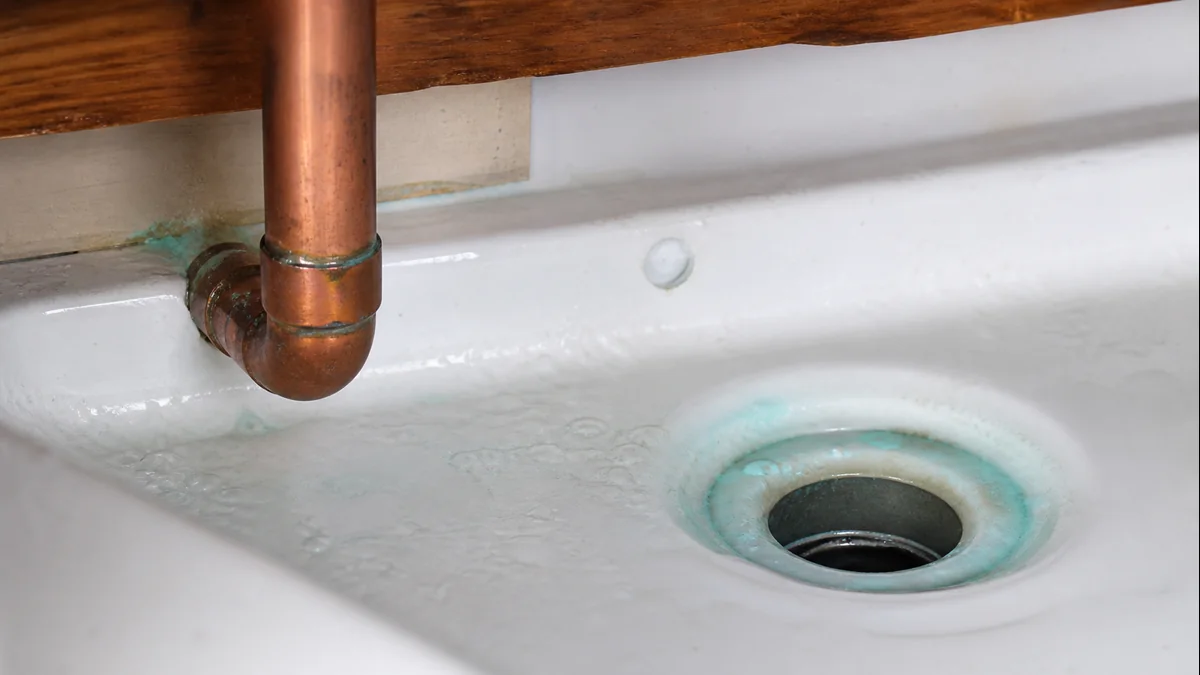
Blue-green stains on sinks, tubs, and fixtures mean your well water is acidic — pH below 7 — and it's corroding copper pipes. The dissolved copper leaches into your water and deposits as a blue-green stain wherever it sits or drips. A calcite neutralizer raises the pH and stops the corrosion at the source, though neutralizing adds hardness, so many acidic wells need a softener afterward too.
What causes blue-green stains in well water?
Water with a pH below 7 is acidic enough to slowly dissolve copper plumbing. As that water moves through copper pipes, it picks up small amounts of copper, which then oxidizes and deposits as a distinctive blue-green stain — usually around drains, faucet aerators, and anywhere water sits or drips repeatedly.
This is a different mechanism than iron staining (orange-brown, from dissolved iron in the source water itself) or sulfur odor (rotten-egg smell, from hydrogen sulfide gas). Blue-green staining specifically points to low pH attacking your pipes, not something already in the groundwater.
Is acidic well water safe to drink?
The immediate concern with low-pH well water isn't the acidity itself — it's what the acidity is doing to your plumbing. Corroded copper pipes can add copper and other metals to your water over time, on top of the staining. If you're seeing blue-green stains, it's worth getting pH tested along with a full comprehensive panel rather than treating the stain as a cosmetic-only issue.
How do you fix acidic well water?
A calcite neutralizer is the standard fix. It works by passing water through a bed of calcium carbonate (calcite) media, which slowly dissolves into the water and raises the pH above the corrosive threshold — stopping the copper leaching at the source rather than treating symptoms downstream.
| Symptom | Likely cause | Fix |
|---|---|---|
| Blue-green stains at drains/fixtures | Low pH corroding copper pipe | Calcite neutralizer |
| Metallic taste alongside blue-green staining | Copper picked up from corrosion | Neutralizer + retest |
| Stains plus new hardness/scale after treatment | Calcite raising both pH and hardness | Add a softener downstream |
Why does neutralizing acidic water add hardness?
Calcite neutralizers work by dissolving calcium carbonate into the water — that's what raises the pH. But calcium is also a hardness mineral. So the same process that fixes the acidity also raises your water's hardness. This is a known tradeoff, not a malfunction: many wells that start out acidic and "soft" end up needing a softener installed after the neutralizer, once the pH problem is solved and the hardness becomes the next thing to address.
This is exactly why a one-off pH strip test isn't enough to plan treatment — you need the full picture (pH, hardness, iron, sulfur, TDS) up front so the equipment gets sized and sequenced correctly the first time.
What this means for well owners locally
Acidic well water shows up regularly across central NC's private wells — Wake, Johnston, Franklin, Chatham, and Granville counties all have well water profiles where low pH is a factor, often independent of whether the well also has iron or sulfur issues. Because NC doesn't regulate private well water quality after construction, corrosion damage can go unnoticed for years until staining or a plumbing repair reveals it.
FAQ
What's the difference between blue-green stains and orange stains in well water? Blue-green comes from acidic water corroding copper pipe. Orange-brown comes from dissolved iron in the water itself. See iron in well water orange stains for the iron side.
Can low pH well water damage my plumbing? Yes — acidic water slowly corrodes copper pipe over time, which is the source of the blue-green staining and can shorten the life of plumbing fixtures.
Do I need a softener if I install a pH neutralizer? Not always, but often. Calcite neutralizers raise hardness as a side effect of raising pH, so many acidic wells need both stages. A comprehensive test tells you whether that's the case for your water.
How do I know if my well water is acidic? Blue-green staining is the visible clue, but pH needs to be measured directly — it's part of a comprehensive water test, not something you can eyeball from staining severity alone.
What does a neutralizer system cost? Triangle Waterworks well systems, including neutralization where needed, are sized and quoted based on a free water analysis of your specific water.
Get a free well water analysis
If you're seeing blue-green staining, get pH tested before you buy anything — it's the only way to confirm acidity is the cause and size the right neutralizer. A free Triangle Waterworks water analysis covers pH along with iron, hardness, sulfur, and TDS. See the well water treatment guide for NC for the full test-diagnose-treat sequence, or do I need a water softener in North Carolina if hardness turns out to be part of your picture too.
Answer nine practical questions, then request a written quote or well-water analysis.
Start My Water Analysis