
Air Injection Iron Filters: How They Work
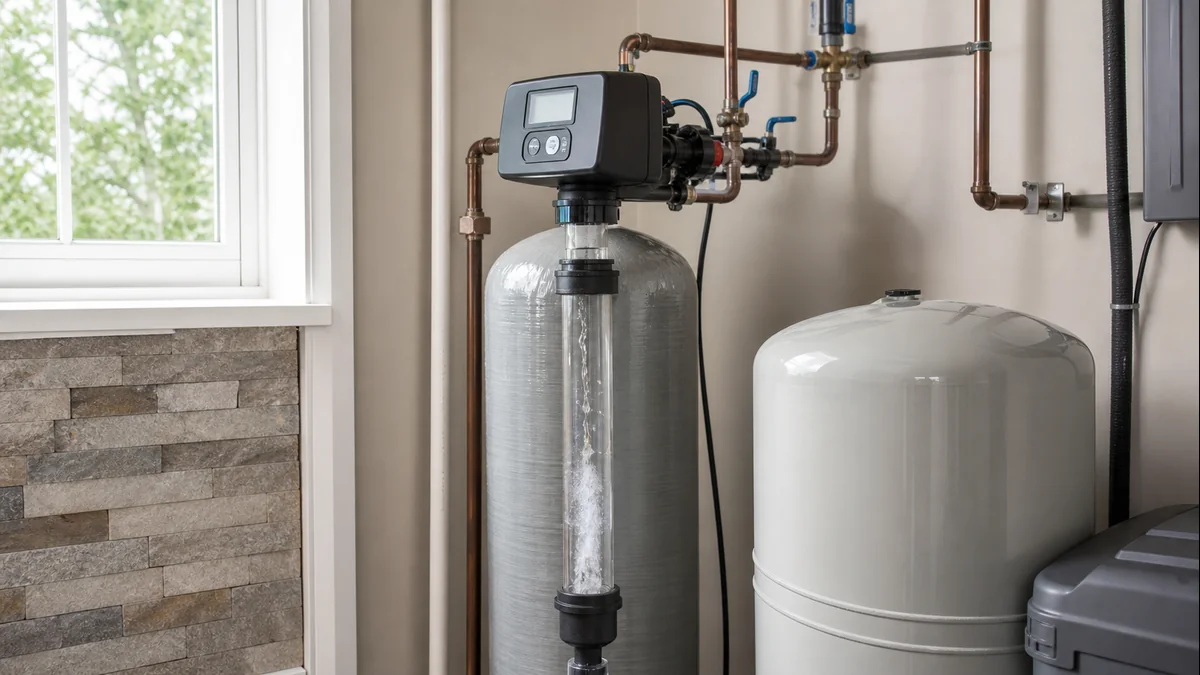
An air injection (AIO) filter injects a bubble of air into your well water to oxidize dissolved iron into solid particles, then filters those particles out on a media bed — no chlorine, no salt, no chemical feed. Air-injection oxidation systems can typically handle iron up to about 15 ppm, which covers most residential well iron problems. Maintenance is mostly automatic backwash cycles, not manual dosing.
How does an air injection iron filter actually work?
Iron in well water usually starts out dissolved (ferrous iron) — invisible in a glass, but it's what turns orange once it hits air, which is why sinks, tubs, and toilets stain even though the water looks clear coming out of the faucet. An AIO system does that oxidation on purpose, inside a sealed tank, before the water ever reaches your fixtures:
- An air pocket is injected or maintained at the top of the mineral tank.
- Water passes through that air pocket, oxidizing dissolved iron (and often manganese and hydrogen sulfide) into solid particles.
- The now-solid particles get trapped in a filter media bed as the water flows through.
- On a set schedule, the system backwashes — flushing the trapped particles out to drain and recharging the air pocket.
The result is water that never gets the chance to stain a fixture, because the iron is already solid and filtered out before it exits the tap.
Air injection vs. greensand vs. birm — what's the difference?
All three are iron-oxidation media systems, but they oxidize differently:
| System | Oxidizes with | Iron capacity | Chemical feed needed |
|---|---|---|---|
| Air injection (AIO) | Injected air pocket | Up to ~15 ppm | No |
| Greensand (manganese greensand) | Manganese dioxide coating, often regenerated with potassium permanganate | Moderate, but usually needs the chemical regen | Often yes |
| Birm | Catalytic media using dissolved oxygen already in the water | Lower — needs decent dissolved oxygen and near-neutral pH to work well | No |
Air injection tends to be the preferred choice for households that don't want to store or feed a chemical regenerant, and it holds up across a wider iron range than birm without the ongoing potassium permanganate costs that greensand systems often require.
What does AIO maintenance actually look like?
Day to day, there's nothing to do. The system generates its own air pocket and backwashes on a programmed schedule — most homeowners never touch it between service visits. What does matter over time:
- Backwash schedule needs to match your actual water use and iron load, or the media bed loses capacity between cycles.
- Media bed life — the filtering media isn't consumed like a cartridge, but it does wear down over years and eventually needs replacement.
- Air pocket maintenance — some systems use a small compressor or venturi to maintain the air charge; that component is the main mechanical part that can need service.
Compare that to iron-removal water softeners or chemical-feed systems, which need salt or regenerant chemical restocked on a regular basis — AIO's ongoing cost is closer to "check it periodically" than "replenish it monthly."
When is an air injection filter the wrong fit?
If your iron level is above what the system is rated for, or if hydrogen sulfide and iron are both present at high concentrations, a single AIO stage may not fully resolve staining or odor — this is a case-by-case sizing question that a water analysis answers, not a rule of thumb. AIO also doesn't address hardness, so a well with both iron and hard water typically pairs an AIO stage with a separate softener downstream.
Local angle: iron in Triangle-area well water
Iron and sulfur are among the most common well water complaints in the counties surrounding Raleigh and Cary — Johnston, Franklin, Chatham, and Granville all have a meaningfully higher share of private wells than Wake County's roughly 15%, and well water chemistry in this part of the Piedmont commonly includes dissolved iron. That's why AIO systems show up so often in well setups here: they solve the staining problem without adding an ongoing chemical or salt cost, which matters for well owners already budgeting for other treatment stages like a softener or UV.
FAQ
Will an air injection filter fix rusty-orange stains in my sinks and toilets? Yes, if the staining is from dissolved iron oxidizing after it leaves the tap — which is the most common cause. The AIO system oxidizes and removes the iron before it reaches the fixture, so the staining source is gone.
Does an air injection filter need electricity? Yes, the control valve and, on some models, the air-charging mechanism need power to run the backwash cycle and maintain the air pocket.
How is air injection different from a plain sediment filter? A sediment filter only catches particles that are already solid. It won't do anything for dissolved iron, which passes right through until it oxidizes downstream — usually in your fixtures. AIO does the oxidizing itself, upstream of the point where staining would happen.
Can an air injection system handle both iron and sulfur smell? Air injection oxidizes hydrogen sulfide the same way it oxidizes iron, so many systems address both. Whether one stage is enough depends on the concentration of each, which a water test should confirm before sizing the system.
What does an AIO system cost as part of a well setup? Triangle Waterworks well systems are sized and quoted depending on what your water actually needs, always starting with a free water analysis rather than a guess based on symptoms alone.
Not sure if it's iron, sulfur, or both in your well water? Start with a free water analysis — we'll tell you exactly what's there before recommending a system.
Related reading: Well Water Treatment: The Complete NC Guide · Iron in Well Water: Orange Stains Explained · Is Iron in Well Water Dangerous? · UV Water Treatment for Well Water
Answer nine practical questions, then request a written quote or well-water analysis.
Start My Water Analysis