
All-in-One Water System Cost in North Carolina
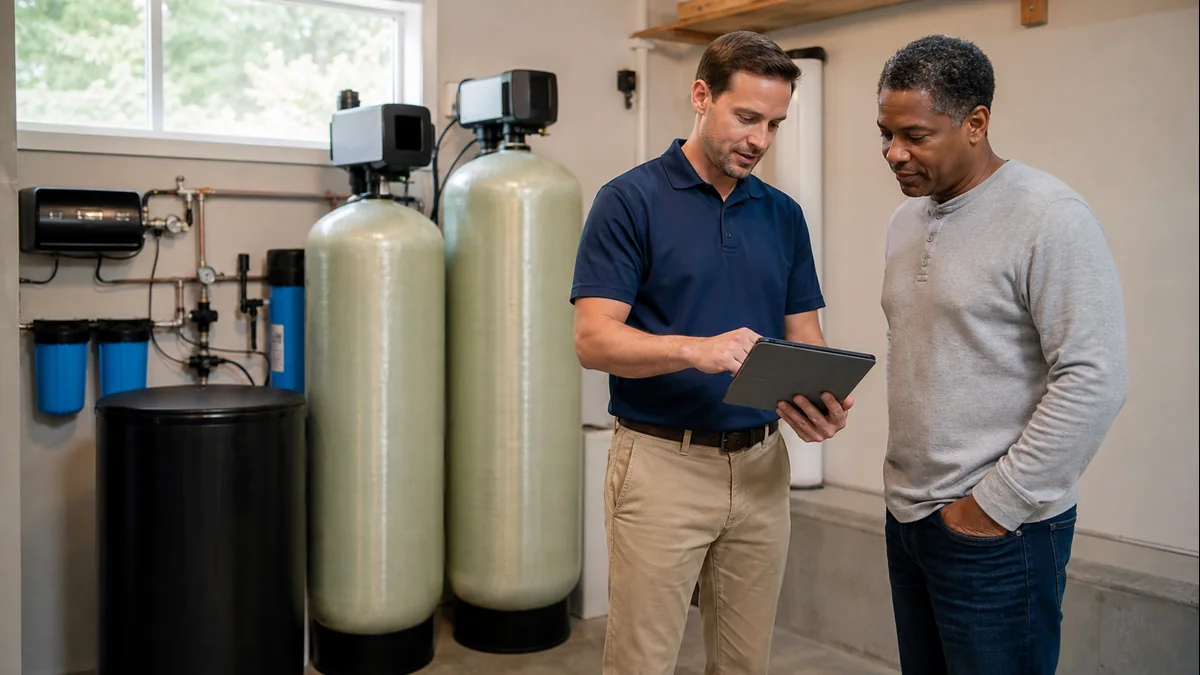
Direct answer: An all-in-one system — softening resin plus carbon filtration in a single unit — is priced and sized off two things: how many bathrooms the home has to serve (which sets the flow capacity needed) on Triangle city water, or what a free water analysis finds on a private well. Every tier includes an under-sink reverse osmosis system and a lifetime warranty with terms in writing. There's no fixed number to quote sight-unseen — the water test and household size come first, the price second.
What sets an all-in-one water system's price on city water?
On Raleigh, Cary, Apex, Morrisville, and the rest of the Triangle's municipal water systems, Triangle Waterworks sizes each install by bathroom count:
| Bathrooms | What drives the tier | What's included |
|---|---|---|
| 1–2 | Lower simultaneous water demand | Softening + carbon filtration, under-sink RO, lifetime warranty (terms in writing) |
| 3–4 | Moderate simultaneous water demand | Softening + carbon filtration, under-sink RO, lifetime warranty (terms in writing) |
| 5+ | Higher simultaneous water demand | Softening + carbon filtration, under-sink RO, lifetime warranty (terms in writing) |
Every tier is the same system — the same softening resin, the same carbon stage, the same RO unit, the same warranty. What changes is the flow capacity needed to serve the fixture count in the home. Installation is done by an NC-licensed plumber (required under NCGS §87-21, which classifies whole-home water treatment installation as licensed plumbing work), and most city-water installs are a single visit, typically 2–4 hours. You can verify any installer's license through the NC State Board's public lookup before work begins.
Why does price scale with bathroom count?
Bathroom count is a practical proxy for household water demand. A 1–2 bath home typically has fewer people and fewer simultaneous draws on the plumbing — a shower running while a dishwasher and washing machine also pull water. A 5+ bath home needs a system sized to keep pressure and flow consistent across more fixtures pulling water at once, which means a larger-capacity unit. It isn't a smaller or cheaper version of the technology at the lower tiers — it's the same softening and carbon system, sized to the demand your home actually places on it.
What sets an all-in-one system's price on a well?
Well water varies enormously from lot to lot — hardness, iron, sulfur, and pH can all be different two houses apart, even on the same road. Because of that, well systems aren't sold off a fixed price sheet the way city systems are. The number depends entirely on what a free water analysis finds: a well with elevated hardness and some iron needs less equipment than a well needing more aggressive iron removal, pH correction, and a larger combined system. The water analysis comes first, the price second — never the reverse.
How does this compare to national big-brand pricing?
National franchise water treatment brands commonly quote $6,000–$12,000 for a comparable whole-home system — often well above what a locally sized system runs here, for equipment doing the same basic job of softening and filtering. The pattern behind those numbers is documented: one Leaf Home Water Solutions quote opened at $12,241 and was negotiated down to $4,825 after the homeowner pushed back — more than half off, for the identical system. That gap between the opening number and the number after pushback is the real story. Sizing off your actual bathroom count and a free water analysis, rather than a padded opening number, removes that negotiation altogether.
What ongoing costs should I expect after installation?
The two ongoing costs are salt (for the softening side) and periodic media changes (for the carbon side).
Salt. Using the EPA WaterSense estimate that a family of four uses roughly 210 gallons of water per day indoors, and the NSF/ANSI 44 efficiency standard requiring at least 3,350 grains of hardness removed per pound of salt, the math works out roughly like this for Triangle city water:
- At Raleigh's hardness (about 1.6 grains per gallon): 210 × 1.6 ≈ 336 grains/day, or about 122,600 grains/year. Divided by 3,350 grains/lb, that's roughly 37 lb of salt a year — about one 40-lb bag.
- At the top of Cary's hardness range (about 3.7 grains per gallon): 210 × 3.7 = 777 grains/day, or about 283,600 grains/year. Divided by 3,350 grains/lb, that's roughly 85 lb/year — about two 40-lb bags.
At retail salt prices of roughly $8–$12 per 40-lb bag, that puts most Triangle city-water households at about one to two bags of salt a year, or roughly $8–$24 annually — not a monthly expense. Actual use varies with household size and habits, and this is a general calculation from EPA and NSF/ANSI figures, not a guarantee for any specific home. A softener sized for well water with higher hardness will use more salt than this, proportional to how hard the water tests — another reason well systems are sized after an analysis rather than off a fixed chart.
Media changes. The carbon stage needs periodic media changes to keep performing — carbon media has a working life and needs replacement on a schedule, the same way any filtration media does. Get the exact replacement schedule and cost in writing from your installer before you sign, since it varies by system size and water conditions. Don't accept a verbal estimate on this — ask for it in writing alongside the warranty terms.
All-in-one system vs. separate softener and filter: cost comparison
| All-in-one system | Softener only | Filter only | |
|---|---|---|---|
| Installed cost (city water) | Sized by bathroom count, priced after a free water analysis | Lower upfront, but doesn't address contaminants | Lower upfront, but doesn't address hardness |
| Covers hardness (scale, buildup) | Yes | Yes | No |
| Covers chlorine taste/odor, disinfection byproducts, PFAS | Yes (carbon stage) | No | Yes |
| Number of installs / warranties to manage | One | One | One |
| Best fit for Triangle city water | Yes — addresses both documented issues at once | Addresses only half the picture | Addresses only half the picture |
Buying the two pieces separately usually means two installs, two warranties, and two maintenance schedules — and neither piece alone addresses what's actually documented in Triangle water. The all-in-one system folds both into one price, one visit, and one warranty.
Frequently Asked Questions
Is the under-sink RO system included, or is it added to the price later? It's included at every bathroom tier — not a separate line item and not an upsell added after the sale. It's part of what you're quoted from the start.
I have a 3-bathroom house in Cary — what should I actually expect to pay? For city-water installs, 3–4 bathroom homes fall into their own tier based on typical water demand. Get any additional charges — for unusual plumbing configurations, for example — in writing before the visit so there are no surprises.
Why does well pricing vary so much from house to house? Well water conditions vary significantly from property to property — hardness, iron, sulfur, and pH all differ. The free water analysis identifies what your specific well needs, and the system is priced from that, not from a flat schedule the way city systems are.
What's actually in writing with the lifetime warranty? Ask for the specific warranty terms in writing before you sign — coverage details should be spelled out on paper, not described verbally during the sales visit. That's true of any installer, not just this one.
Do I need to do anything to prep my house before a same-day install? Clear access to your main water line and the area where the system will be installed (often a garage or utility closet). Most city-water jobs are a single visit of 2–4 hours, so beyond access, there's little prep needed.
My neighbor got quoted way more from a national brand for what sounds like the same system — why? That's a common pattern. National franchise quotes commonly start in the $6,000–$12,000 range for comparable systems, with room built in for negotiation, as in the documented Leaf Home case where a $12,241 quote dropped to $4,825 after pushback. Sizing from a free water analysis, rather than a padded opening number, avoids that negotiation entirely.
Get your exact price
If you're on city water, take the 60-second water quiz to see your bathroom-count tier and what's included before you ever schedule a visit. If you're on a well, start with a free water analysis — it's the only way to get an accurate number for your specific water, and it comes before any price discussion, not after.
For more on how this fits into the bigger picture, see whole-house water filter cost in Raleigh, well water treatment system cost in NC, do I need a water softener in North Carolina, how a water softener is sized in grains, and what NSF certifications actually mean.
Answer nine practical questions, then request a written quote or well-water analysis.
Start My Water Analysis