
Why Does Apex, NC Water Taste Like Chemicals?
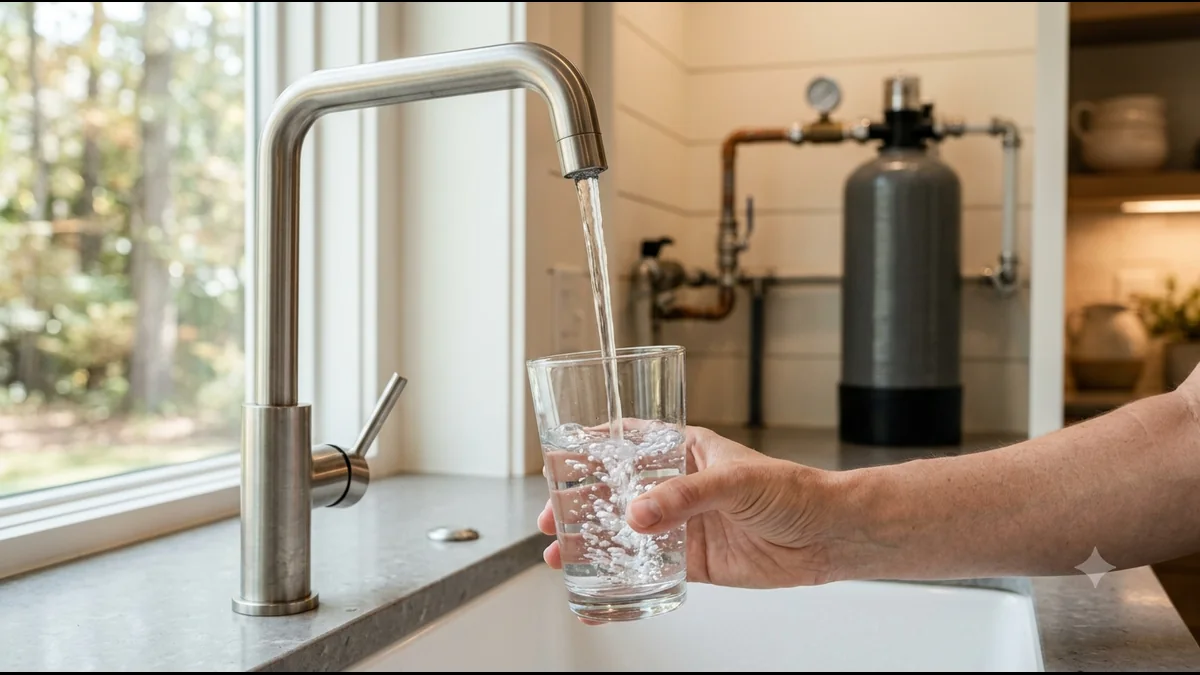
Direct answer: Apex tap water can taste like chemicals because of chloramine and disinfection byproducts (TTHM, HAA5) formed treating Jordan Lake water — Apex's 2024 report shows TTHM averaging 41 ppb, up to 53. Compliant isn't zero-risk: these are the same compounds EPA regulates for cancer risk long-term. A whole-home carbon system removes them at every faucet — the fix is a free water analysis away.
Why does Apex, NC tap water sometimes taste like chemicals?
Because of what's dissolved in it after treatment, not because anything is wrong with your plumbing. One Apex resident described it bluntly on a local forum: "I moved to Apex three years ago and I swear the water is getting worse. I can't even drink it or use it making soup." We can't verify a trend from a single comment — there's no published data showing Apex's water quality changing year over year — but we can tell you exactly what's in the water right now and why it can taste "off" even while it's fully compliant. Apex draws its water from B. Everett Jordan Lake, treated at the Cary/Apex Water Treatment Facility, a plant co-owned by the two towns with Cary as the lead operator. The treatment train adds powdered activated carbon and ozone to the raw lake water, coagulates it with alum and polymer, filters it through sand and carbon, then adds chlorine and ammonia together in the clearwell to form chloramines — the disinfectant that travels through the pipes to your tap. Chloramine is chemically stable and long-lasting, which is exactly why utilities like it for distribution, but it's also the kind of compound a sensitive palate picks up as a faint pool or chemical note, especially in the first glass drawn after water has sat in your home's pipes overnight.
Is it safe to drink Apex water even if it tastes bad?
Yes — taste and legal safety are two different things. Apex's water is monitored continuously and every figure in its 2024 Consumer Confidence Report falls within EPA's legally allowed limits, with no MCL (Maximum Contaminant Level) violations reported for the year. A chemical taste doesn't mean the water is unsafe; it usually means you're tasting the disinfectant and its byproducts at levels well under the regulatory ceiling. That said, "legally compliant" and "tastes the way you want to drink or cook with" are separate bars, and EPA's compliance limit is not the same thing as a taste-and-odor target — which is exactly the gap carbon filtration is built to close.
What's actually in Apex's water that causes the chemical taste?
A combination of the chloramine residual and disinfection byproducts, both confirmed in Apex's own 2024 report. The strongest verified figure is TTHM, a class of disinfection byproducts that forms when chlorine-based disinfectants react with organic matter in the source water:
| Parameter | Apex 2024 value | Reported range | EPA limit (MCL/MRDL) |
|---|---|---|---|
| TTHM (total trihalomethanes) | 41 ppb | 20–53 ppb | 80 ppb |
| HAA5 (haloacetic acids) | 19 ppb | 8–19 ppb | 60 ppb |
| Chloramines (residual) | 3.23 ppm | 1.04–3.98 ppm | 4.0 ppm |
| PFBA (a PFAS compound) | 3.8 ppt | ND–7.6 ppt | not currently regulated |
| PFHxA (a PFAS compound) | 3.65 ppt | 3.3–4.0 ppt | not currently regulated |
Apex's TTHM figure — averaging 41 ppb and reaching as high as 53 in the year's testing — is roughly double what Raleigh Water reports for the same byproduct class, making it one of the more notable verified numbers anywhere in our service area. All of it is compliant, but TTHM and HAA5 are both known to carry taste and odor of their own, on top of whatever chloramine contributes.
Does Apex's water taste change throughout the year?
It can, and there's a documented reason why. Like other chloramine systems, the Cary/Apex plant periodically switches to free chlorine for a limited period to flush the distribution system — a standard maintenance step recommended for chloramine systems generally. Free chlorine has a more noticeable taste and smell to most people than chloramine does, so households often notice a sharper "pool" taste during that window. The exact dates shift from year to year, so the town's own water quality announcements are the best source for current timing rather than a fixed calendar. Outside that period, the everyday taste complaint is more likely chloramine itself, or the disinfection byproducts in the table above.
Will a pitcher filter fix the chemical taste, or do I need something bigger?
A pitcher filter can help at the one tap it treats, but it won't cover your whole home. Look for one certified under NSF/ANSI 42, the standard covering aesthetic effects like chlorine, chloramine, taste, and odor — but even a well-rated pitcher only filters what you pour through it. It does nothing for the shower, the kitchen faucet you didn't fill it from, the ice maker, or the washing machine, all of which still carry the same chloramine residual and disinfection byproducts. Chloramine is also more chemically stable than free chlorine, which means it takes more contact time and more carbon capacity to reduce than a small pitcher cartridge is built to provide.
| Approach | Coverage | Chloramine taste | TTHM / HAA5 | Ongoing cost |
|---|---|---|---|---|
| Bottled water | None of your tap water | N/A | N/A | Recurring, adds up |
| Pitcher or fridge filter | One tap/dispenser only | Reduced, if certified | Limited, product-dependent | Frequent cartridge swaps |
| Whole-home carbon (all-in-one system) | Every tap, shower, and laundry line | Reduced house-wide | Removed effectively | One system, sized for your home |
What actually removes the chemical taste from Apex tap water for good?
A whole-home carbon filtration system, sized for your household's water use. Activated carbon is the same media utilities themselves use earlier in the Jordan Lake treatment process — at home, a properly sized whole-house carbon stage:
- Removes chloramine and chlorine taste and odor at every tap, not just one
- Reduces disinfection byproducts like TTHM and HAA5, the same class of compounds shown in Apex's own report
- Treats the shower and laundry lines too, not just drinking and cooking water
- Runs continuously without pitchers to refill or bottled cases to haul home
Triangle Waterworks builds this into the all-in-one whole-home system — carbon filtration paired with softening resin — so the same install that fixes the taste also protects your water heater, dishwasher, and plumbing from mineral buildup over time. Pricing depends on your home's size and water use, which is why we start with a free water analysis rather than a guess.
FAQ
I just moved to Apex and my water tastes like a swimming pool — is that normal? It can be, especially if you moved in during the town's periodic switch to free chlorine for system flushing, which has a stronger taste than the chloramine that runs the rest of the year. If the taste persists outside that window, it's more likely the everyday chloramine residual or disinfection byproducts documented in Apex's 2024 report — both are things a whole-home carbon system addresses.
My neighbor says their water tastes fine — why does mine taste different? Disinfectant levels and disinfection byproducts can vary somewhat across a distribution system depending on how far water travels from the treatment plant and how long it sits in local pipes before reaching a given street. Apex's reported ranges (TTHM 20–53 ppb, chloramines 1.04–3.98 ppm) reflect that same kind of spread across the system.
Does boiling the water get rid of the chemical taste? Boiling can reduce free chlorine somewhat, but it does not reliably remove chloramine or disinfection byproducts like TTHM and HAA5, and it does nothing for PFAS — in fact boiling can concentrate some contaminants rather than remove them. It's not a substitute for filtration.
I've started buying bottled water because the tap tastes bad — is there a better fix? Bottled water solves it for whatever you remember to buy and carry, but it doesn't touch your shower, cooking water, ice maker, or laundry, and the cost adds up over months and years. A whole-home carbon system treats every tap continuously, which is the more complete and lower-effort fix for a taste problem that's happening throughout your house, not just in your drinking glass.
Will a whole-home carbon system also help with hardness, or just taste? Carbon filtration on its own addresses taste, odor, and disinfection byproducts — it doesn't touch calcium and magnesium hardness, which is a separate ion-exchange process. That's why Triangle Waterworks' all-in-one system pairs carbon filtration with softening resin in one install, so you're covered on both fronts rather than needing two separate systems.
How do I know what's actually causing the taste in my specific home? The most reliable way is a free water analysis rather than guessing from a report or a forum post. Every home's plumbing, pipe age, and position in the distribution system is a little different, and testing your own water tells you exactly what's present before you choose a system sized to handle it.
Ready to fix the taste at every tap?
Take our 60-second water quiz to see which all-in-one system fits your Apex home, or request a free water analysis to find out exactly what's causing the taste before you decide.
Related reading: Water Softener Apex, NC: Protecting New Homes From Day One | Whole House vs. Point-of-Use Filter | How to Get Rid of Chlorine Taste in Tap Water | Just Moved to Apex, NC? A New Resident's Water Guide | Haloacetic Acids in Drinking Water
Sources
- Town of Apex, NC — Water Quality
- US EPA — Chloramines in Drinking Water
- NSF — Standards for Water Treatment Systems
Answer nine practical questions, then request a written quote or well-water analysis.
Start My Water Analysis