
What Are the Benefits of Soft Water in Your Home?
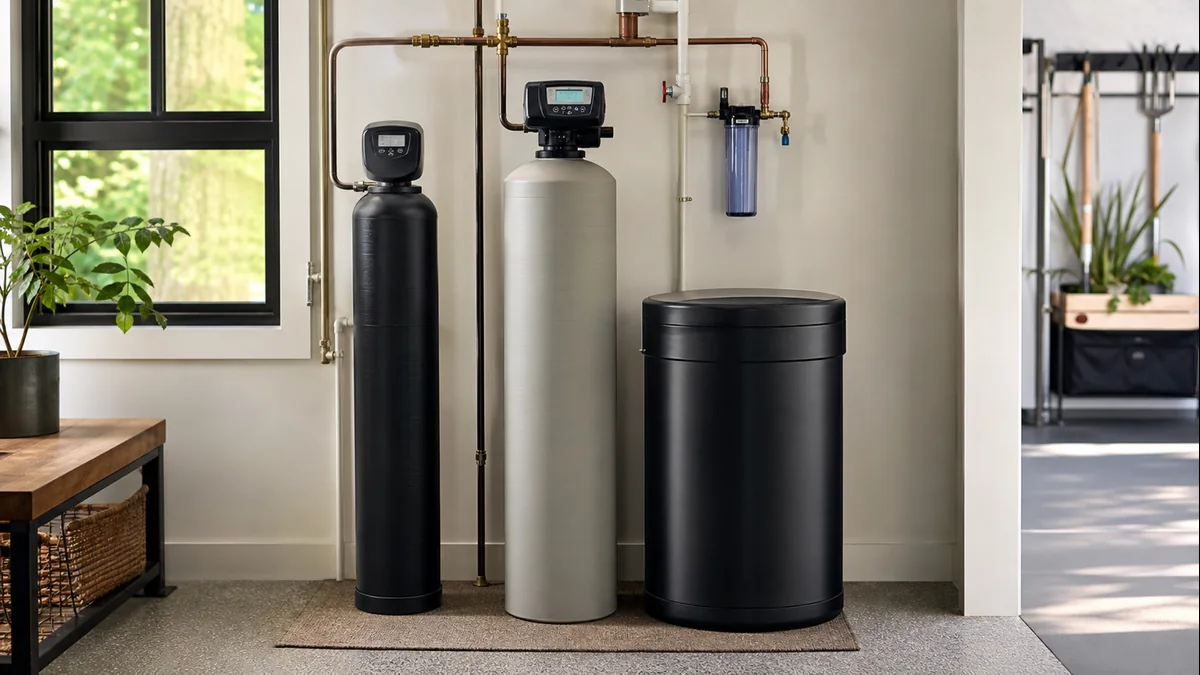
Direct answer: Soft water protects your plumbing and appliances from mineral scale, lathers better with less soap and detergent, leaves dishes and glassware spot-free, and leaves skin, hair, and laundry noticeably softer. It doesn't touch chlorine taste, disinfection byproducts, or PFAS — which is exactly why Triangle Waterworks pairs a softening stage with a carbon stage in one all-in-one system, so a household gets both benefits at once.
What does "soft water" actually mean?
Soft water is water with low dissolved calcium and magnesium — the two minerals responsible for what's commonly called "hardness." A water softener uses ion exchange to swap those minerals out of the water before it reaches your fixtures and appliances. The result isn't water with zero minerals; it's water where the minerals that cause scale and soap-scum buildup have been removed.
Does soft water protect appliances and plumbing?
Yes — this is the core mechanical benefit. Without softening, dissolved calcium and magnesium precipitate out as scale wherever water sits, heats, or evaporates: inside a water heater, on dishwasher and washing machine components, and in faucet aerators and showerheads. That buildup is gradual and cumulative, building over years of daily use rather than showing up overnight. A softener removes the minerals before they ever reach those surfaces, which is the direct way to prevent it.
Does soft water really mean better lather and less soap?
Yes. Calcium and magnesium react with soap to form the insoluble curd commonly known as soap scum, which is why hard water makes soap and shampoo harder to lather and rinse away cleanly. With those minerals removed, soap and detergent lather more readily and rinse more completely, which is also why soft water tends to leave less filmy residue on skin, in tubs, and on shower glass.
What does soft water do for skin and hair?
Soft water rinses more completely, without the mineral film that can sit on skin and hair after a shower on hard water. Many people notice skin feeling less tight or dry after a switch, and hair feeling less weighed down — because the soap and shampoo aren't leaving mineral residue behind along with their own film.
Does soft water improve laundry?
Yes. Mineral deposits from hard water can settle into fabric fibers over repeated wash cycles, contributing to a stiffer feel and faster fading. Soft water lets detergent rinse cleanly out of fabric, which is why clothes and towels washed in soft water are commonly described as feeling softer and looking brighter over time.
Does soft water stop spots on dishes and glassware?
Yes, largely. The chalky film and water spots left on glasses and dishes after a dishwasher cycle are mineral deposits drying on the surface — a direct hardness effect. Softened water removes the minerals causing that film, which is why dishes and glassware come out of the dishwasher cleaner and clearer.
Benefits at a glance
| Benefit | What causes it | What softening does |
|---|---|---|
| Appliance and plumbing protection | Scale from dissolved calcium/magnesium | Removes the minerals via ion exchange before buildup occurs |
| Better lather, less soap/detergent needed | Minerals reacting with soap to form scum | Lets soap and detergent work as intended |
| Spot-free dishes and glassware | Mineral film drying on surfaces | Removes the minerals causing the film |
| Softer skin and hair | Mineral residue left after rinsing | Cleaner rinse, less residue |
| Softer, brighter laundry | Minerals settling into fabric fibers | Cleaner rinse through fabric |
| Fewer deposits on fixtures/showerheads | Mineral buildup in small openings | Removes minerals before they accumulate |
What soft water doesn't fix
This is the half of the picture that matters just as much. Softening resin removes calcium and magnesium — full stop. It has no effect on chlorine taste and odor, on disinfection byproducts, or on PFAS, because those are entirely different classes of contaminant that ion exchange for hardness minerals isn't built to address.
Both are documented in Triangle city water. Raleigh's system shows HAA9 at 19.9 ppb and TTHM at 21.7 ppb. Cary's system runs higher — HAA9 at 27.5 ppb and TTHM at 38.2 ppb — reflecting its Jordan Lake source water. All of these figures are legally compliant with EPA limits; they're referenced here against EWG's stricter, non-regulatory health guideline as a separate benchmark, not a violation.
That gap — real benefits from softening, zero effect on chlorine byproducts or PFAS — is exactly why Triangle Waterworks builds softening resin and a carbon filtration stage into one all-in-one system rather than selling a standalone softener. The softening side delivers everything above; the carbon side handles what softening structurally can't touch. Best of both worlds, in one installed system.
Does Triangle's water hardness affect how the benefits show up here?
It affects how efficiently the system runs, which is a genuine local advantage. Raleigh tests slightly hard at roughly 1.6 gpg on the Water Quality Association (WQA) scale — the same scale the Hach Total Hardness Test Kit uses; Cary, Apex, and Morrisville span a wider range, roughly 1.6–3.7 gpg, running slightly-to-moderately hard, with the top of that range moderately hard. Because Triangle hardness is on the lower end nationally, a properly sized softener here doesn't have to work as hard or regenerate as often as it would in a genuinely hard-water region — meaning lower salt use and less frequent maintenance, while still delivering the full list of benefits above.
How much salt does that actually take?
Using EPA WaterSense's estimate of roughly 210 gallons of indoor water use per day for a family of four, and the NSF/ANSI 44 efficiency-rating minimum of 3,350 grains of hardness removed per pound of salt, the math works out roughly like this:
- Raleigh at 1.6 gpg: 210 × 1.6 = 336 grains/day, about 122,600 grains/year, divided by 3,350 ≈ 37 lb of salt a year — about one 40-lb bag.
- Cary at the 1.6 gpg low end (the same floor as Raleigh): ≈37 lb/year — about one bag.
- Cary at the 3.7 gpg top end: 210 × 3.7 = 777 grains/day, about 283,600 grains/year, divided by 3,350 ≈ 85 lb/year — about two 40-lb bags.
Rounded for Triangle city water generally: about one to two 40-pound bags of salt a year, depending on where you fall in the hardness range and your household's actual water use. A well with higher hardness will use considerably more salt than this, since salt use scales directly with hardness — which is why well systems are sized after a water analysis rather than off a general estimate.
Frequently Asked Questions
I just had a softener installed in Apex — how long before I notice a difference in my skin and hair? Most people notice a difference in lather and rinse feel within the first few showers, since the effect starts as soon as softened water reaches your fixtures. The cumulative benefits — less buildup on skin, hair, and fixtures — become more apparent over the following weeks.
Does soft water really mean I can use less soap and detergent? Yes. Because calcium and magnesium react with soap to form scum, removing those minerals lets soap and detergent lather and rinse more efficiently, so many households find they need less to get the same result.
My dishwasher still leaves spots on glasses even though I have a softener — what's going on? If hardness has been addressed, the remaining film could be related to detergent type, water temperature, or a rinse-aid setting rather than minerals. It's worth confirming your softener is sized and regenerating correctly, since an undersized unit won't fully treat peak household demand.
Will a water softener fix the chlorine smell in my tap water? No. A softener only removes calcium and magnesium — it has no effect on chlorine, chloramine, or disinfection byproducts. That's handled by a separate carbon filtration stage, which is why the all-in-one system includes both.
How much salt does a softener actually use in the Triangle? Based on EPA usage figures and the NSF/ANSI 44 efficiency standard, a typical Triangle household on city water uses roughly one to two 40-pound bags of salt a year, since local hardness runs lower than in many other parts of the country.
Is soft water safe to drink? Yes. Softening is an ion-exchange process that swaps calcium and magnesium for a small amount of sodium; it doesn't introduce anything unsafe. If you're specifically concerned about sodium intake, a potassium chloride alternative is available, though it costs more than standard salt.
Ready to see what your water needs?
Take our 60-second water quiz to find out what system fits your home if you're on city water, or request a free water analysis if you're on a well.
Related reading: Raleigh Water Hardness | What Size Water Softener Do I Need? | Haloacetic Acids in Drinking Water | How to Remove PFAS From Water | Whole House Filter vs. Water Softener
Answer nine practical questions, then request a written quote or well-water analysis.
Start My Water Analysis