
How to Choose the Best Water Softener Company in Durham, NC
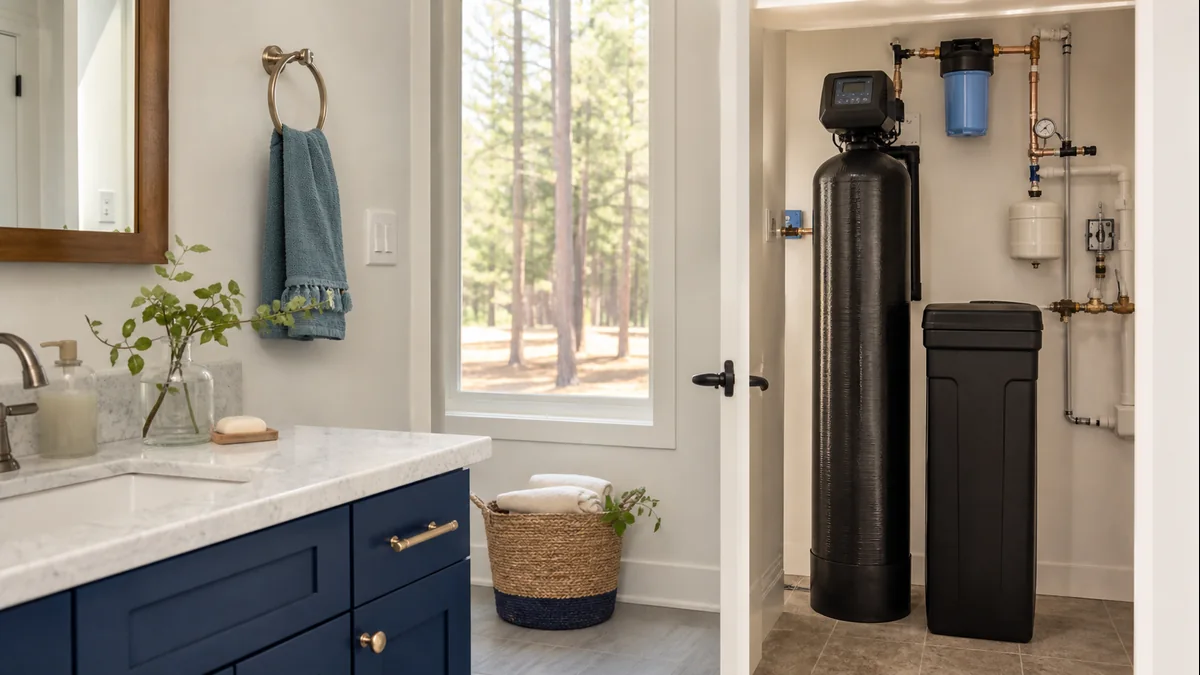
Direct answer: The best water softener company in Durham, NC is the one that tests your actual address before quoting, because Durham publishes no citywide hardness figure at all — it sizes the system to that reading rather than a chart, installs the work as a licensed plumbing contractor, and recommends an all-in-one softening-plus-carbon system instead of softening alone. Compare quotes only after a free water analysis, never before one.
What makes one Durham water softener company better than another?
Whether it tests your water at your own address before it prices anything. That single habit matters more in Durham than in almost any other Triangle town, because Durham runs its own municipal utility — the City of Durham Water, part of the Department of Water Management — with its own treatment process and its own annual report, and that report does not publish a citywide hardness number. There is no official "Durham is X grains per gallon" figure to quote off a chart, borrow from a neighboring town, or average across the city, because none exists. A company that gives you a price over the phone, or off a general Triangle-area estimate, is guessing.
The only way to know your own number is to measure it at your own address, which is exactly what a free water analysis does. If you'd rather check it yourself first, the at-home test we always point people to is the Hach Total Hardness Test Kit, Model 5-B — a drop-count titration that reads out in grains per gallon on the same Water Quality Association scale a real installer should be using.
The second differentiator is whether the company's recommendation covers everything actually in Durham's water, not just the mineral side. The city's own reporting states that Durham Water "achieved 100% compliance with all drinking water quality standards in 2025" and that it "routinely monitors more than 150 contaminants." That's a genuine, meaningful safety floor — but compliance is a legal pass/fail against EPA limits. It doesn't measure hardness, and it says nothing about how the water tastes or smells coming out of your own tap. A softener alone doesn't touch either of those, because ion exchange treats calcium and magnesium only. A company that sells softening and stops there has addressed one half of the picture.
What should I ask before hiring a water treatment company in Durham?
Work through these, roughly in order:
- Do you test my water at my address before quoting? In Durham specifically, this isn't optional — there's no published citywide number for anyone to fall back on, so a real reading is the only honest starting point.
- Will you explain what drives the price before the visit? A company willing to walk through sizing and options up front tends to be straightforward about everything else, too.
- Is the installation done as licensed plumbing work? North Carolina law, N.C. Gen. Stat. § 87-21, defines plumbing contracting to include installing "whole-house water purification or treatment systems." A whole-home unit ties into your main supply line — it is not a plug-in appliance, and the work should be treated accordingly.
- What does the system actually treat? Ask the company to separate what the softening stage does from what the carbon stage does. A vague answer here is informative.
- What certifications back up specific claims? NSF/ANSI 42 covers aesthetic effects like chlorine taste and odor; NSF/ANSI 44 covers softeners; PFAS reduction requires carbon certified to NSF/ANSI 53 or P473, or reverse osmosis under NSF/ANSI 58. Ask which claim applies to which stage.
- Who services it after installation, and are they local? This is where a real local company and a national franchise structure tend to diverge most.
- What does the warranty actually cover? Ask to see it in writing rather than hear it summarized on the sales visit, and compare what's covered — not just how it's described.
Our warranty guide goes deeper on that last question.
Local company or national brand — which is better in Durham?
The equipment differs less than the process around it. National big-brand whole-home quotes commonly run $6,000 to $12,000; Triangle Waterworks doesn't publish a fixed price for Durham because every system is configured to your home's own test results after a free water analysis. The gap in price isn't a gap in equipment quality — it more often reflects franchise overhead, national ad spend, and multi-layer sales commissions.
| What you're comparing | Local licensed installer | National big-brand installer |
|---|---|---|
| First step | Free water analysis at your address | Phone quote or standardized in-home sales pitch |
| Basis for sizing | Your own measured hardness reading | Often a citywide or regional average |
| Pricing transparency | Explained before the visit, tied to your reading | Frequently disclosed only at the close |
| Typical installed price | Set after the free analysis | $6,000–$12,000 |
| Who services it later | The company that installed it, based locally | Varies by franchise territory |
| Familiarity with Durham's own reporting | Direct — reads the city's own annual report | Generic national script |
For a broader look at the tradeoffs, see our full comparison of big-brand and local water treatment.
Should I buy a softener or an all-in-one system in Durham?
The all-in-one, and Durham's water is a clean example of why. It gives you two different jobs, and a standalone softener only does one of them.
- The softening half handles calcium and magnesium — the film on glassware, the crust around faucet aerators, soap that won't lather well, and the scale that builds slowly inside a water heater. That buildup is cumulative over the years a system runs, regardless of exactly where your own untested address falls on the range.
- The carbon half handles what a compliance pass doesn't measure at all — chlorine taste and smell at the tap, and the disinfection byproducts that form as part of any municipal treatment process. Durham's own report proves the water meets every legal standard; it doesn't speak to how it tastes in your kitchen, and softening resin does nothing about either one.
- Together in one unit is what actually answers both halves of the question, which is why the recommendation shouldn't change based on which complaint happens to be bothering you this month — spotty glasses or a chlorine smell.
There's also a real practical reason to test before buying: sizing a system to your actual reading, rather than an assumed regional figure, is what keeps the softening side running efficiently — regenerating only as often as it needs to.
What high-pressure sales tactics should I walk away from?
A handful of tactics show up across this industry, and none of them belong in an honest sale:
- A price before a test. If a number arrives before anyone has measured your water, it isn't based on your home.
- Pressure to sign the same visit. Water chemistry at your address doesn't change between now and next week — there's no technical reason a quote expires by dinner.
- Scare talk not backed by your own results. A company should be able to point to a specific reading or report, not a vague warning.
- A quote that can't be walked through line by line. If sizing, stages, and price can't each be explained separately, the number likely isn't tied to anything specific either.
- No answer on who handles service later. A company that can't say who shows up if something needs adjusting after install is telling you something about its structure.
Get the number your quote should be based on
Since Durham doesn't publish a citywide hardness figure, the only number worth pricing around is the one from your own address. Take our 60-second water quiz to see how an all-in-one system fits your Durham home, or book a free water analysis and get that reading before you talk price with anyone — see our Durham water softener overview for the broader picture first if you're still comparing options.
Frequently Asked Questions
I just moved to Durham and have no idea if my water is hard — where do I start? Start with a reading, not a guess — Durham doesn't publish a citywide hardness number, so there's nothing to look up. A free water analysis gives you the actual figure for your address, and it's the only honest basis for sizing or pricing a system.
Do I need a plumber, or does the water treatment company handle installation? A whole-home system ties into your main supply line, so the work should be done as licensed plumbing regardless of who schedules the visit. Ask any company directly whether they do that work themselves or bring in a subcontractor.
Is a bigger system always better? No — oversizing adds cost without adding benefit, and undersizing can leave capacity short during heavy household use. The right size comes from your measured reading and your household's actual water use, which is what the free analysis is for.
My water report says Durham is 100% compliant — so what would a system actually change? Compliance means the water passes every legal standard, and Durham monitors more than 150 contaminants to prove it — but that pass/fail doesn't measure hardness or describe taste. Mineral buildup on fixtures and appliances, plus chlorine taste at the tap, are both compatible with a clean compliance report.
How long does installation take once I've had the water tested? A typical whole-home install is a single scheduled visit after the analysis sets the sizing, though your home's plumbing layout and where the unit goes can affect the day. Ask whichever company you're considering to walk you through their own process before you book.
Why do quotes for the exact same house vary so much between companies? Usually because each company is quoting something different — a different treatment stage, a different sizing assumption, or a very different overhead structure behind the price. Ask each one what the system treats and what number it's sized from, and most of the spread explains itself.
Answer nine practical questions, then request a written quote or well-water analysis.
Start My Water Analysis