
What's the Best Whole-Home Water System for Cary, Apex, and Morrisville?
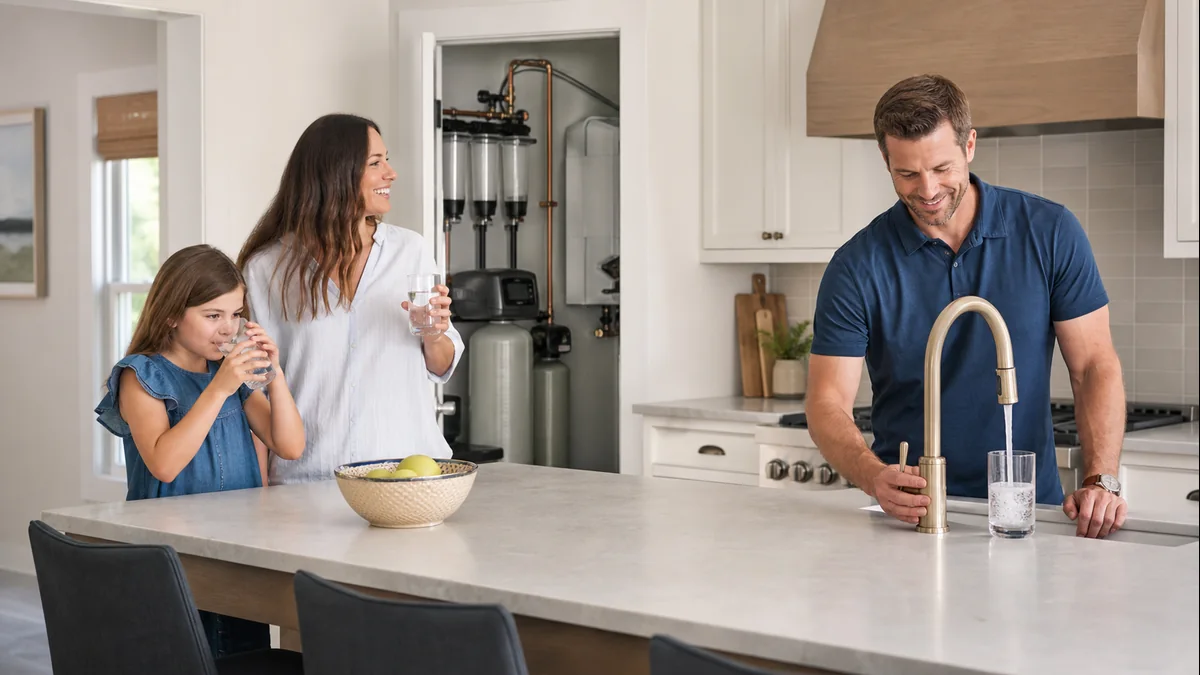
Direct answer: For Cary, Apex, and Morrisville, the best whole-home system is an all-in-one unit pairing carbon filtration with a softening resin stage. All three towns draw from B. Everett Jordan Lake and share one treatment facility, so the recommendation holds across city lines: carbon handles the chloramine residual, the annual chlorine taste, and disinfection byproducts, while softening addresses hardness that runs 1.6 to 3.7 grains per gallon by ZIP — cheap to run at the low end, a straightforward hardness case at the top.
Why does one article cover Cary, Apex, and Morrisville?
Because they're not three separate water supplies — they're one. Cary, Apex, and Morrisville all draw from B. Everett Jordan Lake, part of the Cape Fear River Basin, and that raw water is treated at the Cary/Apex Water Treatment Facility. The facility is co-owned by Apex and Cary, with Cary serving as the lead agency that operates it, and it runs at 56 million gallons per day — large enough to also serve RDU and RTP South. Morrisville doesn't operate its own water treatment at all; Cary has run Morrisville's water and sewer utility since April 2006, which means Morrisville customers receive the same finished water as Cary. A recommendation that's right for one of these towns is right for all three, because it's genuinely the same water coming out of the tap.
What treatment does the water go through before it reaches my house?
A multi-step process designed to make Jordan Lake's raw water safe and clear, finishing with a chloramine residual. The train starts with powdered activated carbon added at the pump station, followed by ozonation to oxidize organics and address color, taste, and odor. Alum and polymer coagulation and sand-and-carbon filtration remove particulates, and fluoride plus pH and corrosion-control chemicals are added before the water leaves the plant. The last step is disinfection: chlorine and ammonia are added separately in the clearwell to form chloramines, the residual that travels with the water the rest of the way to your home in Cary, Apex, or Morrisville.
Why does my water taste like chlorine once a year if the normal disinfectant is chloramine?
Because Cary and Apex run a planned, temporary switch to free chlorine to flush the distribution system, and that's the disinfectant most people can actually taste. Chloramine is the day-to-day residual and generally has little taste or odor of its own. Free chlorine does. The exact timing shifts from year to year, so the reliable source for current dates is the Town's own announcement rather than a fixed calendar — but if your water suddenly tastes or smells different for a stretch, that annual flush is almost always the reason, not a plumbing problem in your house.
Is Cary, Apex, or Morrisville's water hard?
It depends on your ZIP code. The Town of Cary's Public Works FAQ puts finished water hardness at 25 to 30 parts per million (roughly 1.5 to 1.75 grains per gallon), and the Town of Apex's 2024 Annual Drinking Water Quality Report lists average total hardness at 33.3 ppm (1.9 grains per gallon), which Apex itself classifies as "moderately soft." Those are plant-wide averages, though — not a reading at any one tap. Our own testing across Cary, Apex, and Morrisville measures hardness running 1.6 to 3.7 grains per gallon depending on ZIP code: slightly hard at the low end, moderately hard at the top of that range on the WQA scale — the same one the Hach Total Hardness Test Kit uses. Morrisville doesn't publish separate figures, because it's on Cary's system, but the same range applies there too.
The town figures are a real, useful starting point — they describe the plant average, not any one address. The number that actually determines whether you have a straightforward hardness case is the one at your own tap, and that test is free. A household at the top of the range has calcium and magnesium heavy enough to matter on their own; a household at the bottom still has the cumulative-buildup case — years of daily use leaving deposits on fixtures, glassware, and the water heater. Either way, a softening stage sized to your actual water is cheap to run at the low end and earns its keep at the top.
What's actually documented in the treated water — and is it something to worry about?
There's a real, documented case for carbon filtration here, and it's stronger than the hardness case. The Town of Apex's 2024 report shows total trihalomethanes (TTHM) averaging 41 ppb, ranging as high as 53, and haloacetic acids (HAA5) averaging 19 ppb — both comfortably under EPA's legal limits of 80 ppb and 60 ppb, and both compliant. But 41 ppb is roughly double Raleigh Water's reported TTHM figure of 21.7 ppb, which makes it the strongest verified filtration argument in this market. Disinfection byproducts like these form as a normal result of disinfecting water at scale; activated carbon removes them effectively.
Apex's 2024 report also detected two PFAS compounds: PFBA at 3.8 ppt (ranging ND to 7.6) and PFHxA at 3.65 ppt (ranging 3.3 to 4.0). Neither is individually regulated, and the more closely watched compounds — PFOA, PFOS, PFHxS, PFNA, and PFBS — were all non-detect. This traces back to the watershed rather than the treatment plant: Duke University researchers measured combined PFAS above 200 ppt in raw Jordan Lake source water back in 2017. It's a source-water story, and it's exactly the kind of thing a carbon stage certified for PFAS reduction (NSF/ANSI 53 or P473) is built to address.
Cary vs. Apex vs. Morrisville, side by side
| Cary | Apex | Morrisville | |
|---|---|---|---|
| Water source | B. Everett Jordan Lake | B. Everett Jordan Lake | B. Everett Jordan Lake (via Cary) |
| Treatment facility | Cary/Apex Water Treatment Facility (Cary is lead agency, 56 MGD) | Same facility, co-owned with Cary | On Cary's system since April 2006 |
| Published hardness | 25–30 ppm (≈1.5–1.75 gpg) — slightly hard | 33.3 ppm (≈1.9 gpg) — "moderately soft" | No separate figure published; receives Cary's water |
| What's documented in the treated water | Chloramine residual, annual chlorine flush, HAA9 27.5 ppb / TTHM 38.2 ppb | Chloramine residual, annual chlorine flush, TTHM 41 ppb (to 53) / HAA5 19 ppb, PFBA and PFHxA detected | Same treated water as Cary — same residual, same byproduct profile |
| Recommended system | All-in-one whole-home system | All-in-one whole-home system | All-in-one whole-home system |
The precision matters here. Apex publishes its own annual report with its own hardness figure and its own byproduct data. Cary publishes a separate hardness range in its Public Works FAQ. Morrisville publishes neither, because there's nothing separate to publish — it's Cary's finished water. Three towns, one honest answer, and the reasoning behind it is verifiable town by town rather than assumed. Those are plant averages, not tap-level readings — our own testing across all three areas shows up to 3.7 gpg by ZIP, and the address-level test is free.
Why an all-in-one system instead of just a filter or just a softener?
Because each half of the water profile calls for a different tool, and installing them separately means two footprints, two installs, and two things to maintain. The carbon side is the headline reason to treat water here: it's what handles the chloramine taste, the annual free-chlorine period, the documented disinfection byproducts, and PFAS reduction. The softening side's importance depends on your ZIP — at the low end it's inexpensive insurance against slow, cumulative buildup; at the top of the range, a household has a straightforward hardness case on its own. An all-in-one system puts both stages in one unit, one install, and one footprint, which is simpler to own than running two separate systems side by side.
What does a whole-home system cost in Cary, Apex, or Morrisville?
Installed systems in this market are priced only after a free water analysis, with the final number depending on your home's plumbing and the system size that fits it. For context, national big-brand whole-home quotes commonly run $6,000 to $12,000 for comparable coverage. A free water analysis is the accurate way to know your number — it identifies what's actually coming through your pipes before you're quoted a size.
Frequently Asked Questions
I just moved to Apex — should I be worried about the PFAS numbers in the annual report? The detected compounds, PFBA and PFHxA, are both low-level and not individually regulated, and the compounds with legal limits (PFOA, PFOS, PFHxS, PFNA, PFBS) were all non-detect in Apex's 2024 report. It's a watershed-level story tied to Jordan Lake, not a sign the treatment plant is failing. A carbon stage certified for PFAS reduction is the direct, documented way to address it at your own tap.
My water tastes different for a few weeks every year — is that specific to my house? No, it's system-wide. Cary and Apex both run a planned annual switch from chloramine to free chlorine to flush the distribution network, and free chlorine has a taste and smell that chloramine largely doesn't. Check your Town's current announcement for the exact dates, since they shift year to year.
I live in Morrisville — does any of this actually apply to me, since we're a different town? Yes. Morrisville doesn't operate its own treatment plant; it's been on Cary's water system since April 2006, so the water reaching your tap is the same finished water Cary produces at the Cary/Apex facility. Everything documented for Cary's treated water — the chloramine residual, the annual flush, the byproduct levels — applies to your home too.
I've read that Cary's water is soft — so why would I still need a softener? Because "soft" isn't quite right, and even where it's close it's only part of the picture. The town's published average (25 to 30 ppm) falls in the "slightly hard" band on the WQA scale — the same scale the Hach Total Hardness Test Kit uses — not "soft." Our own testing shows hardness running up to 3.7 grains per gallon depending on ZIP — moderately hard at the top of that range. Calcium and magnesium are present at every level and build up over years on fixtures, glassware, and inside your water heater. At the low end, a softening stage regenerates rarely and runs on very little salt; at the top, it's handling real mineral load — either way it's a worthwhile addition alongside the carbon stage.
How do I find out exactly what's in my own water before I buy anything? Start with a free water analysis rather than guessing from the town-wide averages in this article. It tells you what's actually coming through your specific plumbing, which is the real basis for sizing a system correctly.
What's the fastest way to see which system fits my house? Take the 60-second water quiz — it takes your answers about your home and water use and points you to the system size and configuration that fits, backed up by a free water analysis to confirm it.
Ready to see what fits your home? Take the quiz or request a free water analysis to get exact numbers for your address in Cary, Apex, or Morrisville.
Related reading: Water Softeners in Cary, NC | Water Softeners in Apex, NC | Water Softeners in Morrisville, NC | What Does an All-in-One Water System Cost in NC? | Whole House Water Filters in Cary
Answer nine practical questions, then request a written quote or well-water analysis.
Start My Water Analysis