
Is Cary, NC Tap Water as Good as Bottled Water?
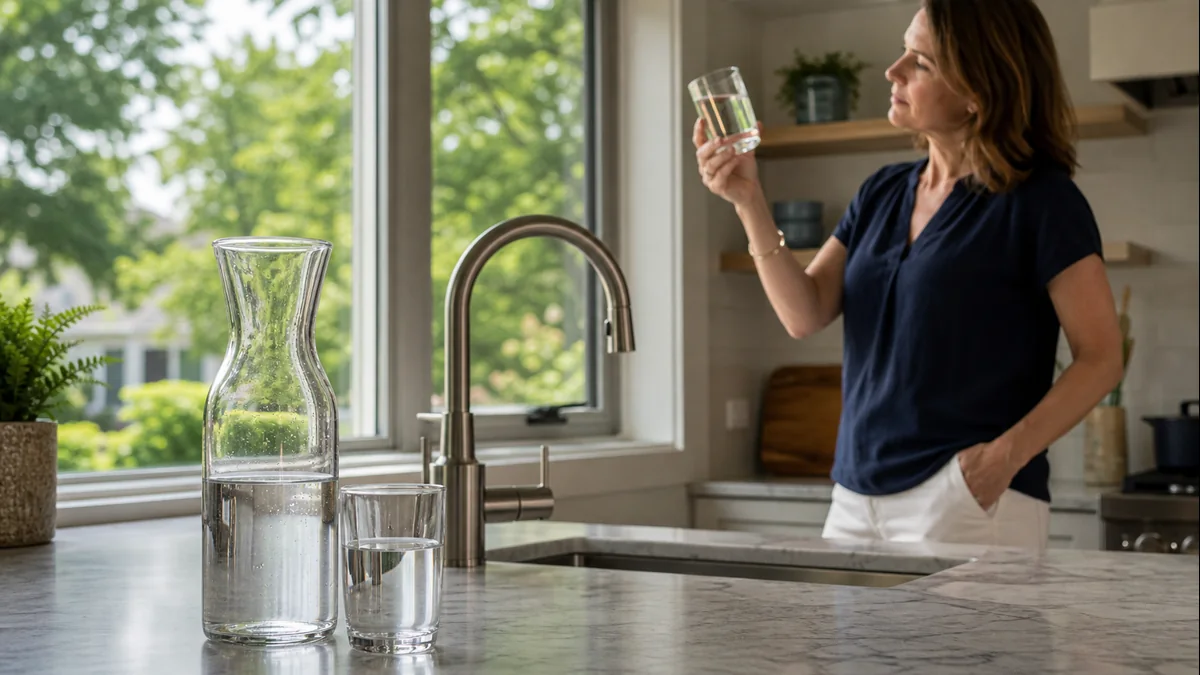
Direct answer: Yes, legally — Cary's tap water meets every EPA drinking-water standard, so bottled water isn't buying you extra safety. What it buys is taste, since Cary's chloramine residual and annual chlorine switch affect flavor more than compliance. A whole-home carbon system delivers that same clean taste at every faucet, the shower, and the ice maker, plus it addresses hardness and buildup, which bottled water never touches.
Is Cary tap water actually safe compared to bottled water?
Yes. Cary's water system meets EPA's Safe Drinking Water Act requirements, and bottled water sold in North Carolina is regulated separately by the FDA rather than EPA — both are legally safe products, and neither one is "cleaner" by default just because it's legal. Cary isn't cutting it close on one contaminant while passing the rest; the compliance picture is consistent across the board.
So if safety were the only question, bottled water and Cary tap water would be a wash. The real reason so many Cary households keep a case in the pantry has almost nothing to do with legality.
If it's compliant, why does so much of Cary still buy bottled water?
Taste. Cary's water is disinfected with chloramine most of the year, and the Cary/Apex Water Treatment Facility — the shared plant that serves Cary, Apex, and Morrisville, drawing from B. Everett Jordan Lake — runs an annual switch to free chlorine only, on the state's recommendation, to flush the distribution system.
That switch produces a noticeably stronger, more "pool-like" taste for a few weeks each year, and it's exactly the kind of thing that sends a household back to the bottled-water aisle even though nothing about the water is out of spec.
Apex's 2024 water quality report, covering the same shared plant, shows total trihalomethanes (TTHM) averaging 41 parts per billion and ranging up to 53, along with haloacetic acids (HAA5) at 19 ppb — both legally compliant, and both compounds that carry flavor along with them.
EPA's own National Primary Drinking Water Regulations table lists TTHM's potential health effect from long-term exposure above the legal limit as "liver, kidney or central nervous system problems; increased risk of cancer," and HAA5's as "increased risk of cancer."
Compliant water isn't causing those effects — the limit itself is a ceiling EPA set with those exact compounds in mind, not a promise of zero taste or zero trace presence.
Cary's own EWG Tap Water Database profile lists 13 contaminants above EWG's stricter, non-regulatory health guidelines, including HAA9 at 27.5 ppb and TTHM at 38.2 ppb. HAA9 itself has no EPA maximum contaminant level — it's EWG's own nine-compound sum, not a number Cary is required to meet — but TTHM and HAA5 are federally regulated, and Cary's own numbers sit comfortably under those legal limits.
What is a whole-home carbon system actually removing that bottled water doesn't touch?
Bottled water solves one thing: the glass you fill from it. Everything else — the shower, the coffee maker, the ice maker, the pasta pot — still runs on untreated Cary tap water. A point-of-entry carbon stage treats water where it enters the house, so the same clean taste shows up everywhere at once:
- Chlorine and chloramine taste and odor — reduced at every tap, not just the kitchen sink, including during the annual conversion window.
- Disinfection byproducts (TTHM, HAA5, and the broader HAA9 group) — removed effectively by activated carbon.
- PFAS — Cary and Apex both draw from Jordan Lake, and Duke University's 2017 testing found the collection of related fluorinated compounds added up to 100 to 200 parts per trillion in the lake's untreated water, with PFOA and PFOS combined at 27 parts per trillion in that same untreated water. Treated Cary drinking water at the time tested at PFOA 5.6 ppt, with PFOS undetectable — a real reduction, not a complete elimination. PFAS removal requires carbon specifically certified under NSF/ANSI 53 or P473, or reverse osmosis certified under NSF/ANSI 58; a standard carbon filter isn't automatically rated for it.
Boiling doesn't belong on that list. Boiling does not remove PFAS, and because water evaporates while PFAS does not, boiling can actually concentrate it rather than reduce it.
Does bottled water solve Cary's hardness problem?
No — bottled water and hardness are unrelated issues entirely. Triangle Waterworks measures 1.6 to 3.7 grains per gallon (gpg) in homes across the Cary/Apex/Morrisville area, classifying as slightly hard at the low end and moderately hard at the top of that range on the Water Quality Association scale the Hach Total Hardness Test Kit, Model 5-B, uses.
The Town of Cary's own Public Works FAQ publishes finished-water hardness of 25–30 ppm, roughly 1.5–1.75 gpg, which the Town calls very soft. Both are accurate: the Town reports an average for water leaving the plant on a USGS-style scale, while we classify what we measure at the tap on the WQA scale. A test at your address is what settles which end of the range you are actually on.
That calcium and magnesium load has nothing to do with what you drink and everything to do with what your water touches: the water heater, the dishwasher, the washing machine, and every fixture in the house.
A case of bottled water in the fridge does zero for any of that. Only a softening stage, paired with the carbon stage that handles taste, addresses both sides of what's actually in Cary's water.
How does bottled water compare to a pitcher filter and a whole-home system, room by room?
| Bottled water | Pitcher filter | Whole-home all-in-one system | |
|---|---|---|---|
| Drinking taste | Consistent, but only from the bottle | Improves taste at that pitcher only | Consistent clean taste at every tap |
| Cooking water | Untreated unless you pour from a bottle | Untreated unless filled from the pitcher | Treated automatically |
| Ice maker | Untreated — ice is made from tap water | Untreated | Treated |
| Coffee maker | Untreated unless you manually fill it | Improved if filled from the pitcher | Treated automatically |
| Shower | No effect | No effect | Chlorine/chloramine taste and odor reduced |
| Laundry | No effect | No effect | Softening resin reduces mineral buildup in fabric |
| Water heater / scale buildup | No effect | No effect | Softening resin reduces mineral accumulation over time |
| Ongoing effort | Hauling and storing cases, restocking trips | Refilling pitcher, changing cartridges | One system, minimal day-to-day effort |
| Waste | Plastic bottles, ongoing | Filter cartridges, ongoing | No per-use waste |
The gap isn't close once you look past the glass on the counter. Bottled water treats one use case; a whole-home system treats the house.
Does a whole-home system replace what I'm paying for in bottled water?
In the sense that it removes the reason you started buying bottled water — taste — yes. We won't put a dollar figure on what your household spends on bottled water, since that varies by household and we haven't verified a Cary-specific number. What's true regardless: bottled water is a recurring cost with no end date and ongoing plastic waste, while a whole-home system is installed once and treats every tap without another purchase decision.
What actually fixes the taste and the hardness at the same time?
An all-in-one whole-home system — softening resin and a carbon stage installed as one unit. The carbon side pulls chlorine and chloramine taste out of the water, reduces disinfection byproducts, and cuts PFAS when it's certified for it; the softening side handles the calcium and magnesium bottled water was never going to touch anyway.
Pricing depends on your home's plumbing and what a free water analysis finds at your specific address, which is why we don't publish a number here — for comparison, national big-brand whole-home installers commonly quote $6,000 to $12,000 for similar systems.
See what your Cary tap actually needs
Take the 60-second water quiz to see which all-in-one system fits your home, or book a free water analysis and find out exactly where your address falls before you buy another case of bottled water.
FAQ
I've been buying bottled water in Cary for years because the tap tastes like a pool sometimes — am I wasting money buying bottled at all? Not wasting it exactly, but you're solving the problem for one glass at a time. The pool-like taste usually traces back to Cary's annual free-chlorine conversion or the everyday chloramine residual, and a whole-home carbon system removes that same taste at every tap, the shower, and the ice maker, not just the water you remember to pour from a bottle.
My kids only drink from the bottled water in the fridge — would they even notice a whole-home system? Likely yes, since the whole point is that carbon-filtered tap water tastes closer to what bottled water tastes like, straight from any faucet in the house. Many households scale back on bottled water once every glass tastes the same as the one from the fridge.
Does Cary tap water have PFAS the same way bottled water might? Cary and Apex draw from Jordan Lake, where Duke University's 2017 testing found combined PFAS in untreated lake water running 100 to 200 ppt, with treated Cary water testing lower. Bottled water isn't automatically PFAS-free either — it depends on the source and treatment, which most labels don't disclose in detail.
Is a pitcher filter basically the same thing as a whole-home system, just cheaper? No — a pitcher filter only treats what you pour into it, so your shower, ice maker, and dishwasher still run on untreated water. A whole-home system treats water at the point it enters the house, covering every fixture at once.
Will a whole-home system fix the hard-water spots on my glasses too, or just the taste? Both, if it's an all-in-one system. The carbon stage handles taste and odor; a paired softening stage removes the calcium and magnesium that causes spotting on glassware and buildup in the water heater — something bottled water was never going to touch either way.
Is it actually legal for Cary's water to taste this different depending on the time of year? Yes. The annual switch between chloramine and free chlorine is a state-recommended maintenance step, not a violation, and both disinfectants stay within EPA's legal limits throughout. The taste shift is a real, noticeable side effect of a normal process, not a sign the water fell out of compliance.
Sources
- Town of Apex — Water Quality / Annual Drinking Water Quality Report
- WRAL — Elevated Levels of Perfluorinated Chemicals Found in Cary Drinking Water
- EPA — National Primary Drinking Water Regulations
- EWG Tap Water Database — Town of Cary
Related reading: Whole House Water Filter in Cary, NC | Does Activated Carbon Remove PFAS? | Does Boiling Water Remove PFAS? | Haloacetic Acids in Drinking Water | Is Cary, NC Water Safe to Drink?
Answer nine practical questions, then request a written quote or well-water analysis.
Start My Water Analysis