
Why Your Dishwasher's Spray Arm Keeps Clogging With Hard Water Minerals in Knightdale, NC
Direct answer: Mineral deposits gradually clog the small holes in a dishwasher's spray arms, cutting water pressure to individual jets so dishes — especially on the top rack — come out dirty, filmy, or gritty even on a normal cycle. Vinegar and citric acid treat those deposits after they've formed, so only a whole-home system that softens the water before it reaches the dishwasher, paired with a carbon stage for taste and disinfection byproducts, stops the buildup at the source.
Why Are My Dishes Coming Out Dirty, Gritty, or Spotty Even on a Good Cycle?
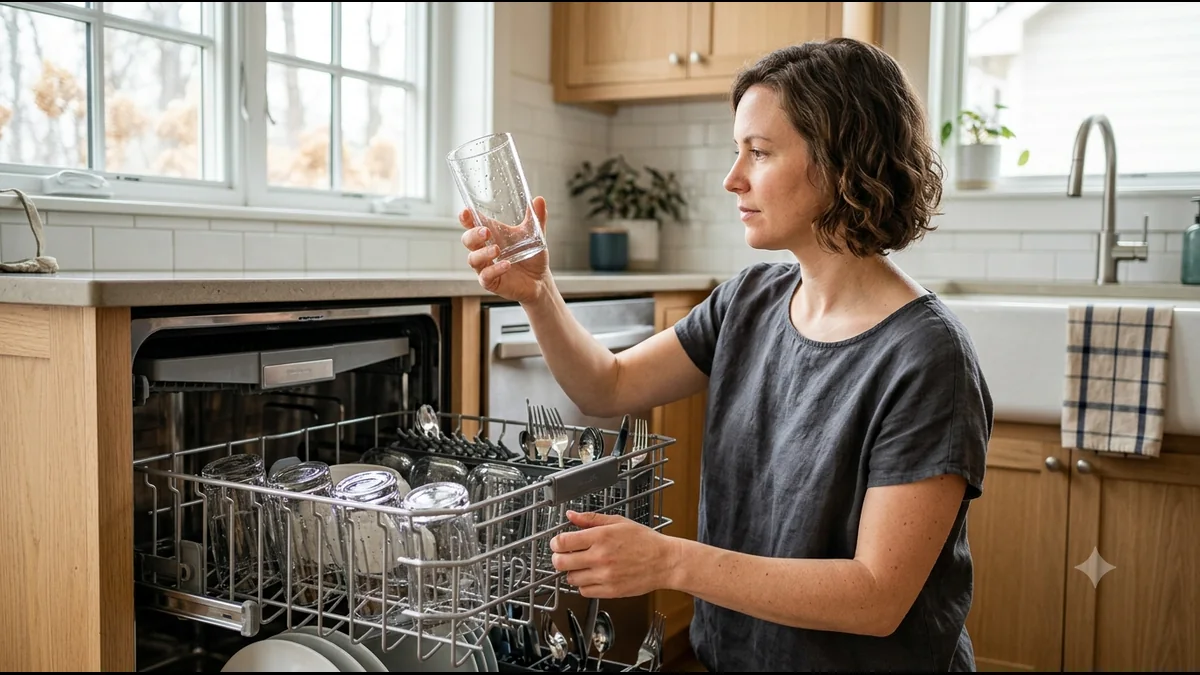
Dishes coming out dirty or spotty on an otherwise normal cycle almost always trace back to reduced spray coverage, which traces back to partially blocked spray-arm holes. Each spray arm has dozens of small holes engineered to shoot water at a specific pressure and angle so it reaches every rack position evenly. When calcium and magnesium dissolved in the water pass through those holes cycle after cycle, a thin mineral residue builds up on the inside edges, the holes narrow, and the jet pattern weakens. Whichever plates or glasses sit in the arm's weakest zones — often the top rack, farthest from the main wash arm — stop getting properly rinsed. The result is a familiar cluster: a gritty film on glassware, cloudy spots that don't wipe off, and food residue left on dishes that should have come out clean.
Why Won't My Dishwasher's Spray Arm Spin Freely?
A spray arm that sticks, spins slowly, or doesn't rotate at all is usually held back by mineral crust at its pivot point or inside the holes, not a mechanical failure. The arm sits on a small hub that lets it spin freely as water pressure pushes against it; if scale builds up around that hub or inside the arm's channel, friction increases and rotation slows or stops. You can often see the cause directly — a chalky white crust ringing the holes, a dull haze on the underside of the arm, or buildup where the arm meets its mount. If the arm spins when turned by hand but stalls once the cycle starts, that points to scale restricting water flow rather than a mechanical break.
How Does Knightdale's Water Contribute to This?
Knightdale is served by Raleigh Water, drawn from Falls Lake, the same utility that supplies Raleigh, Garner, Wake Forest, Rolesville, Wendell, and Zebulon. On the Water Quality Association scale the Hach test kit uses, Raleigh Water measures roughly 1.6 grains per gallon (gpg) — slightly hard, not the higher bands people often picture. Our own testing across the service area measures 1.6 to 3.7 gpg depending on the exact address, so the number that matters most is the one from your own tap.
That's genuinely low as hard water goes, but low hardness doesn't mean mineral-free, and a dishwasher pushes heated water through the same narrow holes dozens of times a week, every week, for years. Buildup is cumulative: even a small amount of dissolved calcium and magnesium left behind after every cycle adds up over enough runs. A spray arm that looked spotless the day the dishwasher was installed can be visibly crusted a few years later — not because anything went wrong, but because minerals were present in every load the whole time.
Do Vinegar Cycles, Citric Acid, and Dishwasher Cleaner Actually Clear a Clogged Spray Arm?
Yes, in that they dissolve existing deposits and can restore normal spray pressure for a while. A vinegar cycle run empty, a citric-acid-based cleaner, or a store-bought descaling product all work the same way — an acid dissolves the calcium and magnesium crust coating the arm and its holes. Removing the arm and soaking it reaches spots a running cycle can't, and poking each hole clear with a toothpick or thin wire clears blockages a soak might miss. These are legitimate fixes for an arm that's already clogged.
Why Do I Have to Keep Redoing These Same Fixes?
Because every one of them treats deposits after they've formed, and the water feeding the dishwasher keeps depositing new minerals with every cycle that follows. A vinegar rinse or citric-acid cleaner dissolves what's currently coating the holes, but doesn't change what's dissolved in next week's water — so residue starts rebuilding from the next cycle onward. Poking the holes clear removes a physical blockage in the moment without touching the water source that put it there. That's why the same maintenance keeps landing back on the calendar — it's an after-the-fact response to a problem that starts upstream, not inside the appliance.
What Actually Stops Spray Arm Clogging Before It Starts?
A whole-home water softener removes calcium and magnesium at the point where water enters the house, through ion exchange, so water reaching the dishwasher — and every other fixture and appliance — has nothing left to deposit. Instead of a running schedule of vinegar cycles, citric acid packets, and manual hole-clearing, the spray arm simply isn't fed the minerals that cause the crust. That shifts maintenance from "keep dissolving what built up" to "nothing builds up," protecting the water heater, faucets, and glassware at the same time.
Low local hardness works in a homeowner's favor here: at 1.6 to 3.7 gpg, a correctly sized softener doesn't need to regenerate often and uses relatively little salt, so protecting every water-using appliance in the house is inexpensive to maintain.
Does a Water Softener Handle Everything Else in Knightdale's Water?
No — softening is only half the picture, which is why it's typically paired with a carbon stage rather than installed alone. A water softener is ion exchange for calcium and magnesium; it does nothing for chlorine or chloramine taste and odor, PFAS, or disinfection byproducts, since none of those are hardness minerals. Raleigh Water's documented figures show HAA9 at 19.9 ppb and TTHM at 21.7 ppb — both legally compliant with EPA limits, though above the stricter, non-regulatory EWG guideline — and activated carbon removes both while softening resin leaves them untouched. Raleigh Water also normally disinfects with chloramine and converts to free chlorine only once a year, on the North Carolina Department of Environmental Quality's recommendation, flushing the system during the changeover; dates shift year to year, so check the City's own announcement. An all-in-one system pairs both stages — softening resin to stop mineral buildup everywhere, and a carbon stage for what softening alone can't touch.
Manual Descaling vs. Whole-Home Softening
| Manual descaling (vinegar, citric acid, poking holes) | Whole-home softening | |
|---|---|---|
| What it treats | Deposits already stuck to the arm and holes | Minerals before they reach the dishwasher |
| Frequency | Repeats as new deposits form | One system protects every cycle going forward |
| Scope | Spray arm only, one appliance at a time | Water heater, faucets, glassware, every fixture at once |
| Chlorine taste, PFAS, disinfection byproducts | No | Only when paired with a carbon stage |
| Best suited for | An arm that's already crusted or slow to spin | Preventing buildup from forming in the first place |
Frequently Asked Questions
My dishwasher's top rack never gets clean even though the bottom rack looks fine — why? The top rack sits farthest from the main spray arm, so it shows reduced coverage first when mineral deposits narrow the holes. Clearing the crust with vinegar or citric acid restores pressure temporarily, but a whole-home softener stops new deposits from narrowing those holes again.
I ran a vinegar cycle and the spray arm spins better, but will this just happen again? Yes, unless something changes about the water feeding the dishwasher — a vinegar cycle dissolves existing crust but doesn't stop new calcium and magnesium from depositing with every load that follows. A whole-home softener addresses the water itself, so the arm has nothing to rebuild scale from.
Is a crusted spray arm a sign something is wrong with my dishwasher? No, it's a normal sign that mineral-bearing water has passed through the arm's holes for a long time, not a defect in the appliance. It shows up in dishwashers across Knightdale because the water carries dissolved calcium and magnesium, even at a comparatively low level.
I just moved into a Knightdale home and the glasses already look cloudy from the dishwasher — what's going on? Cloudy glassware usually means mineral film left behind during the dry cycle, which happens whenever water containing calcium and magnesium evaporates on the glass surface. A whole-home softener removes those minerals before the water reaches the dishwasher, so glasses come out clear cycle after cycle.
Does poking the spray arm holes clear with a toothpick actually fix the problem? It clears the immediate physical blockage, which can restore spray pattern right away, but doesn't change what's dissolved in the water feeding the next cycle. New deposits start forming again from the very next wash unless the water itself is treated.
Will a water softener also stop the chlorine smell I notice from my tap? No — a softener only removes calcium and magnesium through ion exchange; it doesn't affect chlorine, chloramine, or disinfection byproducts like the HAA9 and TTHM levels in Raleigh Water's supply. That's handled by an activated carbon stage, which is why an all-in-one system combines both instead of relying on softening alone.
Related Reading
For the fuller picture on Knightdale's water supply, see water treatment in Knightdale, NC. To confirm your own address's numbers first, how to test water hardness at home walks through the at-home GPG test. The same buildup showing up on a spray arm often shows up elsewhere too — see white residue on faucets and glasses and ice maker mineral buildup from hard water. For the carbon half of the equation, haloacetic acids in drinking water covers what softening alone won't remove.
Take the 60-second water quiz to see what an all-in-one system would look like for your Knightdale home, or book a free water analysis to get an exact reading at your own address before deciding how to stop the spray arm from clogging again.
Answer nine practical questions, then request a written quote or well-water analysis.
Start My Water Analysis