
Does Activated Carbon Remove PFAS from Water?
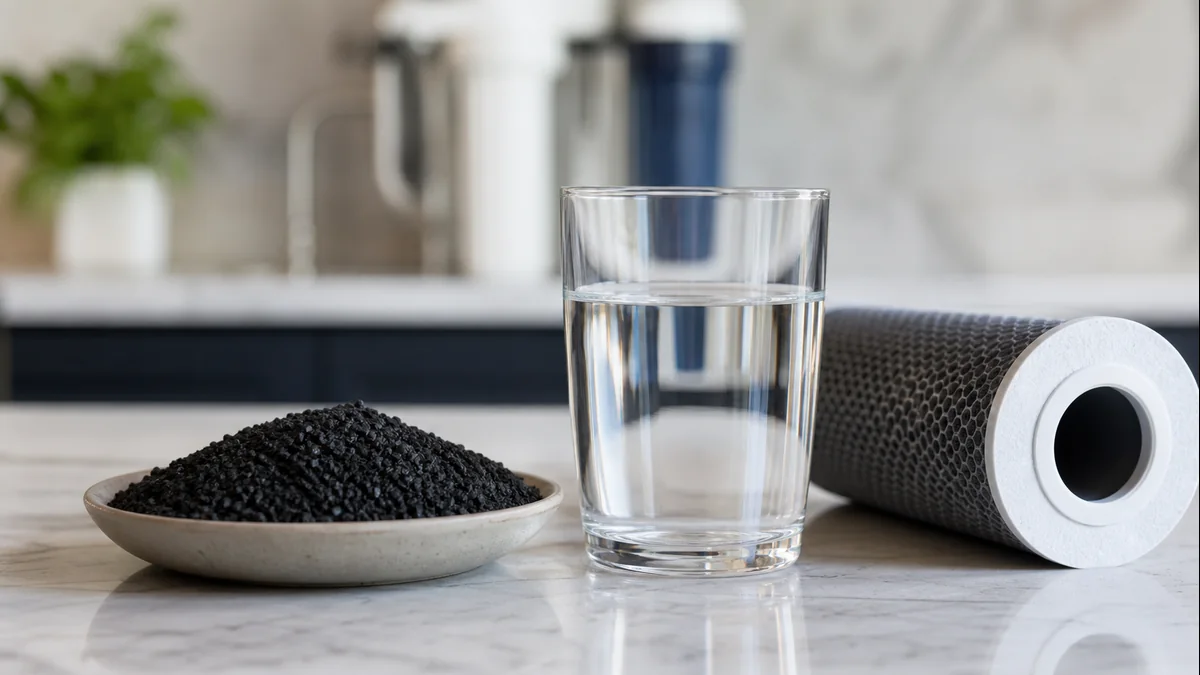
Direct answer: Yes, activated carbon can remove PFAS — but "can" isn't "always does." Performance depends on contact time, the type of carbon, and how many PFAS compounds are in your water. A whole-home carbon system certified to NSF/ANSI 53 or P473 removes PFAS reliably. An undersized pitcher filter or a system left in past its media life often doesn't. Reverse osmosis (NSF/ANSI 58) is the more consistent standalone answer.
How does activated carbon remove PFAS?
Activated carbon works by adsorption — PFAS molecules physically stick to the carbon's surface as water passes through. It's not a chemical reaction; it's surface area doing the work. Granular activated carbon (GAC) and catalytic carbon both have enormous internal surface area, which is why they're the backbone of most whole-home filtration.
The catch: PFAS is a family of thousands of compounds, and they don't all behave the same way in a carbon bed. Long-chain PFAS (like PFOA) adsorb onto carbon relatively well. Short-chain PFAS (like PFBS, GenX) are harder for carbon to grab and pass through more easily. This is why some homeowners see "PFAS removed" numbers online and assume every carbon filter does the same job — it doesn't.
Does contact time matter for PFAS removal?
Yes — this is the single biggest factor separating a filter that works from one that doesn't. Contact time is how long water sits in contact with the carbon media before it exits the system. A whole-home unit with a properly sized carbon tank gives water minutes of contact time. A cheap under-sink cartridge or a pitcher filter gives water seconds. More contact time means more opportunity for PFAS molecules to adsorb onto the carbon surface, which is why undersized or flow-restricted systems underperform even when they use the "right" media.
Is all activated carbon the same for PFAS?
No. Two carbon types show up in filtration:
| Type | How it's made | PFAS performance |
|---|---|---|
| Standard GAC (granular activated carbon) | Coconut shell or coal, steam-activated | Removes long-chain PFAS well with adequate contact time; weaker on short-chain |
| Catalytic carbon | GAC treated to boost surface reactivity | Same PFAS mechanism as GAC (adsorption), marketed mainly for chloramine/H2S — not inherently better at PFAS |
The real differentiator isn't the marketing name on the media — it's whether the finished system has been tested and certified for PFAS reduction, not just chlorine or taste/odor.
How do I know if my carbon filter actually removes PFAS?
Check the certification, not the label. A filter that says "carbon filter" or even "removes PFAS" in ad copy isn't proof. Look for NSF/ANSI 53 certification specifically for PFOA/PFOS reduction, or the newer NSF/ANSI P473 standard, which was built specifically for PFAS. You can verify any product's actual certified contaminant list — not just marketing claims — at listings.nsf.org. Search the brand and model; the listing will show exactly which contaminants that specific unit is certified to reduce.
Carbon vs. reverse osmosis for PFAS
| Activated carbon (whole-home) | Reverse osmosis (point-of-use) | |
|---|---|---|
| PFAS mechanism | Adsorption | Membrane filtration (rejects molecules by size) |
| Long-chain PFAS (PFOA, PFOS) | Good, with sufficient contact time | Excellent |
| Short-chain PFAS (PFBS, GenX) | Inconsistent | More consistent |
| Coverage | Whole house — every tap, shower included | Point of use — typically kitchen sink only |
| Certification to look for | NSF/ANSI 53 or P473 | NSF/ANSI 58 or P473 |
The two aren't competitors — they solve different problems. Carbon protects the whole house (including shower inhalation exposure to other contaminants like the haloacetic acids and trihalomethanes common in chlorinated NC city water). RO gives you the highest-confidence removal at your drinking and cooking tap. That combination is why we install both as a bundle rather than picking one.
Local angle: why this matters in Cary and Apex
If you're on Cary or Apex water, this question isn't theoretical. Both towns draw from Jordan Lake, and a 2017 Duke University sampling of the lake measured combined PFAS levels above 200 ppt in the source water. Cary's own system data shows PFOA at 2.86 ppt (32× the EWG health guideline) and PFOS at 3.79 ppt (13× the guideline). That's the water entering your home before any treatment — see our full breakdown in is Cary NC water safe to drink.
FAQ
Does boiling water remove PFAS along with removing carbon-related contaminants? No — boiling does not remove PFAS and can concentrate it slightly as water evaporates. Carbon filtration and reverse osmosis are the methods with real removal mechanisms. See does boiling water remove PFAS for the full explanation.
Will a Brita or pitcher filter remove PFAS? Most standard pitcher filters use a small carbon cartridge with very short contact time and aren't certified for PFAS reduction. Check the specific model against NSF/ANSI 53 or P473 certification before assuming it works — don't assume "activated carbon" on the box means PFAS coverage.
Does activated carbon remove all forever chemicals? It removes many PFAS compounds well, particularly long-chain types, but short-chain PFAS can pass through carbon more easily. No single technology removes 100% of every PFAS variant — that's why pairing whole-home carbon with point-of-use RO is the more complete approach.
How can I check if my specific filter is certified for PFAS? Search the brand and model number at listings.nsf.org. The listing shows the exact contaminants that unit is certified to reduce — don't rely on packaging claims alone.
Do I need both carbon and RO, or just one? It depends on your priorities and budget. Whole-home carbon covers every tap in the house (showers, laundry, all faucets). RO gives the highest-confidence removal specifically for drinking and cooking water. Many Triangle homeowners run both, which is why Triangle Waterworks includes an under-sink RO unit with every whole-home install.
Not sure what's actually in your water or what it would take to address it? Take our 60-second water quiz for a straight answer on what's worth fixing at your address.
Answer nine practical questions, then request a written quote or well-water analysis.
Start My Water Analysis