
Does Boiling Water Remove PFAS? No — Here's Why
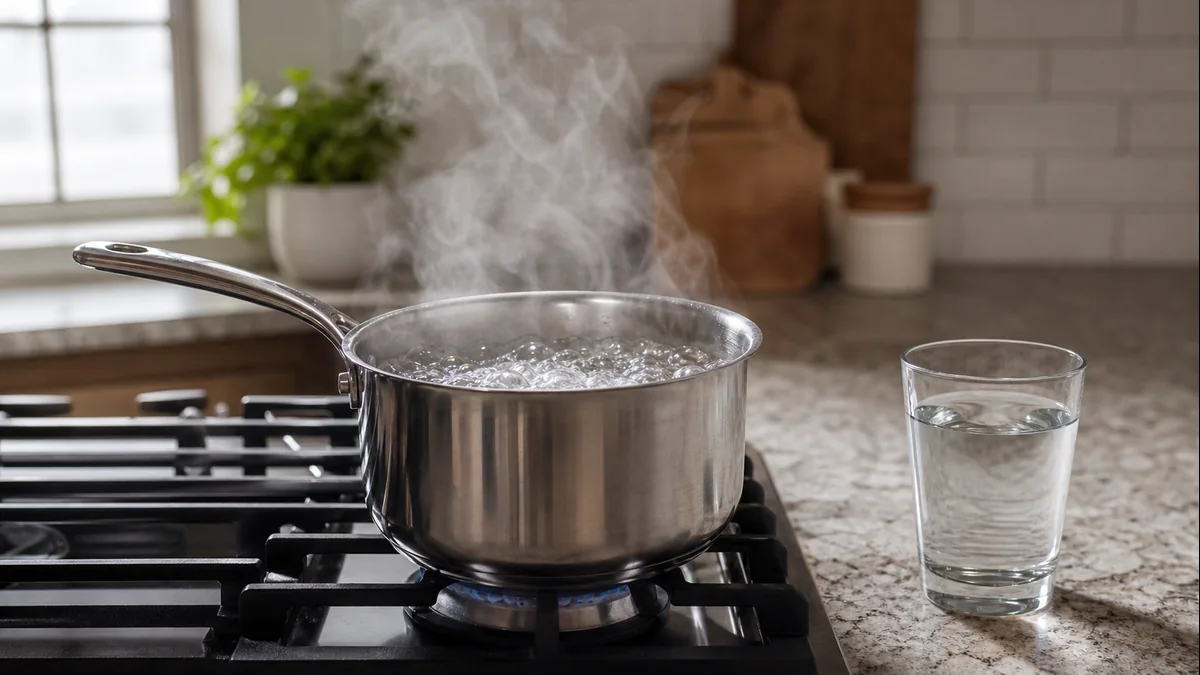
No. Boiling water does not remove PFAS ("forever chemicals") — it makes the concentration worse, not better. PFAS compounds don't break down or evaporate at boiling temperature the way water does, so as water boils off as steam, the PFAS that was dissolved in it stays behind in a smaller volume of water, concentrating it. The only methods that actually remove PFAS are filtration systems certified to NSF/ANSI 53 or P473 (activated carbon) or NSF/ANSI 58 (reverse osmosis).
Why doesn't boiling remove PFAS?
Boiling works for certain contaminants — it kills bacteria and some pathogens — because heat destroys biological organisms. PFAS are synthetic chemical compounds, not living organisms, and they're specifically engineered to be extremely stable, which is the same property that earned them the "forever chemicals" nickname. Water evaporates at its boiling point; PFAS compounds do not. The result is straightforward chemistry: less water, same amount of PFAS, higher concentration per glass. Boiling a pot of PFAS-containing water and letting it reduce actually leaves you with worse water than you started with.
Does filtering through a basic pitcher filter help?
Not necessarily, and this is where it's worth checking rather than assuming. Not every filter — including some pitcher filters and standard refrigerator filters — is tested and certified for PFAS reduction. A filter can be excellent at improving taste and odor while doing nothing for PFAS specifically, because those are different contaminants requiring different filtration media and contact time. The way to know is certification, not brand name: look for NSF/ANSI 53 or P473 certification on carbon-based filters, or NSF/ANSI 58 certification for reverse osmosis systems. If a product doesn't list one of those, it hasn't been independently verified for PFAS.
What actually removes PFAS from tap water?
Two technologies, verified by certification:
| Method | Certification | Notes |
|---|---|---|
| Activated carbon filtration | NSF/ANSI 53 or P473 | Whole-home or point-of-use; media and contact time matter |
| Reverse osmosis | NSF/ANSI 58 | Typically under-sink; removes PFAS along with a broad range of other dissolved contaminants |
| Boiling | None — not effective | Concentrates PFAS rather than removing it |
| Freezing | None — not effective | Does not remove PFAS from the water that remains liquid |
The certification number is the specific thing to look for — "carbon filter" alone isn't a guarantee, since not every carbon filter is built or tested to that standard.
Why does this matter more in Cary and Apex than elsewhere in the Triangle?
Cary and Apex draw drinking water from Jordan Lake, which has its own documented PFAS history: a 2017 Duke University sampling effort measured combined PFAS levels above 200 ppt in Jordan Lake source water. That's a source-water number, not necessarily what comes out of your tap after treatment, but it's part of why PFAS shows up on the list of contaminants EWG flags for the Town of Cary system — alongside elevated haloacetic acids and trihalomethanes from the same chlorination process. If you're on Cary or Apex water, PFAS isn't a hypothetical — it's tied to a known, documented source.
Local angle: what Triangle homeowners should actually do
Skip the boiling-water myth entirely — it doesn't help and can make a bad situation slightly worse by concentration. Instead, check whether your current filtration (if any) carries an NSF/ANSI 53, P473, or 58 certification specifically. If it doesn't, it isn't doing anything for PFAS regardless of how well it improves taste. Whole-home carbon filtration handles PFAS along with the chlorination byproducts (HAA9, TTHM) that also show up on Raleigh and Cary water reports, which is why it's the standard recommendation rather than a single under-sink fix.
FAQ
Does boiling water make PFAS worse? Yes, technically — boiling evaporates water while PFAS stays behind, which concentrates it in the remaining liquid rather than removing it.
Does freezing water remove PFAS? No. Freezing doesn't remove PFAS from the water that remains liquid, similar to boiling.
How do I know if my filter actually removes PFAS? Check for NSF/ANSI 53 or P473 certification (activated carbon) or NSF/ANSI 58 certification (reverse osmosis) on the product. Without one of those certifications, PFAS removal isn't verified.
Is bottled water free of PFAS? This isn't something we have verified data on either way — check the specific brand's own testing disclosures rather than assuming bottled is automatically PFAS-free.
Does a whole-home carbon filter remove PFAS and chlorination byproducts at the same time? Yes — activated carbon filtration certified for PFAS also addresses haloacetic acids and trihalomethanes, since all three are treated by the same carbon media at the point where water enters the home.
Not sure what's in your water or what actually removes it? Take our 60-second water quiz to see what a certified system looks like for your address.
Related reading: Is Cary, NC water safe to drink? · Is reverse osmosis water healthy? · Does activated carbon remove PFAS? · How to remove PFAS from drinking water
Answer nine practical questions, then request a written quote or well-water analysis.
Start My Water Analysis