
Does Soft Water Make Appliances Last Longer?
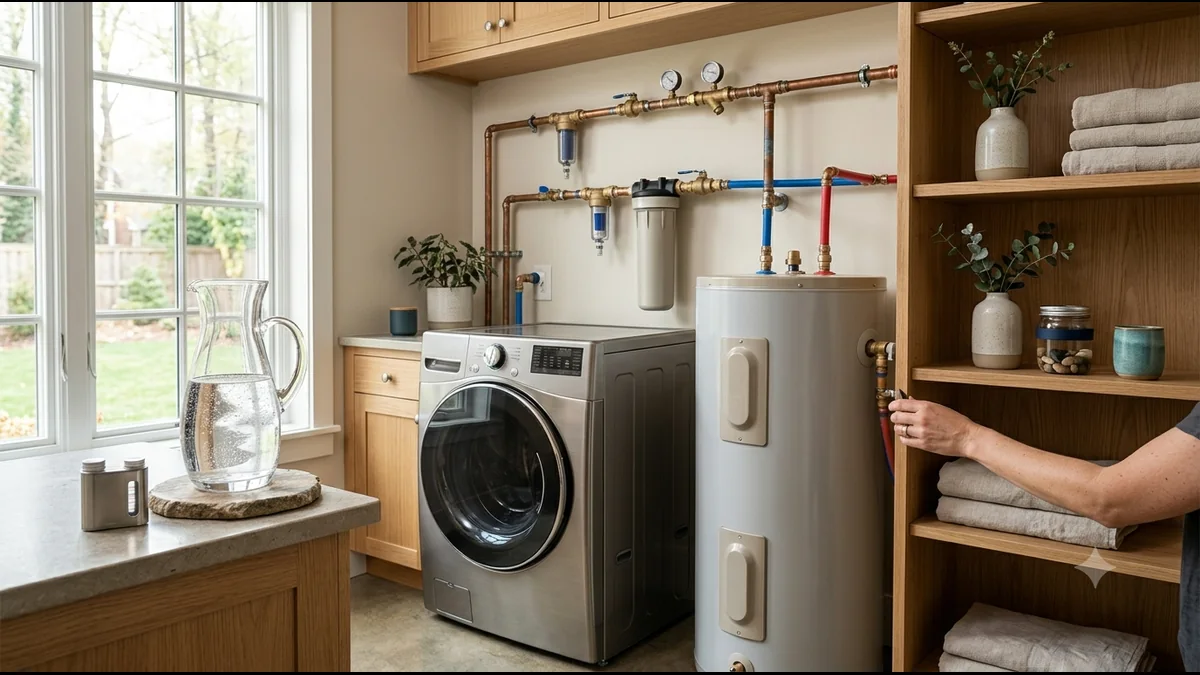
Direct answer: Yes. Soft water extends appliance life by removing the calcium and magnesium that would otherwise form mineral scale inside water heaters, dishwasher and washer components, and faucets. That buildup happens gradually, over years of daily use, which is why softening protects appliances best as part of a whole-home system — carbon filtration plus softening resin — installed early rather than after scale has already accumulated.
Does soft water make appliances last longer?
Yes — this is a mechanical outcome, not a marketing claim. Appliances that heat or hold water are damaged over time by mineral scale, the same calcium and magnesium deposits responsible for hardness. A softener uses ion exchange to remove those minerals from the water before it ever reaches an appliance, so the scale that would otherwise form on tanks, elements, and components simply has nothing left to build from. Preventing scale from forming in the first place is the direct mechanism by which softening protects appliance life.
How does scale actually damage appliances?
Scale doesn't damage appliances all at once — it accumulates wherever water heats, sits, or evaporates, gradually coating surfaces that are supposed to transfer heat or move water cleanly. Inside a water heater, the Department of Energy's Building America Solution Center describes scale and sediment acting as an insulator between the burner (or heating element) and the water, forcing the tank to work harder to reach the same temperature. Research from Battelle Columbus Laboratories, conducted for the Gas Research Institute, found that water heaters run on untreated hard water accumulated up to 5.8 pounds of scale in the equivalent of one year of typical residential use, while heaters run on softened water accumulated an insignificant amount over the same period. On a dishwasher or washing machine, mineral deposits collect on heating elements and internal components with every hot cycle. In faucets, showerheads, and ice makers, deposits build inside small openings and water lines. None of it happens overnight — it's a slow accumulation across years of ordinary use.
Which appliances does mineral buildup affect?
Any appliance that heats, holds, or dispenses water is exposed to scale. The most affected are the water heater, where the hottest surfaces accelerate the process, and the dishwasher and washing machine, which combine repeated heating cycles with standing water. Smaller fixtures — faucet aerators, showerheads, and ice makers — are affected too, since deposits narrow the small openings water passes through. The table below breaks down what happens at each one and what softening prevents.
What does scale do to each type of appliance?
| Appliance | What scale does | What softening prevents |
|---|---|---|
| Water heater | Acts as an insulator between the burner or heating element and the water, per DOE/PNNL research, raising surface temperatures and — over years — contributing to glass-lining and steel damage inside the tank | Removes calcium and magnesium before they reach the tank, so there's nothing left to build scale from |
| Dishwasher | Mineral deposits collect on heating elements and internal components with every hot cycle | Ion exchange removes the minerals before each cycle, so nothing accumulates on the elements |
| Washing machine | Scale builds on heating elements and internal parts over repeated hot-water cycles | Minerals are removed upstream, before the water ever reaches the machine |
| Faucet aerators & showerheads | Mineral deposits narrow the small openings water passes through, gradually reducing flow | Removes the minerals before they reach the fixture |
| Ice makers | Scale can build inside the water line and internal components feeding the unit | Softened water reaching the line carries nothing left to deposit |
Why does this matter even though Triangle's water isn't that hard?
Because the buildup is cumulative, not a one-time event, and every gallon of water — soft or hard — carries some dissolved mineral. Raleigh Water tests at about 1.6 gpg — slightly hard on the Water Quality Association (WQA) scale the Hach Total Hardness Test Kit uses. Cary, Apex, and Morrisville span a wider range, roughly 1.6–3.7 gpg, moderately hard at the top of that range. Even at the low end, a household running water through a water heater and dishwasher for years is depositing a small amount of mineral with every cycle. It adds up more slowly here than it would in a genuinely hard-water region, but it doesn't stop — which is why prevention still matters on Triangle city water, just on a longer timeline.
Does the type of water heater change how much this matters?
Yes, in how forgiving it is after scale has already built up. For electric storage water heaters, the Department of Energy notes that regular flushing to prevent sediment buildup maintains efficiency for the lifetime of the equipment. For gas water heaters, cleaning scale out after it has accumulated does not fully restore efficiency, because the burner surface at the bottom of the tank can't be completely cleaned — though preventing the buildup in the first place significantly limits the effect either way. That's the core argument for softening over relying on maintenance alone: prevention beats remediation, and softening prevents the scale from forming at all.
Does a whole-home system make more sense than protecting one appliance at a time?
Yes — because scale forms at every point in the house where water heats or sits, not just at the water heater. A whole-home system installed where water enters the house treats everything downstream — the water heater, dishwasher, washer, and fixtures — from one installation, rather than trying to protect appliances individually. Triangle Waterworks' all-in-one system pairs softening resin with a carbon filtration stage, so the same installation that prevents scale also handles chlorine taste, disinfection byproducts, and PFAS — contaminants softening alone doesn't touch. For a well, the equivalent is an iron removal plus carbon/resin system, sized after a free water analysis, since wells run harder and often carry iron or sulfur that city water doesn't.
Frequently Asked Questions
Does soft water actually make appliances last longer, or is that just a sales pitch? It's a mechanical outcome, not just marketing: softening removes the calcium and magnesium that form scale, and scale is what causes the insulating and corrosive effects described by DOE research on water heaters, plus the mineral buildup on dishwasher and washer components. Removing the minerals removes the mechanism, which is the direct reason appliances protected by softening tend to fare better over years of use.
I just moved to Morrisville — does the water here still cause scale in my appliances? Yes, to some degree. Morrisville draws from the same range as Cary and Apex, roughly 1.6–3.7 gpg, moderately hard at the top of that range. Even at the lower end, scale accumulates gradually with every gallon that heats or sits in an appliance, so the mechanism is still active — it just plays out over a longer timeline than it would in a harder-water region.
My dishwasher is brand new — should I still be thinking about scale already? Yes, because the buildup that affects appliance life happens gradually across years of normal use, not from one bad cycle. Addressing water hardness when an appliance is new, rather than after mineral deposits have already accumulated on its heating element, is when softening does the most good.
How long does it take for scale buildup to actually affect an appliance? There's no single timeline — it depends on local water hardness and how much hot water the household runs. What's consistent, per DOE/PNNL research on water heaters, is that the process is cumulative: deposits build gradually over years rather than appearing suddenly, which is why prevention from the start is more effective than addressing it later.
Will a softener protect appliances I already own, or only new ones? A softener protects any appliance from the point it's installed forward — it removes the minerals from the water supply itself, so every appliance downstream, new or existing, stops receiving water that can deposit scale. It won't reverse scale that has already built up inside an older appliance, but it stops further accumulation immediately.
Does Triangle's lower water hardness change whether softening protects my appliances? It changes the pace, not the mechanism. Raleigh Water tests at about 1.6 gpg — slightly hard on the WQA scale — and Cary, Apex, and Morrisville span a wider range that runs higher at the top; either way, calcium and magnesium are still present in the water and still accumulate as scale over years of daily use. Softening removes those minerals regardless of the starting hardness, which is why it protects appliances on Triangle city water just as it does anywhere else — the difference is how gradually the untreated buildup would occur.
Ready to protect what you already own?
Take our 60-second water quiz to see what system fits your home if you're on city water, or request a free water analysis if you're on a well. Either way, the sooner scale prevention starts, the more of an appliance's life it protects.
Related reading: Hard Water's Cost to Appliances | Water Softener Lifespan: How Long Do They Last? | What Size Water Softener Do I Need? | Raleigh Water Hardness | Water Softener vs. All-In-One System
Answer nine practical questions, then request a written quote or well-water analysis.
Start My Water Analysis