
Does Soft Water Protect Appliances in Cary, NC?
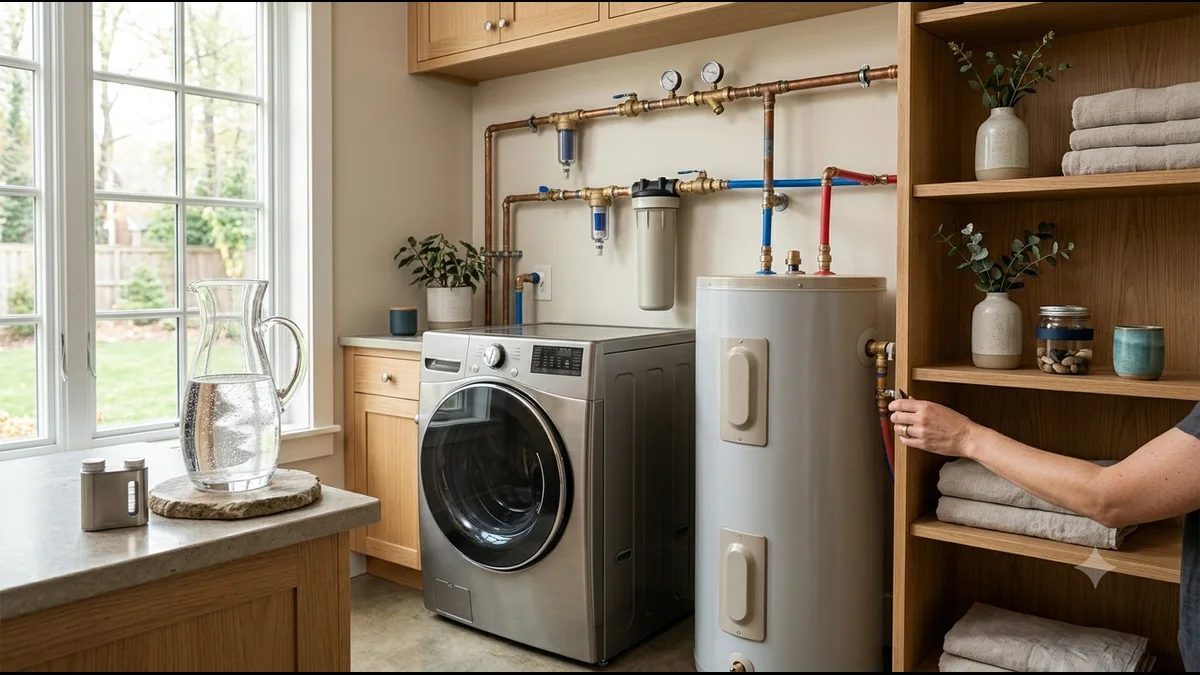
Direct answer: Yes. Cary's measured hardness runs 1.6 to 3.7 grains per gallon depending on ZIP code — slightly hard to moderately hard on the Water Quality Association scale — and calcium and magnesium at those levels accumulate as scale inside a water heater, dishwasher, washing machine, ice maker, and coffee maker over years of daily use. Softening resin removes those minerals before they reach any appliance. The complete fix for a Cary home is an all-in-one whole-home system that pairs softening resin with carbon filtration, since Cary's water also carries chloramines and disinfection byproducts that softening alone doesn't touch.
Does Soft Water Protect Appliances in Cary?
Yes — softened water protects any appliance that heats, holds, or cycles water, because it removes the calcium and magnesium that would otherwise deposit as scale inside it. Triangle Waterworks' own testing across Cary, Apex, and Morrisville measures 1.6 to 3.7 grains per gallon (gpg) depending on ZIP code, and the top of that range — 3.7 gpg, about 63 mg/L — crosses into "moderately hard" on the Water Quality Association (WQA) scale, the same scale the Hach Total Hardness Test Kit, Model 5-B, uses for at-home testing. That makes Cary the strongest appliance-protection case in the service area: every appliance in a Cary home is exposed to more dissolved mineral than a home at the low end of the region's range, for as long as that appliance runs.
Which Appliances Actually Get Damaged by Hard Water?
Every appliance that heats, holds, or cycles water is exposed: dissolved calcium and magnesium come out of solution and deposit as scale wherever water sits or gets hot.
- Water heater — scale settles on the tank bottom and heating element or burner, insulating the heat source from the water it warms.
- Dishwasher — scale builds on heating elements and spray arm nozzles; mineral film on glassware is the same reaction on a smaller scale.
- Washing machine — mineral deposits accumulate in the drum, hoses, and heating components over repeated cycles.
- Ice maker — scale narrows the water line feeding the icemaker and can coat the mold, which is why cloudy or oddly shaped ice is often a hardness symptom.
- Coffee maker — small internal water lines and the heating element scale up faster simply because the passages are narrower.
- Fixtures and the plumbing between all of them — faucet aerators, showerheads, and pipe runs feeding every appliance above collect the same deposits along the way.
None of this happens overnight. It's cumulative — the same mineral load passing through an appliance thousands of times over years, not a single event.
How Does Scale Actually Build Up Inside a Water Heater?
Scale builds up because heating water concentrates dissolved minerals faster than dissolving them, so calcium and magnesium precipitate out and bond to the hottest surfaces inside the tank — the tank bottom and the burner or heating element, the exact surfaces the unit relies on to transfer heat efficiently. A thin layer of scale insulates the heat source from the water, and heat spent working through mineral deposits is heat not spent warming water. Over years, that layer thickens. For more on this mechanism and what it means for a Cary water heater's lifespan, see water heater scale buildup in Cary, NC.
Why Does My Ice Come Out Cloudy or Small?
Cloudy, misshapen, or small ice is usually a sign of mineral scale narrowing the water line or coating the ice maker's mold, not a mechanical fault. The same calcium and magnesium that scale a water heater travel through the narrower tubing feeding a refrigerator's ice maker, where deposits have an outsized effect on flow and ice clarity relatively quickly. Softened water removes the minerals responsible before they reach that line. For more, see ice maker mineral buildup from hard water in Cary, NC.
What Does Scale Buildup Actually Cost Over Time?
The cost shows up as reduced efficiency and shortened service life across every water-using appliance, not as a single repair bill. A scaled water heater works harder to deliver the same hot water; a scaled dishwasher and washing machine cycle less effectively and wear their heating components faster; a scaled ice maker and coffee maker restrict flow through their narrowest passages first. None of it is instant — it accumulates through years of ordinary use, at whatever rate matches a home's hardness level. For more on how that adds up across a household, see what hard water costs in appliance damage.
Untreated vs. Softened Water — Appliance-by-Appliance
| Appliance | Untreated Cary water (1.6–3.7 gpg) | Softened, carbon-filtered water |
|---|---|---|
| Water heater | Scale on tank bottom and heating element/burner accumulates over years | Softening resin removes calcium and magnesium before they reach the tank |
| Dishwasher | Scale on heating elements and spray nozzles; mineral film on glassware | Cleaner rinse, less film, less scale on internal components |
| Washing machine | Mineral deposits in drum, hoses, and heating components | Deposits reduced at the source before water enters the machine |
| Ice maker | Scale narrows the supply line and can coat the ice mold | Clear supply line, less mineral carried into the ice itself |
| Coffee maker | Narrow internal lines and heating element scale relatively fast | Same protection extended to every tap and appliance in the house |
| Chlorine/chloramine taste and odor | Softening resin does nothing about this — it's mineral-only | Carbon stage removes it; softening resin can't on its own |
Does Softening Alone Handle Everything in Cary's Water?
No — softening only addresses the mineral side, which is why Triangle Waterworks routes Cary homes to an all-in-one system rather than a softener by itself. Cary's water is drawn from B. Everett Jordan Lake and treated at the Cary/Apex Water Treatment Facility, where chlorine and ammonia are added separately in the clearwell to form chloramines. Cary's own water quality data (EWG Tap Water Database) shows HAA9 at 27.5 ppb and TTHM at 38.2 ppb — disinfection byproducts formed during treatment, legally compliant with EPA limits, and entirely outside what softening resin can remove, since resin only performs ion exchange on calcium and magnesium. Neighboring Apex's 2024 Consumer Confidence Report, drawn from the same shared source and facility, documented TTHM at 41 ppb, ranging as high as 53 — again compliant, but a real, measurable presence in the finished water. EWG's guidelines are a stricter, non-regulatory benchmark than the EPA's legal limits; both are worth knowing. Carbon filtration is built to reduce that taste, odor, and byproduct load — the half of the story scale protection never touches. See water softener Cary, NC for the full all-in-one picture, and does soft water make appliances last longer for the broader appliance-life case.
Is Cary's Water Really Hard Enough to Matter for Appliances?
It depends on where in Cary's distribution system a given address sits, which is why an address-level test settles it better than either published figure alone. The Town of Cary's Public Works FAQ reports finished water hardness of 25 to 30 ppm (about 1.5 to 1.75 gpg) at the plant and calls that very soft — an accurate reading of water leaving the treatment facility. Triangle Waterworks' own testing across Cary, Apex, and Morrisville measures a wider range, 1.6 to 3.7 gpg, because what reaches a specific house depends on where it falls in the distribution system, not just the plant average. Both figures are true at once. On the WQA/Hach scale, 1.6 gpg reads as slightly hard and 3.7 gpg — about 63 mg/L, over the 60 mg/L line — reads as moderately hard, which is why Cary represents the top end of the appliance-protection case across the service area. The only way to know which end of that range a specific address falls on is a test at that address, and that test is free.
See What Your Cary Address Measures
Take the 60-second water quiz to see which all-in-one system fits your home, or book a free water analysis to find out exactly where your address falls in the 1.6–3.7 gpg range Triangle Waterworks measures across Cary, Apex, and Morrisville.
Frequently Asked Questions
I just moved into a Cary home that's a few years old — could the appliances already have scale buildup from the previous owners? It's possible, since scale accumulates gradually with every gallon that passes through a water heater, dishwasher, or washing machine, regardless of who owned the home. A free water analysis tells you the hardness level your address is dealing with now.
My ice maker keeps making cloudy, small cubes — is that a hard water problem or is my fridge broken? Often it's hardness, not a mechanical fault. Scale can narrow the water line feeding the ice maker and coat the mold itself, which shows up as cloudy or smaller ice well before anything else in the fridge shows a problem. Softened water removes the minerals responsible before they reach that line.
Does a water softener protect my dishwasher and washing machine, or just my water heater? It protects every appliance the softened water reaches — dishwashers, washing machines, ice makers, and coffee makers are all exposed to the same calcium and magnesium, just through smaller passages. Softening resin removes those minerals at the point of entry to the house, so protection applies system-wide.
Is Cary's water actually hard enough to damage appliances, or is that overstated? Cary's own FAQ reports a plant-average hardness of 25–30 ppm and calls it very soft, which is accurate for water leaving the treatment plant. Triangle Waterworks measures a wider address-level range, 1.6–3.7 gpg, with the top crossing into moderately hard on the WQA scale — both figures are true, and a free test at your address settles which end applies to you.
If I get a softener, do I still need to worry about anything else in Cary's water affecting my appliances? Softening handles the mineral side, but Cary's water also carries chloramines and disinfection byproducts that softening resin doesn't remove, since resin only performs ion exchange on calcium and magnesium. That's why the recommended system pairs softening resin with a carbon filtration stage in one install.
How long does it actually take for hard water to damage a water heater or dishwasher in Cary? There's no single timeline — buildup is cumulative and depends on your address's hardness level, water use, and the appliance itself, so it happens gradually over years rather than on a fixed schedule. That's why testing your specific address matters more than a general estimate.
Answer nine practical questions, then request a written quote or well-water analysis.
Start My Water Analysis