
Does Soft Water Protect Appliances in Knightdale, NC?
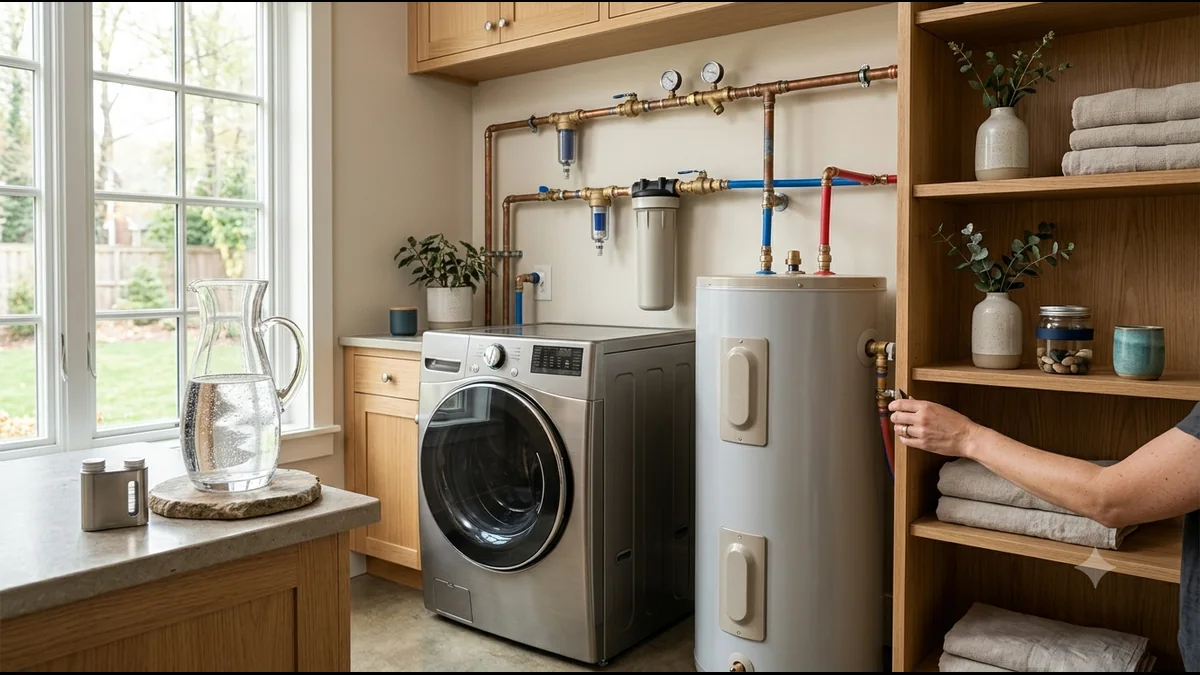
Direct answer: Yes. Softening removes the calcium and magnesium that form scale before it reaches a water heater, dishwasher, washing machine, ice maker, or humidifier. Knightdale runs on Raleigh Water — slightly hard on the WQA/Hach scale — so this isn't a dramatic hardness problem, it's buildup that accumulates across every gallon those appliances heat or evaporate over years. An all-in-one system pairs that softening resin with carbon filtration for taste and disinfection byproducts too.
Does Soft Water Actually Protect Appliances, or Is That a Sales Pitch?
It's a real mechanism, not a pitch. Calcium and magnesium dissolved in water don't vanish when an appliance heats, holds, or evaporates that water — they precipitate out and bond to whatever surface they're left on, whether that's a heating element, a tank wall, a spray arm, or a humidifier pad. A softener uses ion exchange to swap those minerals out before the water ever reaches an appliance, so there's nothing left behind to deposit downstream. Less calcium and magnesium going in means less scale forming on the equipment that handles water every day.
Is Knightdale's Water Hard Enough for This to Matter?
Knightdale is served by Raleigh Water, drawn from Falls Lake and treated at the E.M. Johnson Water Treatment Plant, which measures roughly 1.6 grains per gallon (gpg) — slightly hard on the Water Quality Association scale the Hach Total Hardness Test Kit (Model 5-B) uses, not soft, and not the "hard" tier that starts at 7 gpg. Triangle Waterworks' own testing across the service area finds hardness running 1.6 to 3.7 gpg depending on ZIP code, with the top of that range crossing into moderately hard (3.7 gpg works out to about 63 mg/L, over the 60 mg/L line).
That's not a dramatic number, and that's exactly the point: even mineral content this modest adds up over years, because scale is cumulative and doesn't reset between cycles. One dishwasher run or one tank refill leaves a trace amount that's easy to dismiss on its own — multiply that by every day for a decade across a water heater, a dishwasher, and anything else that heats or evaporates water, and the picture changes. A free water analysis shows exactly where your address falls in that 1.6–3.7 gpg range, since it varies block to block.
What Actually Happens Inside a Water Heater Over the Years?
Scale that forms on a heating element or tank wall acts as insulation, sitting between the metal and the water so the unit has to work through that layer every time it runs. Sediment settling at the bottom of the tank narrows usable capacity and can restrict flow through fittings over time. None of it happens overnight — it happens gradually, cycle after cycle, which is why softening at the source prevents the layer from forming instead of trying to clean it out later.
What About Dishwashers, Washing Machines, Ice Makers, and Humidifiers?
Every appliance that heats, holds, or evaporates water is exposed to the same slow accumulation — just in a different spot for each one:
- Dishwashers — deposits build inside spray arm holes over hundreds of cycles, cutting pressure to individual jets and leaving glassware with a persistent film or grit even on a normal cycle.
- Washing machines — scale accumulates on internal heating elements and in valves over years of use, alongside soap not rinsing as cleanly out of fabric.
- Ice makers — deposits build inside the water line and internal components, part of why ice can come out cloudy or chalky.
- Humidifiers — these units evaporate water rather than draining it, so every mineral in the water is left behind concentrated on the pad, tray, or solenoid, or aerosolized as fine white dust on nearby furniture.
- Faucet aerators and showerheads — buildup shows earliest and most visibly here, since water passes through small openings that deposits narrow over time.
A softener addresses every item on that list at the source, because it removes the calcium and magnesium before any of those appliances ever see it.
How Soft Water Changes What Each Appliance Experiences
| Appliance / fixture | What scale does over time | What softened water changes |
|---|---|---|
| Water heater | Insulating layer on element/tank wall, sediment reduces usable capacity | No calcium/magnesium left to deposit — heating surfaces stay clear |
| Dishwasher | Deposits clog spray arm holes, film on glassware | Cleaner rinse, less film and grit buildup over repeated cycles |
| Washing machine | Scale on heating elements and valves, poorer detergent performance | Less mineral buildup, better lather with less soap |
| Ice maker | Deposits in the water line, cloudy or chalky ice | Clearer ice, fewer deposits feeding the unit |
| Humidifier | Minerals concentrate on pads, trays, and solenoids, or aerosolize as white dust | Far less mineral content left behind as the unit evaporates water |
| Faucets & showerheads | Narrowed openings, visible spotting | Clearer flow, less visible mineral residue |
Does Softening Cover Everything in Knightdale's Water, or Just the Minerals?
Just the minerals — which is exactly why the all-in-one system pairs softening with a carbon filtration stage. Softening resin is an ion-exchange process built for calcium and magnesium; it has no effect on chlorine, chloramine, or disinfection byproducts, a completely different category of chemistry. Raleigh Water normally disinfects with chloramine, then converts to free chlorine for a period each year on the state's recommendation to flush the distribution system — typically when a chlorine taste or smell becomes noticeable at the tap.
Raleigh Water's own reported figures (EWG Tap Water Database) show haloacetic acids (HAA9) at 19.9 ppb and total trihalomethanes (TTHM) at 21.7 ppb — both disinfection byproducts. Those numbers are legally compliant with EPA's regulatory limits; EWG's guideline is a separate, stricter, non-regulatory health benchmark, and both are worth knowing rather than treated as the same standard. Activated carbon is the stage that addresses disinfection byproducts and chlorine taste — softening resin does none of it. That's the "best of both worlds" case: the softening side protects appliances from scale, and the carbon side handles what softening structurally cannot.
Is a Softener Actually Cheap to Run on Knightdale's Water?
Yes — lower local hardness is a genuine reason to install one, not a reason to hesitate. A softener sized for 1.6–3.7 gpg water doesn't need to regenerate as often or cycle through as much salt as one installed on genuinely hard or very hard water, because there's simply less calcium and magnesium for the resin to exchange between refills. That means less salt purchased and fewer regeneration cycles — the appliance protection comes at a lower ongoing cost to run specifically because Knightdale's measured hardness sits at the lighter end of the scale.
Benefits Homeowners Actually Notice
- Water heater, dishwasher, washing machine, ice maker, and humidifier protected from scale buildup on heating surfaces and internal parts
- Cleaner dishes and glassware with less spotting, film, and spray-arm clogging
- Less white dust and pad crusting from humidifiers
- Better lather from soap and detergent, using less product
- A softener sized for Knightdale's measured range regenerates less often and uses less salt to run
- Paired carbon stage removes chlorine/chloramine taste and disinfection byproducts softening alone can't touch
For a closer look at two appliances hit hardest, see why a dishwasher's spray arm keeps clogging with mineral deposits and why humidifiers leave white dust and crusted pads in Knightdale homes. For the broader picture of a new Knightdale homeowner's water, see water treatment in Knightdale, NC. The mechanism itself isn't unique to Knightdale — see the general case for soft water extending appliance life and how it plays out in Raleigh, since both towns share the same Raleigh Water supply.
Ready to See What Your Water Needs?
Take the 60-second water quiz to see how an all-in-one system would protect your appliances, or book a free water analysis to get your exact hardness reading and a system sized to your Knightdale home.
Frequently Asked Questions
Does soft water really protect appliances, or is the effect too small to notice on Knightdale's water? The effect is cumulative rather than immediate — a softener prevents calcium and magnesium from depositing on heating elements, tank walls, and internal components every time an appliance runs. Over years of daily use, that adds up to meaningfully less scale than the same appliance running unsoftened water the whole time.
I just replaced my second water heater in eight years in Knightdale — could the water be a factor? It's possible. Scale insulates heating surfaces and sediment reduces usable tank capacity over time, and that buildup happens even at Knightdale's slightly hard reading if the water was never softened. A free water analysis can confirm your hardness and whether scale contributed.
My dishwasher leaves spots and grit on glasses even though I run it every cycle — is that the water? It can be. Mineral deposits clog spray arm holes and build on interior components over repeated cycles, a common cause of persistent film and grit regardless of the detergent used. Softened water addresses the mineral content causing that residue at the source.
Is Knightdale's water hard enough to justify a softener, or is that overkill for slightly hard water? Knightdale measures slightly hard on the WQA/Hach scale, and testing shows some addresses in the service area reaching moderately hard depending on ZIP. Because scale accumulates over the life of a home's appliances, the case for softening holds across that whole range — it's a question of how quickly the buildup adds up, not whether it happens.
Does a water softener also fix the chlorine taste in my Knightdale tap water? No — softening resin only removes calcium and magnesium, so it has no effect on chlorine, chloramine, or disinfection byproducts. That's handled by a separate carbon filtration stage, which is why the all-in-one system combines both rather than relying on softening alone.
Does a softener cost more to run in Knightdale than somewhere with harder water? No — it's the opposite. A softener sized for Knightdale's 1.6–3.7 gpg range regenerates less often and uses less salt than one on genuinely hard or very hard water, since there's less calcium and magnesium for the resin to process between cycles. Lower local hardness keeps operating cost down while still delivering the same appliance protection.
Answer nine practical questions, then request a written quote or well-water analysis.
Start My Water Analysis