
Does Soft Water Protect Appliances in Raleigh, NC?
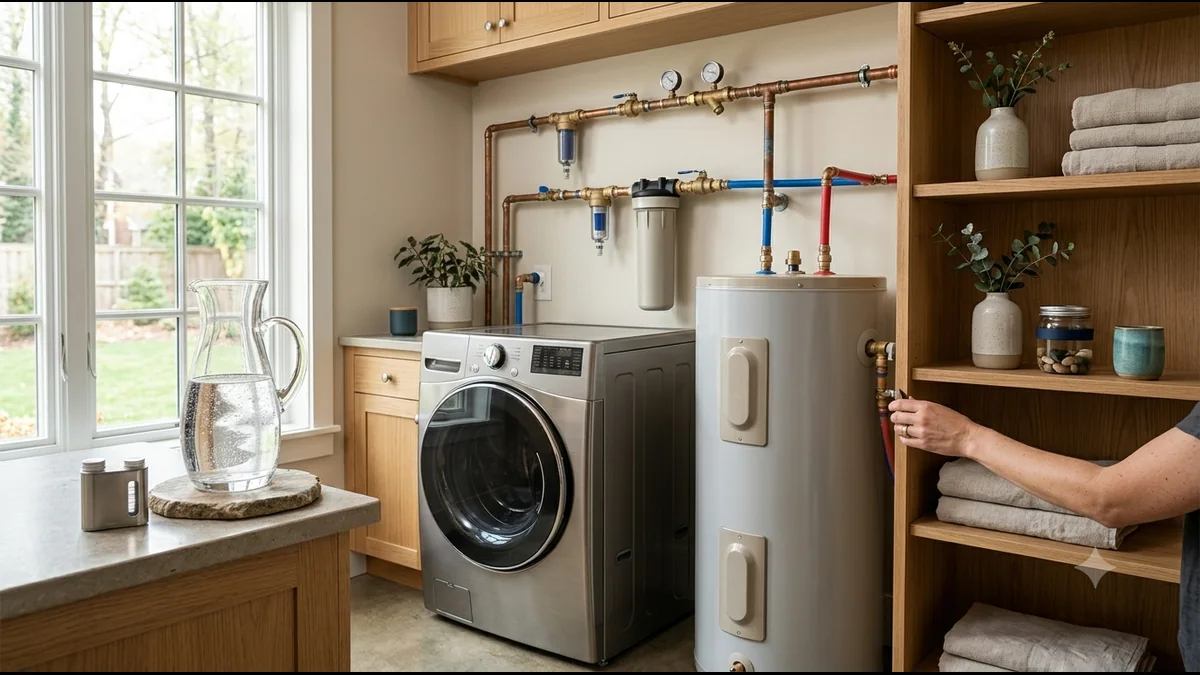
Direct answer: Yes. Softening removes the calcium and magnesium that form scale on heating elements, tank walls, valves, and seals — the deposits that build up gradually inside a water heater, dishwasher, and washing machine every time they run. Raleigh Water measures slightly hard on the WQA/Hach scale, so the protection is about stopping years of cumulative buildup, not a dramatic problem today. Pairing softening with a carbon stage in an all-in-one system also handles chlorine taste and disinfection byproducts, which softening alone never touches.
Does soft water actually protect appliances, or is that a sales pitch?
It's a real mechanism, not a pitch. Calcium and magnesium dissolved in water don't disappear when the water heats up — they precipitate out and bond to whatever surface the hot water touches, whether that's a heating element, a tank wall, or the narrow passages inside a dishwasher or washing machine. A softener uses ion exchange to swap those minerals out before the water ever reaches an appliance, so there's nothing left to precipitate and deposit downstream. That's the entire mechanism: less calcium and magnesium in, less scale forming on the equipment that heats and holds water every single day.
Is Raleigh's water hard enough for this to matter?
Raleigh Water measures roughly 1.6 grains per gallon (gpg), which classifies as slightly hard on the Water Quality Association scale the Hach Total Hardness Test Kit (Model 5-B) uses — not soft, and not the "hard" tier that starts at 7 gpg. Our own testing across the service area finds hardness running 1.6 to 3.7 gpg depending on ZIP code, with the top of that range crossing into moderately hard (3.7 gpg works out to about 63 mg/L, just over the 60 mg/L line for that tier). Raleigh's own Water Service FAQ reports hardness usually under 30 mg/L, which lines up with the low end of what we measure at the tap.
None of that is a dramatic number. That's the point: even mineral content this modest adds up over years of daily use, because scale is cumulative — it doesn't reset between uses. A single load of dishes or one tank refill leaves behind a trace amount that's easy to dismiss. Multiply that by every day for a decade, and it's a different picture. A free water analysis tells you exactly where your address falls in that 1.6–3.7 gpg range, since it varies block to block, not just city to city.
What actually happens inside a water heater over the years?
Scale that forms on a heating element or tank wall acts as insulation — it sits between the metal and the water, so the appliance has to work through that layer to transfer heat. Sediment collecting at the bottom of the tank narrows the effective capacity and can restrict flow through fittings and pipes over time. None of this happens overnight. It happens gradually, cycle after cycle, which is exactly why softening at the source — before water ever reaches the tank — prevents the layer from forming in the first place rather than trying to clean it out later.
What about dishwashers, washing machines, and fixtures?
Every appliance that heats, holds, or repeatedly cycles water is exposed to the same slow accumulation, just in different spots:
- Dishwashers — mineral deposits build on interior components and heating elements over hundreds of cycles, which is part of why glassware can come out with a persistent film even on a normal cycle.
- Washing machines — scale can accumulate on internal heating elements and in valves over years of use, alongside soap and detergent not rinsing as cleanly.
- Faucet aerators and showerheads — these show buildup earliest and most visibly, since water passes through small openings that mineral deposits narrow over time.
- Coffee makers and tankless units — narrow internal passages are especially sensitive to the same gradual buildup.
- Fixtures and glassware — chalky spots and a dulled finish on faucets, shower doors, and drinking glasses are the most visible everyday evidence that deposits are accumulating somewhere in the system.
A softener addresses every item on that list at the source, because it removes the calcium and magnesium before any of those appliances ever see it.
How soft water changes what appliances experience
| Appliance / fixture | What scale does over time | What softened water changes |
|---|---|---|
| Water heater | Insulating layer on element/tank wall, sediment reduces usable capacity | No calcium/magnesium left to deposit — heating surfaces stay clear |
| Dishwasher | Deposits on internal components, film on glassware | Cleaner rinse, less film buildup over repeated cycles |
| Washing machine | Scale on heating elements and valves, poorer detergent performance | Less mineral buildup, better lather with less soap |
| Faucets & showerheads | Narrowed openings, visible spotting | Clearer flow, less visible mineral residue |
| Glassware & fixtures | Chalky film, dulled finish | Spot-free, brighter finish |
Does softening cover everything in Raleigh's water, or just the minerals?
Just the minerals — and that's exactly why the all-in-one system pairs softening with a carbon filtration stage. Softening resin is an ion-exchange process built specifically for calcium and magnesium; it has no effect on chlorine, chloramine, or disinfection byproducts, because those are a completely different category of chemistry. Raleigh Water normally disinfects with chloramine, which the City describes as having no taste or odor associated with it, then converts to free chlorine for a period each year on the state's recommendation to flush the distribution system — which is typically when a chlorine taste or smell becomes noticeable at the tap.
Raleigh's own reported figures (EWG Tap Water Database) show haloacetic acids (HAA9) at 19.9 ppb and total trihalomethanes (TTHM) at 21.7 ppb — both disinfection byproducts. Those numbers are legally compliant with EPA's regulatory limits; EWG's guideline is a separate, stricter, non-regulatory health benchmark, and it's worth knowing both bars exist rather than treating them as the same standard. Activated carbon is the treatment stage that addresses disinfection byproducts and chlorine taste. PFAS reduction requires carbon that's specifically certified for it (NSF/ANSI 53 or P473) or reverse osmosis (NSF/ANSI 58) — softening resin does none of it. That's the "best of both worlds" case for an all-in-one system: the softening side protects your appliances from scale, and the carbon side handles what softening structurally cannot.
Benefits homeowners actually notice
- Water heater, dishwasher, and washing machine protected from scale buildup on heating surfaces and internal parts
- Cleaner dishes and glassware with less spotting and film
- Better lather from soap and detergent, using less product to get the same result
- Softer feel to skin, hair, and laundry
- Fixtures and glassware keep a clearer finish instead of dulling over time
- Paired carbon stage removes chlorine/chloramine taste and odor, PFAS, and disinfection byproducts softening alone can't touch
Frequently Asked Questions
Does soft water really protect appliances, or is the effect too small to notice? The effect is cumulative rather than immediate — a softener prevents calcium and magnesium from depositing on heating elements, tank walls, and internal components every time an appliance runs. Over years of daily use, that adds up to meaningfully less scale than an appliance running unsoftened water the whole time. It's a protection story measured in years, not days.
I just replaced my second water heater in eight years in Raleigh — could the water be the reason? It's possible. Scale insulates heating surfaces and sediment reduces usable tank capacity over time, and that buildup happens even at Raleigh's slightly hard reading if the water was never softened. A free water analysis can confirm your actual hardness and whether scale is a contributing factor before you replace anything else.
My dishwasher leaves spots on glasses even though I run it every cycle — is that from the water? It can be. Mineral deposits build on interior components and glassware over repeated cycles even at moderate hardness levels, which is a common cause of persistent film and spotting regardless of the detergent used. Softened water addresses the mineral content causing that residue.
Is Raleigh's water hard enough to justify a softener, or is that overkill for slightly hard water? Raleigh measures slightly hard on the WQA/Hach scale, and our testing shows some addresses reaching moderately hard depending on ZIP. Because scale accumulates cumulatively over the life of a home's appliances, the case for softening holds across that whole range — it's just a question of how quickly the buildup adds up.
Does a water softener also fix the chlorine taste in my tap water? No — softening resin only removes calcium and magnesium through ion exchange, so it has no effect on chlorine, chloramine, or disinfection byproducts. That's handled by a separate carbon filtration stage, which is why the all-in-one system combines both rather than relying on softening alone.
I've never had my water tested — how do I know where my address falls in that hardness range? A free water analysis is the fastest way to find out, since hardness across the service area runs 1.6 to 3.7 gpg depending on ZIP code rather than one fixed citywide number. That test also confirms what else is present so any system gets sized to what your water actually needs.
Ready to see what your water needs?
Take our 60-second water quiz to see how an all-in-one system would protect your appliances, or request a free water analysis to get your exact hardness reading and a system sized to your home.
Related reading: Does Soft Water Make Appliances Last Longer? | Does Hard Water Really Damage Appliances and Cost You Money? | Water Heater Scale Buildup Prevention | Benefits of Soft Water in the Home
Answer nine practical questions, then request a written quote or well-water analysis.
Start My Water Analysis