
Why Does Durham Water Smell Strange?
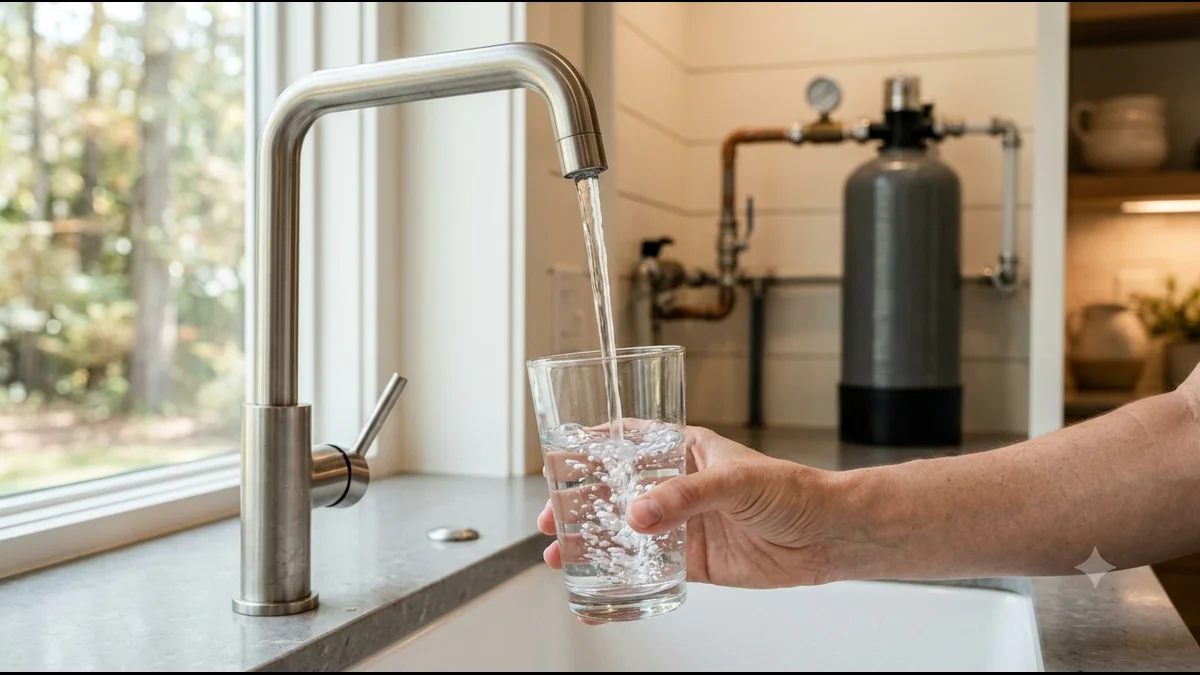
Direct answer: A strange smell in Durham tap water usually traces to seasonal reservoir algae, the annual chlorine-to-chloramine changeover, or — hot tap only — your water heater's anode rod. Durham's water is legally compliant through these events, but compliant isn't the same as nothing worth filtering out. A whole-home carbon and softening system removes the taste, odor, and disinfection byproducts at every faucet — the fix is a free water analysis away.
If you've noticed something off in your glass lately — a musty edge, a faint chlorine sting, or something closer to a sulfur smell — you're not imagining it, and you're not the only one. One Durham resident put it plainly on a local forum: "Smells like sulfide. I've noticed over the past week."
That kind of change has a real, traceable explanation on Durham's municipal system — not the well-water causes people sometimes search for by reflex. It's also a legitimate reason to find out exactly what's in your water rather than wait it out.
Why Does My Durham Tap Water Smell Musty or Earthy Sometimes?
The most common documented cause is seasonal algae in Durham's own source reservoirs. The City of Durham operates two reservoirs, Lake Michie and Little River Reservoir, and its own water-quality program explains that algae naturally occur in both as part of the ecosystem. Under warm, sunny, calm conditions with elevated nutrient levels, certain algae species can bloom and release compounds that show up as an earthy or musty taste and odor at the tap.
The city treats these events with potassium permanganate and copper sulfate, standard water-treatment-industry chemicals for taste-and-odor control, and states plainly that the water remains safe to drink and use throughout. That's a water-source issue upstream of your house, not something wrong with your plumbing — but "safe" and "pleasant at the tap" are two different bars, and only a whole-home carbon stage closes that gap continuously instead of you waiting out the season.
Could the Smell Be Coming From My Water Heater, Not the Water Itself?
Yes, and this is worth ruling out before assuming anything about the supply — especially if the smell is a sulfur or "rotten egg" note, and especially if it only shows up on the hot tap. Water heaters contain an anode rod (often magnesium) that's designed to corrode instead of the tank, and that reaction can convert naturally occurring sulfate in the water into hydrogen sulfide gas — the compound behind that smell.
This happens inside the tank itself, on any home's water heater, on municipal or well water alike; it isn't a sign of contamination in Durham's supply. If cold water at the same tap smells fine, the water heater is the more likely source, and a plumber can address the anode rod directly.
Does Durham's Annual Disinfectant Changeover Cause an Odor?
It can, for a few weeks each year. Durham disinfects primarily with chloramine (chlorine plus ammonia), which the city has used since 2002 in part because it produces fewer disinfection byproducts than chlorine alone. Once a year, the city temporarily switches to free chlorine only and systematically flushes hydrants across the distribution system — a planned, six-week process the city announces in advance, timed to coordinate with neighboring utilities including Raleigh, Cary, Apex, Morrisville, and OWASA.
Chlorine residual runs higher system-wide during that window, and some residents notice a stronger, more chlorine-forward smell as a result. The exact dates shift year to year, so check the City's own announcement for current timing rather than assuming a fixed calendar.
Disinfection byproducts are the reason EPA regulates chlorine and chloramine treatment in the first place — not just the smell. Under EPA's National Primary Drinking Water Regulations, the potential health effects from long-term exposure to total trihalomethanes (TTHMs) above the legal limit are "liver, kidney or central nervous system problems; increased risk of cancer." For haloacetic acids (HAA5), EPA's listed effect is "increased risk of cancer."
Durham's water is legally compliant, and compliant is a ceiling EPA set based on its own risk tolerance — not a guarantee of zero exposure to the compounds above. Those are the exact effects EPA had in mind when it set that limit. A whole-home carbon stage removes TTHMs and HAA5 at the point of entry, continuously, instead of relying on staying under a legal line — the stronger move if you'd rather not leave it to chance.
Is It Safe to Drink Durham Water When It Smells Off?
A strange smell alone doesn't mean the water is unsafe. City of Durham monitors its reservoirs for algae toxins separately from taste-and-odor compounds and reports levels well below what's considered unsafe even during a documented bloom, and its treatment plants — Williams and Brown — have been recognized at state water-operator conferences for water quality.
But "compliant and safe" and "pleasant to drink and cook with" are two different bars, and so is "compliant" versus "everything a carbon filter would otherwise strip out." If the smell bothers you — or the disinfection-byproduct exposure above does — that's reason enough to treat it at the source instead of living with it.
Durham Tap Water Odor Causes at a Glance
| Cause | What It Typically Smells Like | When It Happens | Where the Problem Actually Is | What Fixes It |
|---|---|---|---|---|
| Seasonal algae in the reservoir | Earthy, musty, "swampy" | Most common in warm months during bloom conditions | Source water, upstream of your home | Whole-home carbon stage treats it at the point of entry |
| Annual chlorine/chloramine changeover | Stronger chlorine, "pool"-like | ~6-week window each spring; dates shift, city announces them | City-wide distribution system | Whole-home carbon absorbs the higher residual |
| Routine disinfection byproducts | Faint chemical or medicinal note | Ongoing, low level | Distribution system | Activated carbon reduces disinfection byproducts |
| Sulfur/"rotten egg" smell, hot tap only | Rotten egg, sulfide-like | Any time, isolated to hot water | Usually inside your own water heater (anode rod reaction) | Anode rod service, plus a whole-home carbon system upstream |
How Does a Whole-Home System Get Rid of the Smell?
A whole-home all-in-one system installs where water enters the house and treats every gallon before it reaches any tap, shower, or appliance — rather than you waiting out a seasonal bloom or a springtime changeover each year. The carbon half addresses taste-and-odor compounds and disinfection byproducts continuously, at every fixture.
The softening resin half protects your water heater and appliances at the same time — the same water heater where a sulfur-like smell can otherwise originate. Durham's causes above are seasonal or supply-wide, not constant, so a whole-home system is doing real work even in months when nothing smells off, which is exactly when buildup and byproducts are still present but not yet noticeable.
See how a whole-home carbon system compares to smaller point-of-use options if you're weighing a pitcher or under-sink filter against treating the whole house.
FAQ
I just moved to Durham and the water sometimes smells musty — is something wrong with my house? Not with your plumbing specifically. The City of Durham has documented seasonal algae in its Lake Michie and Little River reservoirs that can produce an earthy or musty taste and odor, most often in warm months, and the city treats it while confirming the water stays safe to drink. If the smell shows up at every tap year-round rather than in short seasonal windows, mention that on your free water analysis so we can look at what's happening at your specific address.
My hot water smells like rotten eggs but the cold water from the same faucet is fine — should I be worried? That pattern points toward your water heater rather than Durham's water supply. The anode rod inside the tank can react with naturally occurring sulfate to produce a sulfur-like odor, and that can happen on any home's water heater regardless of water source. A plumber can service or replace the anode rod directly, and a whole-home carbon system installed upstream reduces the sulfate available for that reaction in the first place.
Does a strange smell mean Durham's tap water isn't safe to drink? Not on its own. City of Durham's water-quality program monitors algae toxins separately from the taste-and-odor compounds themselves and reports the water stays within safe levels even during a documented bloom event. If you want your own reading rather than a citywide average, a free water analysis or an at-home test gives you the numbers for your actual address.
Why does Durham water sometimes smell like a swimming pool? That's usually the disinfectant, not a defect. Durham disinfects with chloramine most of the year, then temporarily switches to free chlorine for several weeks each spring — a planned, announced process used to flush the distribution system — and the chlorine residual runs higher system-wide during that window, which reads to a lot of people as a stronger, more "pool-like" smell.
What actually causes a sulfur smell in city water if it's not the well-water causes I keep reading about? Groundwater sulfur and iron-bacteria issues are specific to private wells, which draw from an aquifer the City of Durham's surface-water reservoirs and treatment plants aren't part of. On municipal water, a sulfur-like note most often traces back to the water heater (see above), not the water main. If the smell is present at every faucet — hot and cold — that points toward the supply side instead, and it's worth a call rather than a guess.
How do I actually get rid of the smell instead of just waiting for it to pass? A whole-home all-in-one system installed at the point where water enters the house treats every tap continuously, so you're not waiting out a seasonal bloom or a springtime disinfectant changeover each year. The carbon stage addresses taste-and-odor compounds and disinfection byproducts, and the softening resin protects your water heater and appliances at the same time. Sizing is set after a free water analysis specific to your Durham address.
Sources
- City of Durham — Algae in Drinking Water Supplies
- City of Durham — Water Quality & Treatment
- City of Durham — Annual Disinfection Changeover
- EPA — National Primary Drinking Water Regulations
Find Out What's Actually in Your Durham Water
A strange smell has a real, findable cause — and it's worth finding, not waiting out. A whole-home system fixes the cause at every tap, continuously, instead of you tracking each seasonal bloom or annual changeover and hoping it passes on its own. Learn more about water treatment options for Durham homes, see how carbon filtration handles chlorine taste specifically, or test your own water hardness at home while you're at it.
The fastest way to know exactly what's in your water is a free water analysis. Take the 60-second quiz at /quiz first, or book the analysis directly and get the real numbers for your address instead of a citywide average.
Answer nine practical questions, then request a written quote or well-water analysis.
Start My Water Analysis