
What Are Haloacetic Acids in Drinking Water?
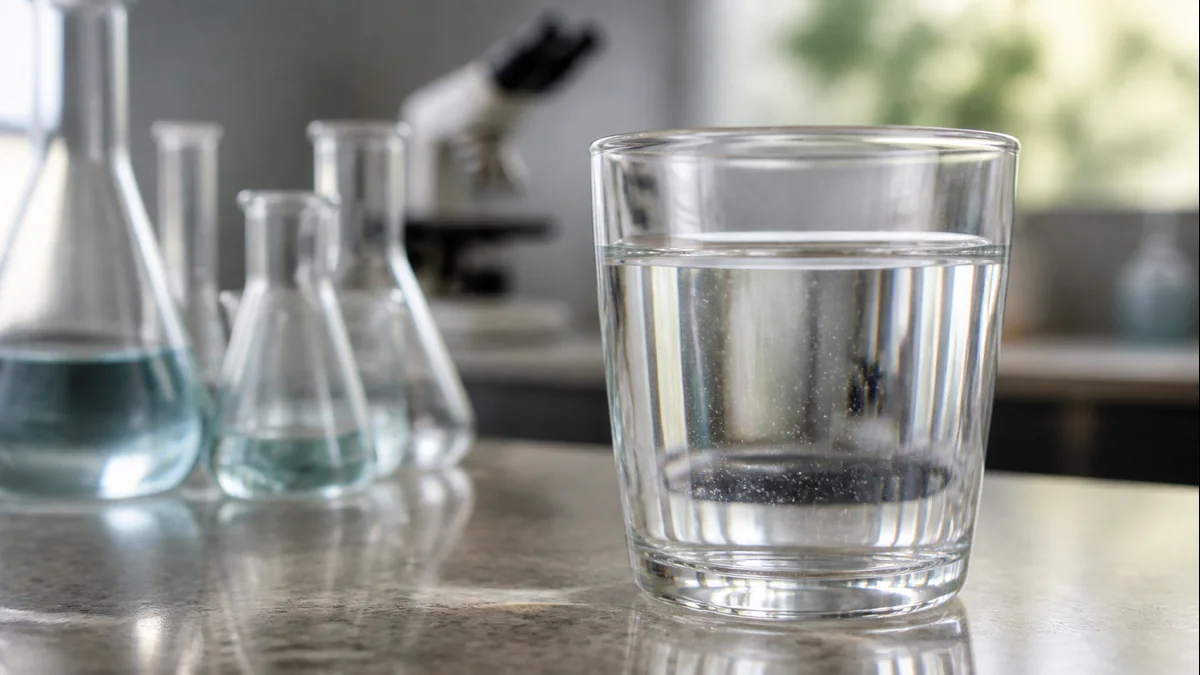
Haloacetic acids (measured as a group called HAA9) are disinfection byproducts that form when the chlorine your water utility uses to kill bacteria reacts with naturally occurring organic matter in the source water. Raleigh Water tests at 19.9 ppb HAA9; the Town of Cary tests at 27.5 ppb — a level roughly 458 times the EWG health guideline of 0.06 ppb. Whole-home activated carbon filtration is the standard way to reduce HAA9 before it reaches your tap.
Why does chlorinated tap water contain HAA9?
Every public water system in the Triangle disinfects with chlorine — it's the reason your tap water is safe to drink without boiling. But chlorine doesn't just react with bacteria. When it comes into contact with organic material already present in the source water (decaying leaves, algae, and other natural matter common in reservoir-fed systems like Jordan Lake), it forms a family of byproducts. Haloacetic acids are one of the two main groups; trihalomethanes (TTHMs) are the other. Both show up on every EWG Tap Water Database report for Raleigh and Cary because both towns disinfect the same way.
How much HAA9 is in Raleigh and Cary tap water?
Here's how the two systems compare, based on EWG Tap Water Database results for each utility:
| System | HAA9 level | TTHM level | Source |
|---|---|---|---|
| Raleigh Water (Raleigh, Garner, Knightdale, Rolesville, Wake Forest, Wendell, Zebulon) | 19.9 ppb | 21.7 ppb | EWG Tap Water Database |
| Town of Cary (Cary, Morrisville, parts of Apex) | 27.5 ppb | 38.2 ppb | EWG Tap Water Database |
| EWG health guideline | 0.06 ppb | — | EWG |
Cary's HAA9 result works out to about 458 times the EWG guideline. Raleigh's number is lower than Cary's but still far above that same 0.06 ppb benchmark — both towns are on the same list of 13 contaminants EWG flags for the Cary system, with Raleigh showing the same contaminant classes at different concentrations.
Is HAA9 in tap water actually dangerous?
This is where "legal" and "healthy" split apart. Public utilities are required to meet the EPA's legal limits, and Raleigh and Cary both do — that's not in question. The EWG guideline is a separate, stricter health-based benchmark, not a legal requirement, and it's the number municipal water keeps landing far above. So the honest answer is: your water is legally compliant and still contains disinfection byproducts at levels well past the point EWG considers health-protective. Neither fact cancels the other out — they're both true at the same time.
How do you reduce HAA9 exposure at home?
Boiling doesn't help — it doesn't remove haloacetic acids, and depending on the compound can concentrate other contaminants further. The standard approach is whole-home activated carbon filtration installed at the point where water enters the house, which treats every tap rather than just the one under your kitchen sink. Because HAA9 forms during the disinfection process itself, there's no way to keep it out of the water utilities deliver — filtration at the home is the only point where a homeowner has control.
What this means if you live in Raleigh vs. Cary
If you're on the Town of Cary system (Cary, Morrisville, parts of Apex), you're dealing with the higher end of both HAA9 and TTHM readings in the Triangle, on top of the PFAS story tied to Jordan Lake as a source. If you're on Raleigh Water — which also serves Garner, Knightdale, Rolesville, Wake Forest, Wendell, and Zebulon — your numbers are lower but still well above the health guideline. Neither system requires you to do anything; both are legal. The question is whether you want water at the legal minimum or the health-protective standard, and that's a household decision, not a compliance one.
FAQ
Is HAA9 the same as chlorine? No. HAA9 is a byproduct created when chlorine reacts with organic matter in the source water — it isn't chlorine itself, and it isn't removed the same way you'd remove chlorine taste and odor.
Does a Brita or pitcher filter remove HAA9? Basic pitcher filters are designed mainly for taste and odor (chlorine, not disinfection byproducts) and typically aren't tested or certified for HAA9 reduction. Whole-home carbon filtration is the approach built for this contaminant class.
Why does Cary have higher HAA9 than Raleigh? Both use chlorine disinfection, but source water and treatment specifics differ between the two systems, which is reflected in their different EWG-reported levels — 27.5 ppb for Cary versus 19.9 ppb for Raleigh.
Is HAA9 covered under legal drinking water standards? Yes — the EPA regulates HAA9 under legal drinking water rules, and both Raleigh and Cary meet those legal requirements. The EWG guideline referenced here is a separate, non-regulatory health benchmark set well below the legal limit.
Does boiling water remove HAA9? No. Boiling is not an effective removal method for haloacetic acids and shouldn't be relied on for this purpose.
Curious what's actually in your water before you decide what to do about it? Take our 60-second water quiz to see what a whole-home system for your address would look like.
Related reading: Is Cary, NC water safe to drink? · Does boiling water remove PFAS? · Trihalomethanes in tap water · Does activated carbon remove PFAS?
Answer nine practical questions, then request a written quote or well-water analysis.
Start My Water Analysis