
How to Remove Hard Water Stains From Granite Countertops in Knightdale, NC
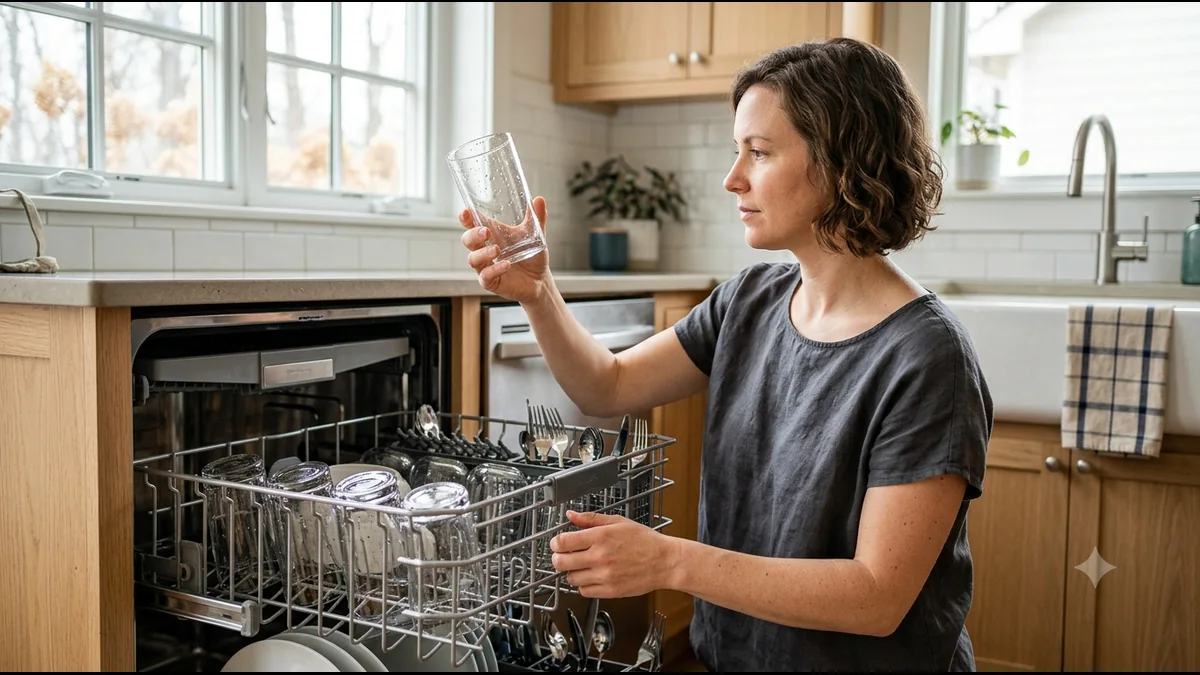
Direct answer: The chalky film around a Knightdale kitchen faucet is mineral residue left behind when splashed water evaporates off the granite, and the two most common internet fixes — vinegar/lemon and commercial rust removers — are both flagged as risky for natural stone by the Natural Stone Institute. The Institute's own routine-care recommendation is a neutral cleaner or mild dish detergent, not an acid. The cleaner long-term answer is treating the water with an all-in-one whole-home softening and carbon system so there's no mineral left to deposit in the first place.
Why Does a Chalky Film Keep Showing Up on Granite Near the Sink?
Because every splash of water that dries on the counter leaves behind whatever was dissolved in it, and the strip of granite around a faucet dries out more often than almost any other surface in the kitchen. Water itself doesn't mark granite — it's the calcium and magnesium riding along in solution that do. While the water is still liquid, those minerals are invisible. The moment it evaporates off the stone, they have nowhere to go, so they settle out as a light chalky haze. A sink apron gets splashed and air-dries dozens of times a day, far more cycles than a countertop area away from the faucet, which is exactly why the film concentrates there first.
Where Does the Film Show Up First, and Why There?
It shows up wherever splashed water sits longest before evaporating, not just wherever water lands. On a typical Knightdale kitchen counter, three spots carry the heaviest buildup:
- Directly around the faucet base, where a slow drip or residual bead sits against the stone between uses.
- Along the sink's front apron, where hand-washing splashback lands and often isn't wiped immediately.
- Under a soap dispenser or near a drying rack, where standing moisture lingers longest.
Each of those spots gets more drying cycles, or slower ones, than the open counter — so the haze builds there before it's visible anywhere else.
Is Vinegar or Lemon Juice Safe to Use on Granite?
Not according to the Natural Stone Institute's own guidance, even though granite isn't the stone type most at risk. The Institute states that "products containing lemon, vinegar or other acids may dull or etch calcareous stones" — calcareous meaning marble, limestone, and travertine, stones built from calcium carbonate. Granite isn't calcareous, so that specific etching warning targets a different category of countertop. But the Institute doesn't carve out an exception recommending acid for granite either — its routine-care guidance for natural stone generally calls for "a neutral cleaner, stone soap, or a mild liquid dishwashing detergent and warm water," not vinegar or lemon. The acid-based descaling advice written for glass or porcelain fixtures simply isn't stone-care advice.
What About Citrus Degreasers and Commercial Rust Removers?
Citrus degreasers fall under the same acid caution as vinegar and lemon — formulated for cutting grease on non-stone surfaces, not for granite. Commercial rust removers are a firmer no. The Natural Stone Institute is specific here: these products "contain trace levels of hydrofluoric acid (HF). This acid attacks silicates in addition to other minerals," and "all stones, including granite and quartzite, will be attacked if exposed to HF." That's a granite-specific warning — a rust-remover reached for because of an orange-tinged water spot can etch the granite it's meant to clean.
What Does the Natural Stone Institute Actually Recommend for Routine Cleaning?
A neutral cleaner, stone soap, or a mild liquid dishwashing detergent and warm water — that's the Institute's stated routine-care standard for natural stone, granite included. For a stubborn soap-scum ring near the faucet, the Institute points to a non-acidic soap scum remover or a diluted ammonia solution, not anything acid-based. None of that is an aggressive regimen; it's mild, low-effort, and it's what keeps a wipe-down from becoming an etching risk.
Does Sealing Granite Stop the Staining for Good?
No — sealing reduces the risk, it doesn't eliminate it. As the Natural Stone Institute puts it, "sealing the stone does not make the stone stain proof, it makes it more resistant to staining." A sealed countertop resists absorbing liquids better than an unsealed one, but it's still a surface minerals can deposit on once splashed water evaporates off the top. Sealing is stone maintenance, not a substitute for reducing what's in the water landing on it.
DIY Wipe-Downs vs. Treating the Water at the Source
| Wiping/cleaning the counter | Whole-home softening and carbon system | |
|---|---|---|
| What it addresses | One splash-and-dry cycle at a time | The mineral content in the water supplying every fixture |
| Product risk | Vinegar/lemon and rust removers carry acid-etch and HF risk per the Natural Stone Institute | None — no acid ever touches the stone |
| Effort required | Ongoing, several times a day near a well-used faucet | One install, then automatic |
| Coverage | Kitchen counter only, and only when done consistently | Kitchen counter, bathroom fixtures, dishwasher, water heater, washer |
| Chlorine/chloramine taste at the tap | Not affected | Reduced by the carbon stage |
Is Knightdale's Water Actually Hard Enough to Cause This?
Yes, enough to explain a recurring chalky film, even though Knightdale's water isn't in the "hard" band on the WQA/Hach scale. Knightdale is served by Raleigh Water — the same utility supplying Raleigh, Garner, Rolesville, Wake Forest, Wendell, and Zebulon — sourced from Falls Lake and treated at the E.M. Johnson Water Treatment Plant, which comes in around 1.6 gpg. That's classified "slightly hard" on the Water Quality Association scale the Hach Total Hardness Test Kit, Model 5-B, uses. Triangle Waterworks' own testing across the service area measures 1.6 to 3.7 gpg by ZIP code, spanning slightly hard up to moderately hard. "Slightly hard" isn't mineral-free — it's a real, cumulative amount of calcium and magnesium, and a well-used sink area is exactly the surface that shows it first. Where a specific Knightdale address falls in that range is worth measuring rather than assuming.
What About Chlorine Taste or Smell at the Same Sink?
That's a separate issue from the mineral film, handled by a different stage of treatment. Raleigh Water normally disinfects with chloramine, which the City describes as having no taste or odor associated with it, and once a year converts to free chlorine only, on the N.C. Department of Environmental Quality's recommendation, to flush the distribution system — timing shifts year to year, so check the City's own announcement rather than a fixed date. Raleigh Water also carries documented disinfection byproducts: HAA9 at 19.9 ppb and TTHM at 21.7 ppb, both compliant with EPA limits. EWG's guidelines are a separate, stricter, non-regulatory benchmark, not a legal limit. None of that is addressed by softening resin; that's what the carbon stage in an all-in-one system handles.
What Actually Stops the Film From Coming Back?
An all-in-one whole-home system — softening resin paired with carbon filtration in a single install — addresses both halves of what's happening at a Knightdale kitchen counter:
- Softening resin removes calcium and magnesium by ion exchange before water ever reaches the faucet, so there's nothing left to deposit when a splash on the granite dries. That stops the haze at the faucet base and sink apron, and protects the water heater, dishwasher, and washing machine from the same cumulative buildup.
- Carbon filtration reduces chlorine and chloramine taste and odor and addresses disinfection byproducts — the part softening resin never touches.
Because it's one system rather than two, every fixture gets the same treated water, not just the kitchen sink. Pricing depends on your home's plumbing and where your address falls in the 1.6–3.7 gpg range, which is why it isn't published here — a free water analysis is how a system gets sized and quoted. For comparison, national big-brand installers commonly quote $6,000 to $12,000 for whole-home coverage.
For more on the specific setup for Knightdale homes, see water treatment in Knightdale, NC. The same mineral buildup shows up in other fixtures — see dishwasher spray arms clogged by hard water in Knightdale and the white residue on faucets and glasses throughout a house. For the source numbers behind local hardness, see Raleigh water hardness, and for what softened water does for appliances specifically, see does soft water protect appliances in Knightdale.
See What's Coming Out of Your Knightdale Tap
Take the 60-second water quiz to see which all-in-one system fits your home, or book a free water analysis to find out exactly where your address falls in the 1.6–3.7 gpg range Triangle Waterworks measures across Knightdale and the surrounding area.
Frequently Asked Questions
I just moved into a Knightdale house with granite counters, and there's already a white ring around the faucet — is that from the previous owners not cleaning, or is it the water? It's almost certainly the water, not neglect. A chalky ring at the faucet base builds up from ordinary splashback drying over time, the same mineral-deposit process that happens in any home on Raleigh Water. It's cosmetic, not damage, and a mild neutral cleaner will lift the surface film — but it will keep reforming until the water itself is treated.
I grabbed a lemon-scented granite spray at the store thinking it was made for stone — should I be worried? Check the label for acid content before regular use. The Natural Stone Institute's routine-care recommendation is a neutral cleaner, stone soap, or mild dish detergent — not a lemon or vinegar-based product — so a neutral formula is the safer default even though granite isn't the stone type most vulnerable to etching.
Is a rust-colored spot near my sink actually rust, or could it be something else? It could be either mineral residue or actual rust, so it's worth looking closely before reaching for a rust remover. Commercial rust removers contain trace hydrofluoric acid, which the Natural Stone Institute states will attack granite and quartzite alike — a product meant to fix one spot can etch the surrounding stone.
Does sealing my granite counters mean I don't have to worry about hard water spots anymore? No — sealing makes the stone more resistant to staining, not stain proof, per the Natural Stone Institute. A sealed counter still gets a mineral film when splashed water evaporates on top of it; sealing is about reducing absorption, not about stopping surface deposits from forming.
Will a whole-home softening system actually reach my kitchen counter, or does it only treat the water heater and appliances? It reaches every fixture in the house, including the kitchen faucet, because softening resin treats the water supply at the point it enters your home rather than at a single appliance. The same treated water that protects your water heater and dishwasher is what comes out of the tap and splashes onto the counter.
How do I know if my specific Knightdale address is on the higher or lower end of that 1.6 to 3.7 gpg range? The only way to know for a specific address is to test it, since the range varies by ZIP code across the service area. A free water analysis reads your actual tap, and for testing in the meantime, the Hach Total Hardness Test Kit, Model 5-B, reports results in grains per gallon on the same scale Triangle Waterworks uses.
Answer nine practical questions, then request a written quote or well-water analysis.
Start My Water Analysis