
How to Remove Hard Water Stains From a Stainless Steel Sink in Holly Springs, NC
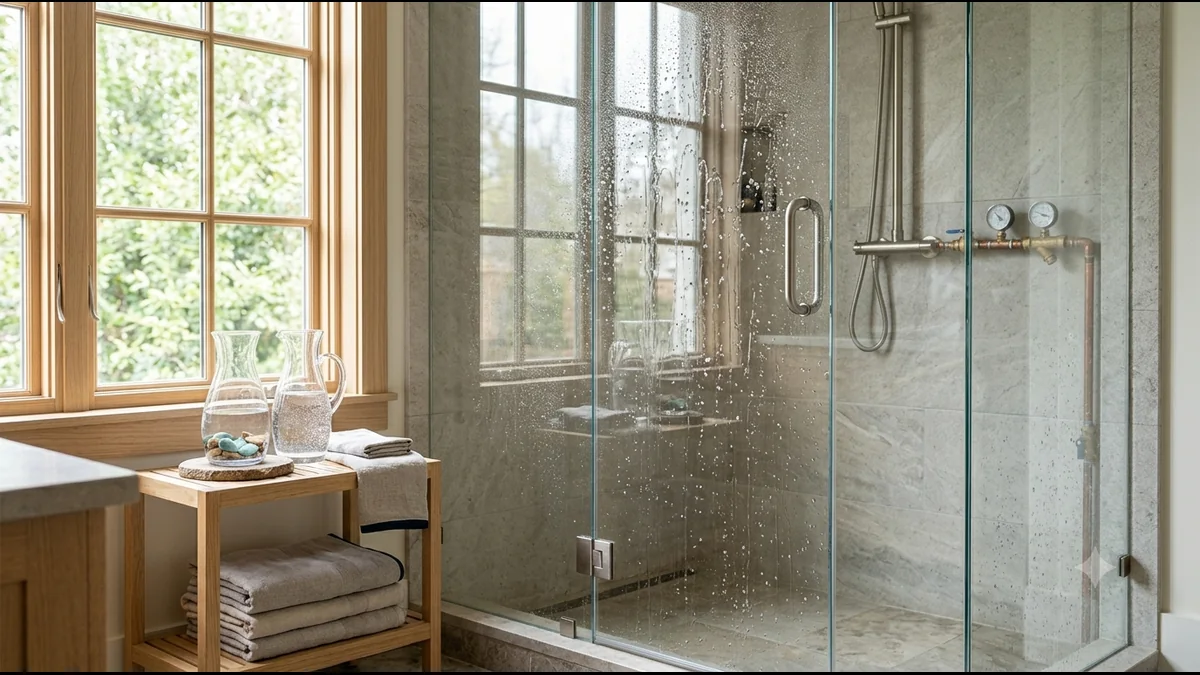
Direct answer: A mix of white vinegar and water, or a stainless-safe cleaner, will lift the chalky film off a stainless steel kitchen sink — but it comes back because the sink is used and dried dozens of times a day, and each cycle deposits more of whatever minerals were in that water. Holly Springs is supplied by Harnett Regional Water from the Cape Fear River, and no hardness figure has been published for that specific supply, so the only way to know how much is in your water is to test it. An all-in-one whole-home softening and carbon system removes the minerals before they reach the faucet, so there's nothing left to deposit.
How Do I Remove Hard Water Stains From a Stainless Steel Sink?
A 50/50 solution of white vinegar and water, applied with a soft cloth and left for a few minutes before rinsing, dissolves the mineral film without scratching the finish. For a heavier ring around the drain, a paste of baking soda and water followed by a vinegar rinse works it loose without abrasive scrubbing. Wipe in the direction of the steel's grain and dry the basin completely afterward — leaving it wet just restarts the cycle. Skip anything abrasive; scouring pads dull the finish and create scratches where the next film gets an easier foothold.
Why Does the Sink Look Cloudy or Spotted Again a Few Days Later?
Because cleaning removes the film that's already formed, but does nothing about the water about to form the next one. Water itself doesn't stain — it's what's dissolved in it. As the sink air-dries after each rinse, any calcium and magnesium it was carrying stays behind once the water evaporates. A kitchen sink dries out more times a day than almost any other surface in the house, so even a modest mineral level compounds fast. Wiping and vinegar treat the symptom one cycle at a time; neither touches what's in the water coming out of the tap.
Where Does the Film Build Up Fastest, and Why?
It builds up fastest wherever water sits or drips longest before it fully evaporates, not just wherever it touches the steel. Three spots take the brunt of it:
- Around the drain, where water pools in the lowest point of the basin and evaporates slowest.
- At the base of the faucet, where a residual bead or slow drip sits against the metal between uses.
- Along the rim and backsplash, where splashed water collects in seams that don't get wiped as often as the open basin.
Each spot gets more drying cycles — or slower ones — than the flat center of the sink, which is why the ring or haze shows up there first even in a kitchen that's cleaned regularly.
Is Holly Springs' Water Hard Enough to Cause This?
There's no published number to answer that with certainty, which is itself the point — you can't look up a Holly Springs hardness figure the way you can for some neighboring towns. Holly Springs is supplied by Harnett Regional Water, drawing from the Cape Fear River, a surface-water source. No verified total hardness figure has been published for that supply, so borrowing a nearby town's number would be a guess, not a fact. What Triangle Waterworks does know, from its own testing across the wider Triangle service area, is that measured hardness runs 1.6 to 3.7 gpg by ZIP code — slightly hard to moderately hard on the WQA/Hach scale. That's general Triangle context, not a Holly Springs figure, and it doesn't substitute for one. A stainless sink that spots and clouds repeatedly is consistent with hardness in that kind of range, but the only way to know what's actually in a specific Holly Springs kitchen is to test that address.
How Do I Find Out What's Actually in My Water?
Test it directly, since no published figure exists for the Cape Fear River supply Holly Springs draws from. Two ways to do that:
- At-home test: the Hach Total Hardness Test Kit, Model 5-B (Drop Count Titration) reads out in grains per gallon on the same Water Quality Association scale Triangle Waterworks uses — soft, slightly hard, moderately hard, hard, very hard. Inexpensive, real number in minutes.
- Free water analysis: a technician tests your actual tap, not a town-wide average, and sizes an all-in-one system to what's really coming out of your faucet.
Because Holly Springs has no published hardness figure, there's no plant average to compare against — the number that matters is the one from your own kitchen.
Cleaning the Sink vs. Treating the Water
| Cleaning the sink (vinegar, baking soda, commercial cleaner) | Whole-home softening and carbon system | |
|---|---|---|
| What it addresses | The film that's already formed | The minerals in the water before they reach any fixture |
| Effort required | Repeated — every few days to weekly | One install, then automatic |
| Coverage | Kitchen sink only, and only where applied | Kitchen sink, bathroom fixtures, dishwasher, water heater, washer |
| Risk to the finish | Abrasive products can scratch stainless over time | No scrubbing needed |
| Chlorine/disinfection taste or odor | Not affected | Reduced by the carbon stage |
What About Taste or Odor at the Kitchen Faucet?
That's a separate issue from the mineral film, handled by a different stage of treatment. Surface-water systems like the one supplying Holly Springs disinfect the water before it reaches your tap, generally with a chlorine-based residual carried through the distribution system to keep the water safe until it reaches your faucet. Any resulting taste or odor is a carbon-filtration problem, not a softening one — softening resin removes calcium and magnesium and does nothing for taste or dissolved compounds. That's exactly what the carbon stage of an all-in-one system is built to address, independent of whatever the hardness turns out to be.
What Actually Stops the Stains From Coming Back?
An all-in-one whole-home system — softening resin paired with carbon filtration in a single install — addresses both halves of what shows up at a Holly Springs kitchen sink:
- Softening resin removes calcium and magnesium by ion exchange before water reaches the faucet, so there's nothing left to deposit once the basin dries. That stops the film at the drain, faucet base, and rim, and protects the water heater, dishwasher, and washer from the same buildup over time.
- Carbon filtration addresses taste and odor from disinfection — what softening resin was never designed to touch.
Because it's one system treating the whole house, every fixture gets the same water — not just the kitchen sink getting occasional attention with a vinegar rag. Pricing depends on your home's plumbing and what a test of your water shows, which is why no number is published here — a free water analysis is how a system gets sized and quoted. For comparison, national big-brand installers commonly quote $6,000 to $12,000 for whole-home coverage.
Permits for a Whole-Home Install in Holly Springs
Holly Springs administers its own plumbing permits rather than going through Wake County Permits & Inspections, which covers unincorporated Wake County and a few specific towns elsewhere in the county. A whole-home installation is plumbing work and needs a permit either way; a licensed installer pulls it and schedules the inspection.
Frequently Asked Questions
I just moved into a Holly Springs home and the stainless sink already has a permanent-looking haze around the drain — did the previous owners damage it? No — that haze is mineral film built up over time from water drying on the surface repeatedly, and it's cosmetic rather than a defect in the steel. A vinegar-and-water soak usually lifts most of it; if a faint haze remains, ongoing treatment of the water is what keeps it from rebuilding.
My glasses come out spotty from the dishwasher and my sink stains the same week I clean it — are those related? Yes, they're the same cause showing up on two surfaces. Both come from dissolved minerals left behind as water evaporates or dries, whether that's on a basin or on glass fresh out of the dishwasher rack. Softening the water addresses both at once, since it removes the minerals before they reach either surface.
Is vinegar safe to use on a stainless steel sink regularly? Yes, diluted white vinegar is a standard, safe way to clean stainless steel and won't damage the finish when rinsed off afterward and not left to sit indefinitely. It's the repeated need for it — not the product itself — that signals the water is the actual source of the problem.
Does a cloudy sink mean my plumbing is being damaged somewhere I can't see? Not necessarily, but it's worth taking seriously as an early signal. The film on a sink is cosmetic on its own, but the same minerals are also depositing inside your water heater and appliance lines, out of sight — buildup that's cumulative and harder to reverse than a sink you can wipe down.
How do I know if my specific address in Holly Springs has hard water, since I can't find a published number? Test it — that's the honest answer, since Holly Springs' Cape Fear River supply doesn't have a published hardness figure the way some neighboring towns do. A Hach Total Hardness Test Kit, Model 5-B gives a quick at-home reading in grains per gallon, and a free water analysis gives you the exact number and a system sized to it.
Will a whole-home system fix the sink specifically, or is it more for laundry and appliances? It fixes the sink along with everything else, since softening resin treats the water supplying every fixture, not just the ones people usually associate with hard water. The same treated water reaching your washer also reaches the kitchen faucet.
See What's in Your Holly Springs Water
Take the 60-second water quiz to see which all-in-one system fits your home, or book a free water analysis for an actual reading at your address — since Holly Springs has no published figure, that test is the real answer. See water treatment in Holly Springs and how to test tap water hardness in Holly Springs for more on the supply. The same buildup shows up elsewhere — see hard water spots on hardwood floors in Holly Springs and white residue on faucets and glasses. Ready to book? Prepping your home for a water softener install in Holly Springs covers what to have ready.
Answer nine practical questions, then request a written quote or well-water analysis.
Start My Water Analysis