
How Do You Clean Hard Water Stains Off Stainless Steel Appliances in Clayton, NC?
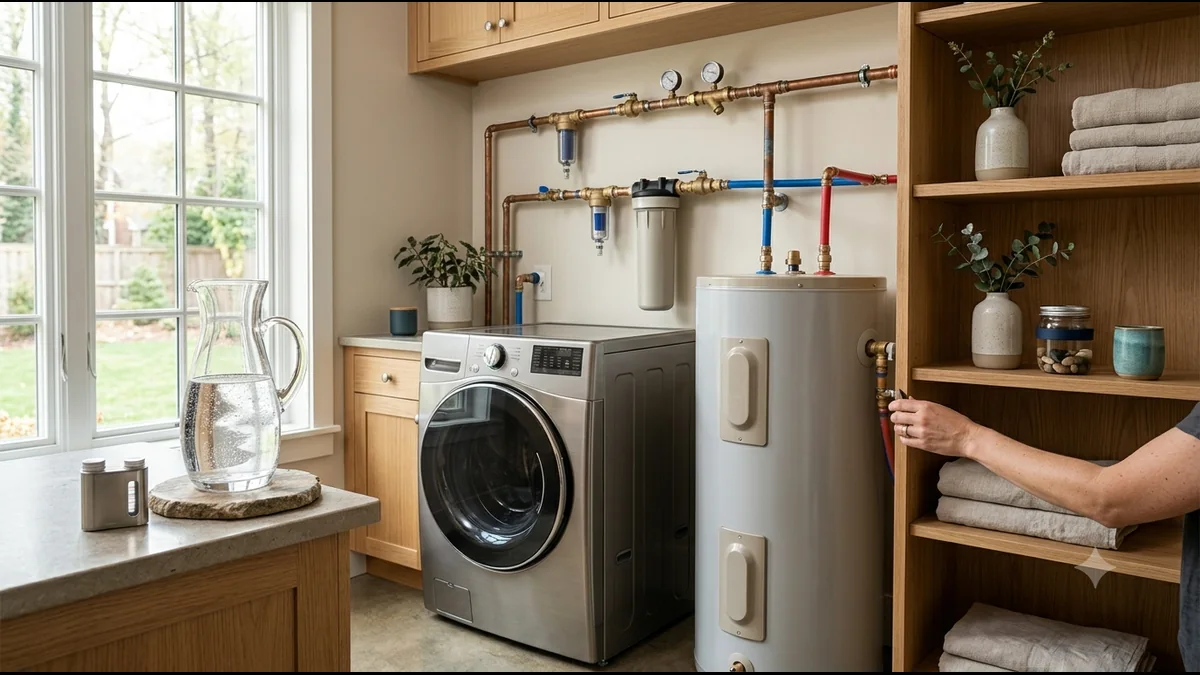
Direct answer: Wiping a stainless fridge, dishwasher, or range only removes the water that's already there — the next splash or hand-wet touch leaves fresh mineral behind as it dries, and the spots return within hours. The same water coats your dishwasher's interior tub and racks every cycle, not just the exterior panels. Clayton's own water report publishes no hardness figure, so guessing isn't the fix — an all-in-one whole-home softening and carbon system, sized after a free water analysis, treats the water itself instead of chasing spots appliance by appliance.
Why Do Hard Water Stains Keep Coming Back on Stainless Steel Appliances?
Because every wet touch on a stainless surface leaves a little mineral behind once it dries, and a kitchen full of appliances gets touched wet more times a day than almost any other surface in the house. Water itself doesn't stain anything — it's what's dissolved in it. Calcium and magnesium ride along invisibly while water is still liquid. A splash on the fridge door while filling a glass, a wet hand on the dishwasher handle, condensation dripping down the range hood — each leaves a thin film of water on the panel, and when that film evaporates, the minerals it carried have nowhere to go but the surface. Stainless steel shows this worse than most materials not because it reacts with the minerals, but because the film breaks up a reflective brushed finish, so even a light haze is visible under kitchen lighting where it would go unnoticed on a matte surface.
Why Doesn't Wiping the Fridge, Dishwasher, and Range Down Fix It?
Wiping removes the water before it evaporates, but it doesn't stop the next splash from starting the cycle over. Drying a panel right after a spill or a wet-hand touch is genuinely useful — no residue forms from that particular contact. But appliance doors and panels in an active kitchen get touched wet dozens of times between deep cleanings, and each one is a fresh chance for water to evaporate and deposit minerals before anyone notices. That's why spots reappear near handles, around the fridge's water and ice dispenser, and along the top edge of the dishwasher door even in kitchens that get wiped down regularly. Wiping treats each contact one at a time; it never touches the mineral content in the water causing all of them.
Is the Inside of My Dishwasher Getting the Same Buildup?
Yes — and it's the higher-stakes version of the same problem, because it happens on a schedule you can't see or wipe away. Every dishwasher cycle runs the same water across the interior tub, the racks, the spray arms, and the heating element, over and over, for years. That's not an occasional splash — it's full immersion, every load. Mineral deposits that accumulate on interior components and heating elements over repeated cycles are part of why dishes and glassware can come out with a persistent film even when a cycle ran normally, and why interior surfaces can look chalky or dulled compared to when the machine was new. A stained exterior panel is cosmetic. A dishwasher that's been running mineral-heavy water across its heating element and internal parts for years is a machine that costs real money to replace — the same mechanism, just on equipment instead of a door panel.
Does Clayton's Water Explain the Stains?
There's no published hardness number to point to for Clayton, and that absence is itself informative. Clayton doesn't operate its own water treatment plant — per Clayton's 2025 annual water quality report, the town purchases treated surface water sourced from the Neuse River, supplied by Johnston County West. Clayton's 2025 report doesn't publish a total hardness figure at all, and the town issues more than one system report covering different parts of town, so there isn't even a single number to borrow from a neighboring supply. That means the only way to know what's actually depositing on your appliances is to test water at your own address — and that test is free.
For general context only — not a Clayton-specific figure — Triangle Waterworks' own testing across its wider service area measures roughly 1.6 to 3.7 gpg, a range that spans slightly hard to moderately hard on the Water Quality Association scale the Hach Total Hardness Test Kit, Model 5-B, uses. That range describes what shows up across the area generally; it says nothing specific about a Clayton tap. Whatever the number turns out to be at your address, calcium and magnesium accumulate the same way regardless of the exact reading — the mechanism doesn't change, only the pace.
Wiping Appliance Surfaces vs. Treating the Water
| Wiping panels and interiors after use | Whole-home softening and carbon system | |
|---|---|---|
| What it addresses | One wet-and-dry cycle at a time | The mineral content in the water supplying every fixture and appliance |
| Effort required | Ongoing, multiple times a day | One install, then automatic |
| Coverage | Whatever surface you just wiped | Fridge, dishwasher (interior and exterior), range, water heater, bathroom fixtures |
| Dishwasher interior and heating element | Not reachable by wiping at all | Minerals removed before they ever reach the machine |
| Chlorine/chloramine taste and odor | Not affected | Reduced by the carbon stage |
What Actually Stops the Stains From Coming Back?
An all-in-one whole-home system — softening resin paired with carbon filtration in a single install — addresses both what's landing on your stainless panels and what's cycling through your dishwasher:
- Softening resin removes calcium and magnesium by ion exchange before water reaches any faucet, appliance line, or dishwasher supply, so there's nothing left to deposit when a splash dries or a cycle runs. That protects stainless exteriors, the dishwasher's interior tub and heating element, the water heater, and the washing machine from the same cumulative buildup.
- Carbon filtration handles chlorine and chloramine taste and odor, plus disinfection byproducts — the part softening resin never touches.
Because it's one system treating water at the source rather than a rag treating one surface at a time, every appliance in the kitchen gets the benefit automatically. Pricing depends on your home's plumbing and what a free water analysis finds at your specific address, which is why it isn't published here. For comparison, national big-brand installers commonly quote $6,000 to $12,000 for whole-home coverage.
If you're renting or planning ahead of an HOA-governed install, see HOA rules for water softener installation in Clayton, NC. For how the same mineral buildup affects a major appliance's warranty, see does hard water void your water heater warranty in Clayton, NC. For the same film showing up on faucets and glassware elsewhere in the house, see white residue on faucets and glasses, and for the longer-term appliance case, see does soft water make appliances last longer and hard water's cost to appliances over time.
Find Out What's Actually in Your Clayton Tap
Take the 60-second water quiz to see which all-in-one system fits your home, or book a free water analysis to find the number that actually applies to your address — since Clayton's own report doesn't publish one.
Frequently Asked Questions
I just moved into a Clayton house with a stainless fridge, and there are already cloudy spots around the water and ice dispenser — is that normal? Yes. The dispenser area gets wet contact every time someone fills a glass or gets ice, and each time that water evaporates it leaves behind whatever calcium and magnesium it carried. It's a high-frequency contact point, so it tends to show buildup earlier and more visibly than the rest of the door.
My dishwasher interior looks chalky and dishes come out with a film even though I use rinse aid — what's going on? Rinse aid is designed to help water sheet off dishes so it dries faster, but it doesn't remove calcium and magnesium from the water itself. If minerals are present, they can still deposit on interior surfaces and glassware as the water evaporates during the dry cycle, which is a water-hardness issue rather than a detergent or rinse-aid problem.
Is stainless steel more likely to stain from hard water than other appliance finishes? No — any finish exposed to the same water would show the same mineral residue, since the deposit comes from what's dissolved in the water, not the material underneath it. Stainless just shows it more clearly because the film disrupts a reflective brushed surface, making even a light haze noticeable under kitchen lighting.
Does this mean my Clayton water is unsafe to drink? No. Nothing here relates to safety — mineral hardness and cosmetic spotting are separate from water safety, and Clayton's supply is subject to the same regulatory compliance standards as any municipal system. This is about buildup on surfaces and inside appliances over time, not about whether the water is safe.
Why can't you just tell me Clayton's hardness number like you do for other towns? Because Clayton's 2025 annual water quality report doesn't publish one. Clayton buys treated surface water from the Neuse River through Johnston County West rather than running its own plant, and its report covers more than one system without a single hardness figure attached to either — so there's genuinely nothing to look up, only something to test.
Will a whole-home system fix my dishwasher's interior buildup, or only the stains I can see on the outside? Both, because softening resin treats the water supplying every line in the house, including the dishwasher's water supply, not just the surfaces you wipe. The same treated water that stops spotting on your fridge and range door also runs through every dishwasher cycle, so the interior tub, racks, and heating element stop accumulating new mineral buildup as well.
Answer nine practical questions, then request a written quote or well-water analysis.
Start My Water Analysis