
Why Does My Stainless Steel Sink Keep Getting Hard Water Spots in Zebulon, NC?
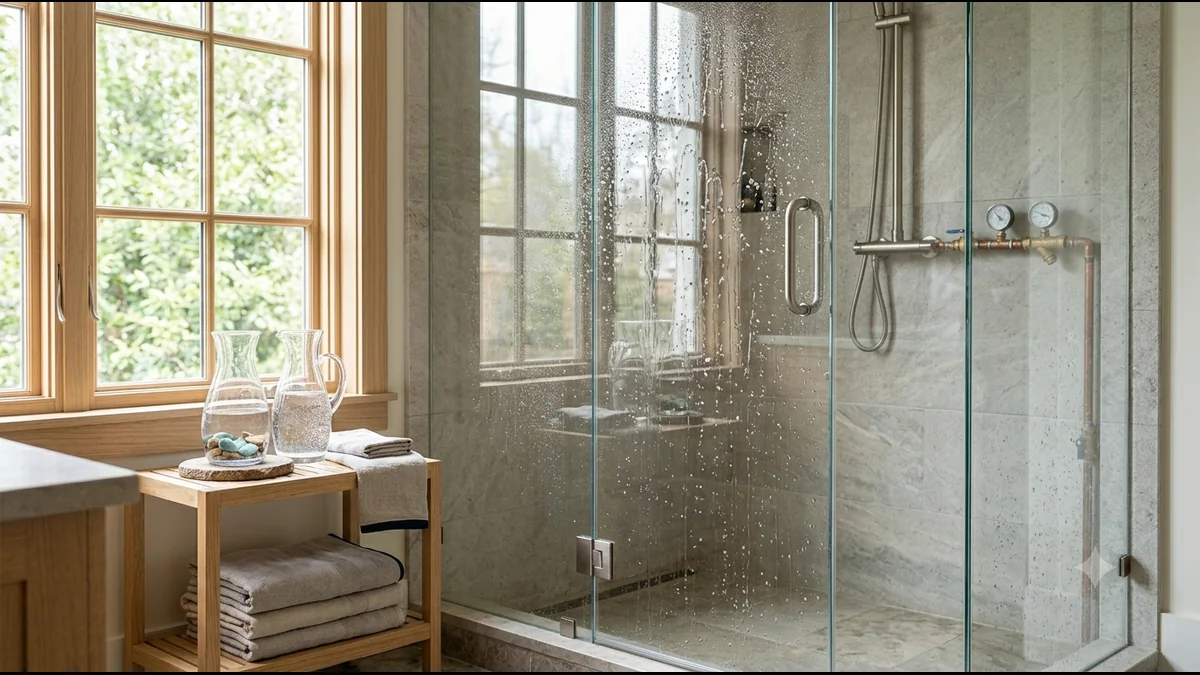
Direct answer: Every time your sink air-dries, the water evaporates and leaves the calcium and magnesium it carried behind as a chalky white film — and a kitchen sink dries out more times a day than almost any other surface in the house. Zebulon runs on Raleigh Water, which Triangle Waterworks measures at roughly 1.6 to 3.7 gpg by ZIP code, a slightly hard to moderately hard range on the WQA/Hach scale. Wiping resets the clock, but the next rinse starts it again — an all-in-one whole-home softening and carbon system treats the water itself so the film stops forming.
Why Does My Stainless Steel Sink Keep Getting Hard Water Spots?
Because stainless steel is a wet-and-dry surface many times over in a single day, and every drying cycle leaves a little residue behind. Water itself doesn't stain anything — it's what's dissolved in it. Calcium and magnesium ride along in solution, invisible while the water is still liquid. The moment that water evaporates off the basin, those minerals have nowhere to go, so they settle out as a fine chalky film on the metal. A sink gets rinsed and left to air-dry dozens of times a day, far more chances to build than a surface that only dries once or twice. That's the whole mechanism — no chemical reaction with the steel itself, just mineral left over from water that's gone.
Where Do the Spots Show Up First, and Why There?
They show up first wherever water sits longest before it evaporates, not just wherever water touches. Three spots on a typical kitchen sink dry more slowly than the rest of the basin, so they carry the heaviest buildup:
- Around the drain, where water pools in the low point of the basin and takes longest to fully evaporate.
- At the base of the faucet, where a slow drip or residual bead sits against the metal between uses.
- Along the rim, where splashed water collects in the seam and isn't wiped away as often as the open basin.
Each area gets more drying cycles, or slower ones, than the flat center of the sink — so the film layers up there first and is usually the first place a chalky ring becomes visible.
Is It the Stainless Steel That's the Problem, or the Water?
It's the water. Stainless steel doesn't react with calcium or magnesium to cause staining — it's simply the surface the minerals sit on once the water that carried them is gone. A glass, ceramic, or stainless sink would all show the same white residue under identical water, because the source is what's dissolved in the water, not what the basin is made of. Stainless just shows it more visibly, since the film sits against a reflective surface where even a light haze breaks up the shine. That's a visibility difference, not a chemistry difference — the sink isn't at fault, and it isn't wearing out the way plumbing and appliances can.
Does Wiping the Sink After Every Use Actually Fix It?
Wiping helps in the moment, but it resets the clock rather than stopping the cause. Drying the basin right after use removes the water before it can evaporate on its own, so no residue forms from that rinse — genuinely useful upkeep. But the next time the faucet runs, the same minerals are back, and the same evaporate-and-deposit cycle starts over. A kitchen sink gets used too many times a day for wiping after every rinse to be realistic for most households, which is why the film reappears at the drain and faucet base even where someone is fairly diligent. Wiping treats each drying cycle one at a time; it doesn't touch the mineral content causing all of them.
Wiping the Sink vs. Treating the Water
| Wiping the basin dry after use | Whole-home softening and carbon system | |
|---|---|---|
| What it addresses | One evaporation cycle at a time | The mineral content in the water supplying every fixture |
| Effort required | Ongoing, multiple times a day | One install, then automatic |
| Coverage | Kitchen sink only, and only when done consistently | Kitchen sink, bathroom fixtures, dishwasher, water heater, washer |
| Buildup at the drain and faucet base | Slows but doesn't stop, since minerals return with every rinse | Minerals removed before they reach the tap |
| Chlorine/chloramine taste and odor | Not affected | Reduced by the carbon stage |
Is Zebulon's Water Actually Hard Enough to Cause This?
It carries enough calcium and magnesium to explain the film, even though Zebulon's water isn't in the "hard" band on the WQA/Hach scale. Zebulon is on Raleigh Water, sourced from Falls Lake and treated at the E.M. Johnson Water Treatment Plant, which comes in at around 1.6 gpg — classified "slightly hard" on the Water Quality Association scale the Hach Total Hardness Test Kit, Model 5-B, uses. Triangle Waterworks' own testing across the service area measures a range of 1.6 to 3.7 gpg by ZIP code, spanning slightly hard up to moderately hard. "Slightly hard" doesn't mean mineral-free — it's a real, cumulative amount of calcium and magnesium, and a sink is one of the highest-frequency wet-dry surfaces in the house, which is why it tends to show the deposit first. Where a specific Zebulon address falls in that range is worth measuring rather than assuming.
What About the Water's Smell or Taste at the Kitchen Sink?
That's a separate issue, handled by a different stage of treatment. Raleigh Water normally disinfects with chloramine, which the City describes as having no taste or odor associated with it, and once a year converts to free chlorine on the N.C. Department of Environmental Quality's recommendation to flush the distribution system — timing shifts year to year, so check the City's own announcement rather than a fixed date. Raleigh Water also carries documented disinfection byproducts: HAA9 at 19.9 ppb and TTHM at 21.7 ppb, both compliant with EPA limits. EWG's guidelines are a separate, stricter non-regulatory benchmark, not a legal limit — the two are different bars, not to be confused. Softening resin does nothing about taste, odor, or byproducts; that's what the carbon stage in an all-in-one system is for.
What Actually Stops the Spots From Coming Back?
An all-in-one whole-home system — softening resin paired with carbon filtration in a single install — addresses both halves of what's happening at a Zebulon kitchen sink:
- Softening resin removes calcium and magnesium by ion exchange before water reaches the faucet, so there's nothing left to deposit when the basin dries. That stops the chalky film at the drain, faucet base, and rim, and protects the water heater, dishwasher, and washing machine from the same cumulative buildup.
- Carbon filtration reduces chlorine and chloramine taste and odor and addresses disinfection byproducts — the part softening never touches.
Because it's one system rather than two, every fixture gets the same treated water, not just the kitchen sink. Pricing depends on your home's plumbing and where your address falls in the 1.6–3.7 gpg range, which is why it isn't published here — a free water analysis is how a system gets sized and quoted. For comparison, national big-brand installers commonly quote $6,000 to $12,000 for whole-home coverage.
For what a system costs installed in Zebulon, see water softener cost in Zebulon, NC. The same buildup shows up in other fixtures — see toilet fill valves in Zebulon and the white residue on faucets and glasses throughout a house. For the source numbers behind Raleigh Water's hardness, see Raleigh water hardness, and for what softened water does elsewhere in the kitchen, see how soft water leaves dishes and glasses spotless.
See What's Coming Out of Your Zebulon Tap
Take the 60-second water quiz to see which all-in-one system fits your home, or book a free water analysis to find out exactly where your address falls in the 1.6–3.7 gpg range Triangle Waterworks measures across Zebulon and the surrounding area.
Frequently Asked Questions
I scrub the chalky ring off my sink every weekend and it's already back by Wednesday — is that normal? Yes, and it's what you'd expect from mineral residue rather than dirt or grime. Every time the basin dries after a rinse, any calcium and magnesium in the water gets left behind again, so scrubbing removes the current layer without touching what's causing it to reappear. Treating the water is what stops the cycle instead of resetting it each weekend.
I just moved to Zebulon from a house with a softener, and my new stainless sink already has white spots around the drain — what's different? Your old house was likely removing calcium and magnesium before water reached any fixture, so that sink never had minerals to deposit. Zebulon's water carries a real, measurable amount of hardness even though it's classified slightly hard rather than hard, and without a softener those minerals settle out every time your new sink air-dries.
Is it worse for stainless steel specifically, or would any sink material show the same thing? Any sink material under the same water would show the same white residue, since the minerals come from the water, not the metal. Stainless just shows it more clearly because the film breaks up the reflective finish, making even a light haze noticeable.
Does the spotting mean my sink is being damaged, or is it just cosmetic? On its own, the film on a sink is cosmetic — it doesn't corrode stainless steel the way scale affects internal plumbing or a water heater over years. It's still worth addressing because the same minerals causing the sink spots are building up inside your appliances at the same time, just less visibly.
Will a whole-home system stop the spots on my sink, or only help things like laundry and dishes? It addresses the sink along with everything else, because softening resin removes calcium and magnesium from the water supplying the whole house. The same treated water that stops soap curd on dishes and glasses reaches your kitchen faucet, so the sink gets the same benefit automatically.
How do I know if my Zebulon address is on the higher or lower end of that hardness range? The only way to know for a specific address is to test it, since the range varies by ZIP. A free water analysis reads your actual tap, and for at-home testing in the meantime, the Hach Total Hardness Test Kit, Model 5-B, reports results in grains per gallon on the same scale Triangle Waterworks uses.
Answer nine practical questions, then request a written quote or well-water analysis.
Start My Water Analysis