
How to Remove Hard Water Stains From Shower Tile Grout in Zebulon, NC
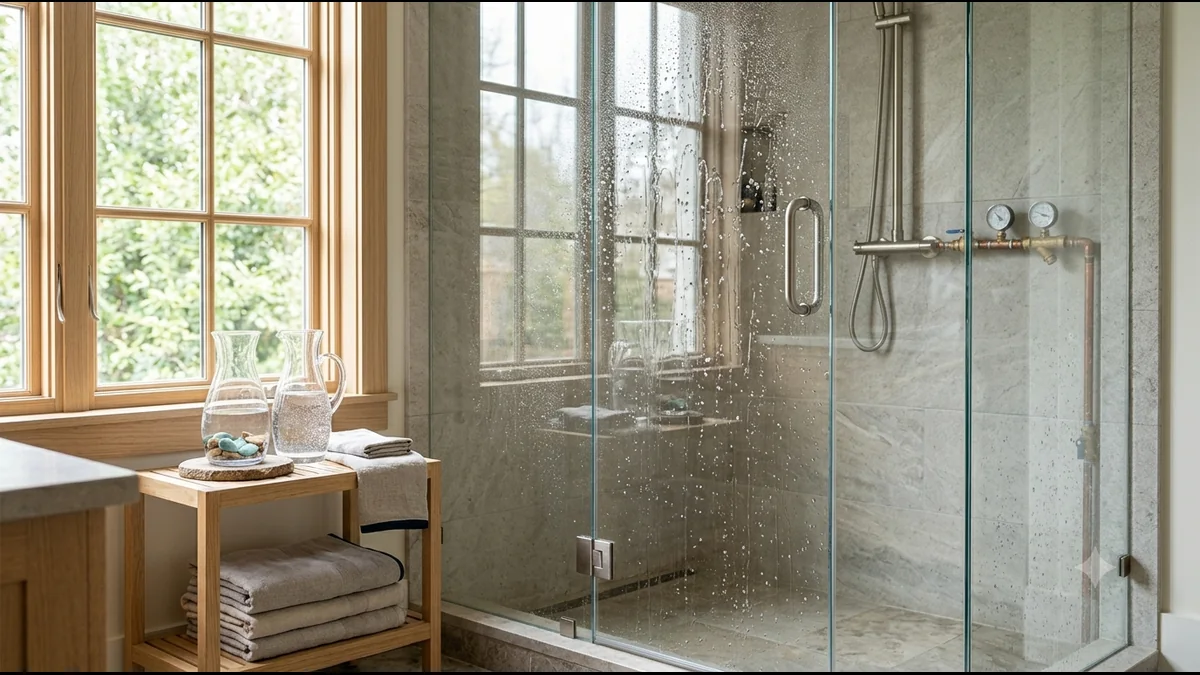
Direct answer: Grout stains keep returning because grout is porous — unlike glass or glazed tile, it holds water in its open pores after every shower, and as that water evaporates inside the material it leaves calcium, magnesium, and soap curd embedded in the grout itself rather than sitting on top of it. Scrubbing and resealing only manage what's already there; they don't stop the next round from forming. Zebulon runs on Raleigh Water, which Triangle Waterworks measures at roughly 1.6 to 3.7 gpg by ZIP code — slightly hard to moderately hard on the WQA/Hach scale — and an all-in-one whole-home softening and carbon system treats that water before it ever reaches the shower, so grout stops re-absorbing new deposits.
Why Do Hard Water Stains Keep Coming Back on My Shower Grout?
Because grout is a porous, absorbent material, and every other surface in your shower isn't. Glass, glazed tile, and chrome fixtures are essentially non-porous — water sits on top until it's wiped away or evaporates cleanly off the surface, leaving residue where it's easy to wipe or squeegee. Cementitious grout is different: it's a mix of cement, sand, and water that cures with a network of open pores, and those pores draw in whatever water touches them. After a shower, that water is absorbed into the grout rather than sitting on top of it. As it evaporates from inside the pore, the calcium, magnesium, and soap curd it was carrying get left behind in the material, not on it — a fundamentally different problem than a film you can wipe off a mirror or a glass door.
Why Does Grout Stain Faster Than Glass or Tile in the Same Shower?
Because the same water that beads and evaporates cleanly off glass gets pulled into and held by grout's pore structure, giving minerals more contact time and more places to settle. A glazed tile surface and a glass shower door both shed water quickly, so there's a narrow window for evaporation to leave anything behind, and what does form sits on the surface where a squeegee or wipe removes it. Grout, by contrast, stays damp longer after every shower because water soaks into it rather than running off. That longer drying time, combined with a porous structure that traps residue below the surface, is why the same shower routine leaves grout looking hazy while the glass next to it still looks clear.
Does Resealing Grout Actually Stop the Staining?
Resealing slows moisture absorption for a while, but it's maintenance on the material, not a fix for what's causing the staining. A sealer coats the grout's pores so less water gets in to begin with, which can reduce how quickly new haze forms. But a sealer wears down with regular use and cleaning, and once it does, the grout goes back to absorbing water the way it did before — and the minerals and soap curd in that water are still there, unchanged. Resealing addresses how much water reaches the grout; it does nothing about what's dissolved in the water, which is the actual source of the staining. Scrubbing and resealing are real maintenance worth doing, but they treat the surface the deposits land on, not the deposits' source.
Scrubbing and Resealing vs. Treating the Water
| Scrubbing and resealing grout | Whole-home softening and carbon system | |
|---|---|---|
| What it addresses | Residue already absorbed into the grout, and how fast new water gets in | The mineral content in the water before it reaches any fixture |
| Effort required | Ongoing — periodic scrubbing plus resealing as the coating wears | One install, then automatic |
| Coverage | Shower grout only | Grout, glass, fixtures, dishwasher, water heater, washer |
| Why staining returns | New water still carries the same calcium, magnesium, and soap curd once the seal wears | Minerals removed by ion exchange before they reach the shower |
| Chlorine/chloramine taste and odor | Not affected | Reduced by the carbon stage |
Is Zebulon's Water Hard Enough to Explain This?
It carries enough calcium and magnesium to explain grout staining, even though Zebulon's water isn't in the "hard" band on the WQA/Hach scale. Zebulon is served by Raleigh Water, sourced from Falls Lake and treated at the E.M. Johnson Water Treatment Plant, which comes in at around 1.6 gpg — "slightly hard" on the Water Quality Association scale the Hach Total Hardness Test Kit, Model 5-B, uses. Triangle Waterworks' own testing across the service area measures 1.6 to 3.7 gpg by ZIP code, spanning slightly hard up to moderately hard. Grout's porosity makes even that range visible fast: a surface that absorbs and holds water while it evaporates shows mineral content a non-porous surface would take much longer to display. Where a specific Zebulon address falls in that range is worth measuring rather than assuming.
What About Soap Scum in the Grout Lines, Not Just Mineral Haze?
Grout stains are often a mix of mineral deposits and soap scum, and both come from the same water. Soap scum forms when the calcium and magnesium in your water react with soap and body-wash residue to form an insoluble curd, and grout's porous surface gives that curd more places to settle into than a flat glass door does. That's why grout lines can look duller and grayer over time even in a shower that gets a regular squeegee pass on the glass — the same reaction is happening, it's just settling into a surface built to absorb it. Softening removes the calcium and magnesium before either the plain mineral film or the soap-scum reaction can form.
Does the Water's Taste or Smell Have Anything to Do With Grout Staining?
No — that's a separate issue handled by a different stage of treatment, though both trace back to the same water. Raleigh Water normally disinfects with chloramine, which the City describes as having no taste or odor associated with it, and once a year converts to free chlorine on the N.C. Department of Environmental Quality's recommendation to flush the distribution system — timing shifts year to year, so check the City's own announcement rather than a fixed date. Raleigh Water also carries documented disinfection byproducts: HAA9 at 19.9 ppb and TTHM at 21.7 ppb, both compliant with EPA limits. EWG's guidelines are a separate, stricter, non-regulatory benchmark, not a legal limit — the two shouldn't be conflated. Softening resin does nothing about taste, odor, or byproducts; that's what the carbon stage in an all-in-one system handles.
What Actually Stops Grout From Staining Again?
An all-in-one whole-home system — softening resin paired with carbon filtration in a single install — addresses both halves of what's happening in a Zebulon shower:
- Softening resin removes calcium and magnesium by ion exchange before water reaches the showerhead, so there's less mineral content left to absorb into the grout's pores as it dries. That reduces new haze and soap-curd buildup at the source, and protects the water heater, dishwasher, and washing machine from the same cumulative deposits.
- Carbon filtration reduces chlorine and chloramine taste and odor and addresses disinfection byproducts — the part softening never touches.
Because it's one system rather than two, every fixture in the house gets the same treated water, not just the shower. Pricing depends on your home's plumbing and where your address falls in the 1.6–3.7 gpg range, which is why it isn't published here — a free water analysis is how a system gets sized and quoted. For comparison, national big-brand installers commonly quote $6,000 to $12,000 for whole-home coverage.
Grout is one of several surfaces in a Zebulon home that shows mineral buildup fastest — see hard water stains on a stainless steel sink for how the same deposits show up in the kitchen. For the glass and fixture side of the same shower, see how to stop soap scum on shower doors, and for why soap struggles to lather in the first place, see why soap doesn't lather well in Triangle, NC. For the source numbers behind Raleigh Water's hardness, see Raleigh water hardness, and for what a system costs installed nearby, see water softener cost in Zebulon, NC.
See What's Coming Out of Your Zebulon Tap
Take the 60-second water quiz to see which all-in-one system fits your home, or book a free water analysis to find out exactly where your address falls in the 1.6–3.7 gpg range Triangle Waterworks measures across Zebulon and the surrounding area.
Frequently Asked Questions
I resealed my shower grout three months ago and it's already going hazy again — is the sealer bad, or is this normal? This is normal for a sealer under regular shower use, not a sign it failed. A sealer reduces how much water gets into the grout's pores, but it wears with use and cleaning, and once it does, the grout absorbs water the same way it did before. The minerals in that water haven't changed, so the same staining resumes — resealing manages the surface, it doesn't remove what's causing the stain.
I just moved into a Zebulon home with older grout that's permanently gray and blotchy — can anything actually reverse that, or is it too far gone? Deep, set-in staining in old grout often needs a professional deep-clean or a fresh reseal to visibly improve, and very old grout may never look brand new again. What a whole-home softening and carbon system does is stop new deposits from adding to it going forward, so whatever cleaning or resealing you do next actually holds instead of getting undone by the next month of showers.
Is it the grout that's failing, or is it always the water? It's almost always the water. Grout's porosity is what makes staining show up there before it does anywhere else in the shower, but the calcium, magnesium, and soap curd being absorbed come from the water supply, not from anything wrong with the grout itself or how it was installed.
Will a softener alone fix grout staining, or do I need the carbon stage too? Softening resin is what stops mineral and soap-scum buildup in the grout, since it removes the calcium and magnesium causing both. The carbon stage doesn't affect grout staining directly — it handles chlorine, chloramine taste and odor, and disinfection byproducts, which is why an all-in-one system covers the full picture rather than just one symptom.
Does darker grout hide staining better than light grout, so I could just switch colors instead of treating the water? Darker grout can make early haze less visually obvious, but it doesn't stop the underlying absorption and mineral buildup happening inside the material. The same deposits are still accumulating in the pores; a lighter or darker grout just changes how soon it becomes visible, not whether it's occurring.
How do I know if my Zebulon address is on the higher or lower end of that hardness range? The only way to know for a specific address is to test it, since the range varies by ZIP. A free water analysis reads your actual tap, and for at-home testing in the meantime, the Hach Total Hardness Test Kit, Model 5-B, reports results in grains per gallon on the same scale Triangle Waterworks uses.
Answer nine practical questions, then request a written quote or well-water analysis.
Start My Water Analysis