
Getting HOA Approval for a Water Softener in Your Rolesville, NC Townhome
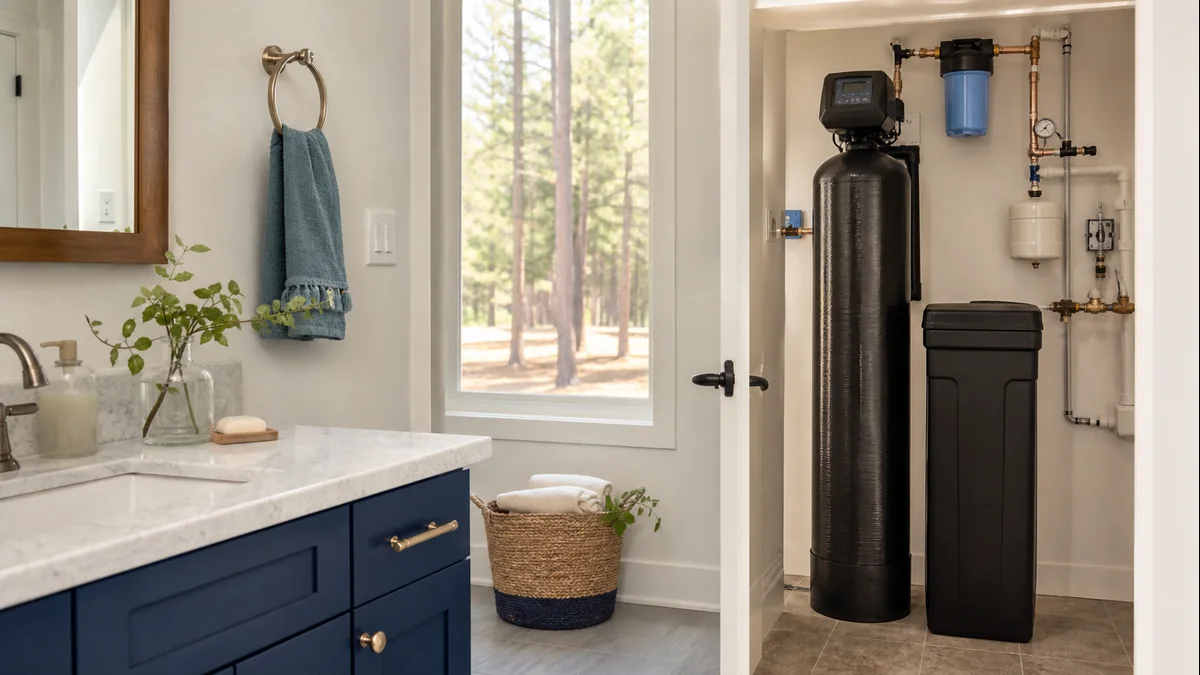
Direct answer: In most Rolesville, NC townhome and planned communities, a whole-home softening-and-carbon system doesn't need architectural approval at all, because it installs indoors on the main water line — in a utility closet, garage corner, or crawl space — with nothing visible from the street or shared exterior walls. The concrete step is to read your own community's declaration and architectural guidelines, confirm whether an interior plumbing installation triggers a review requirement, and if in doubt, submit a short written description before the installer arrives. Keep any approval with your home records and move forward with the system.
Where Does a Whole-Home Water System Actually Go in a Townhome?
A whole-home softening-and-carbon system ties into the main water line where it enters the unit, and in a townhome that's almost always an interior space — a utility closet, a garage corner, a crawl space access point, or a mechanical room shared with the water heater. The unit needs three things to operate: access to that main line, a nearby drain, and a standard electrical outlet. None of those requirements touch the roofline, the shared exterior walls common to townhome construction, or any part of the property a neighbor would see from the sidewalk or a shared courtyard.
What Actually Requires HOA Architectural Review in a Townhome Community?
Architectural review provisions in most planned communities exist to govern what's visible from the exterior — paint colors, roofing, fencing, exterior lighting, satellite dishes, changes to a shared wall or common-element facade. Townhome communities in particular tend to have tighter rules around exterior appearance precisely because units share walls and sightlines with neighbors, so the exterior look of the whole row matters more than it might in a single-family subdivision. A whole-home water system doesn't intersect with any of that: it isn't mounted outside, it doesn't change the footprint or the facade, and it doesn't touch a common element. That's the honest reason this concern rarely turns into an actual rejection — the equipment doesn't fall into the category architectural review exists to catch.
The one placement that changes the calculus is an exterior enclosure — if a homeowner wanted to house equipment in a visible outdoor structure rather than inside the unit, that's the case most likely to need a look from the architectural committee, simply because it's now something a neighbor can see. For nearly every whole-home installation, that question doesn't come up, because the practical, common placement is indoors.
Does State Law or My Own Community's Declaration Actually Control This?
Homeowners associations in North Carolina operate under the North Carolina Planned Community Act, N.C.G.S. Chapter 47F, which establishes the framework for how associations are formed and governed. It doesn't hand down a statewide list of approved or restricted home equipment for every community in Rolesville. What actually controls your specific townhome is your own community's recorded declaration, covenants, and any separate architectural guidelines, and those documents vary from one Rolesville community to the next. So the useful move isn't trying to find a state rule that settles the question — it's reading your own declaration, because that's the document your association can actually enforce.
This is general information, not legal advice. Your own recorded declaration and any architectural guidelines are what govern your townhome, and if you want a definitive answer before installing, your architectural committee is the source to check.
What Should I Actually Do Before Scheduling the Install?
A few sensible, practical steps cover this in an afternoon:
- Pull your community's declaration and any separate architectural guidelines — from your closing documents, your HOA management company, or the Wake County Register of Deeds if you can't find your copy.
- Check whether the document requires an architectural review application for interior plumbing work, or only for exterior changes.
- If your planned placement is indoors (utility closet, garage, crawl space), note that it involves no exterior work, no change to the unit's appearance, and no common-element impact.
- If you're unsure, or your declaration requires notice for any home improvement, submit a short written request in writing rather than guessing. A workable one reads: "Installing an interior whole-home water treatment system on the main water line, located in the [utility closet/garage/crawl space]. No exterior work, no change to the unit's exterior appearance, no common-element impact." That one sentence answers the only question a committee actually cares about — does this change what the building looks like from outside.
- Once approved, or once you've confirmed no approval is needed, keep that documentation with your home records.
None of that is a reason to delay booking the water test or the installation — it's a same-day paperwork check that runs in parallel with getting your water analyzed. Part of a free water analysis is a specialist walking the property with you to identify that indoor placement before anything is installed — the same visit where your home's actual water hardness gets measured, rather than relying on a town average.
HOA Architectural Concern vs. Whole-Home Water System in a Townhome
| Typical HOA architectural concern | Does an indoor whole-home water system trigger it? |
|---|---|
| Visible from the street or a shared courtyard | No — installed indoors, utility closet/garage/crawl space |
| Roof-mounted equipment (satellite dish, solar) | No — nothing mounted on the roof |
| Shared exterior wall or facade changes | No — the unit sits inside, not attached to the shared wall |
| Common-element impact | No — the unit serves only the individual unit's line |
| Yard, courtyard, or landscaping disturbance | No — no digging or exterior plumbing work |
| Exterior equipment enclosure | Sometimes — an outdoor enclosure is the placement most likely to need review |
| Declaration requires notice for any home improvement | Sometimes — a short written description resolves it |
Where Does Rolesville's Water Come From, and Does That Affect the System?
Rolesville is served by Raleigh Water, the same utility supplying Raleigh, Garner, Knightdale, Wake Forest, Wendell, and Zebulon. On the Water Quality Association scale used by the Hach Total Hardness Test Kit, Model 5-B, Raleigh Water measures about 1.6 grains per gallon — classified as slightly hard, not the higher bands people sometimes picture. Our own testing across the service area measures 1.6 to 3.7 gpg depending on the exact address, so the number that actually matters is the one from your own tap, not a service-wide average. That's a real benefit for a townhome owner: a correctly sized softener at that range regenerates infrequently and uses relatively little salt. Buildup is still cumulative, though — minerals are present at any level, and deposits accumulate on fixtures and inside a water heater over years, which is why softening matters even at a slightly hard reading.
Hardness is only half the picture. Raleigh Water's documented figures show HAA9 at 19.9 ppb and TTHM at 21.7 ppb, both legally compliant with EPA limits though above the stricter, non-regulatory EWG guideline, and it normally disinfects with chloramine, converting to free chlorine once a year on the North Carolina Department of Environmental Quality's recommendation. Softening resin does nothing about any of that — it's ion exchange for calcium and magnesium only, which is why the all-in-one system pairs a softening stage with a carbon stage: one protects plumbing and appliances from scale, the other addresses taste, odor, and disinfection byproducts.
Under N.C. Gen. Stat. § 87-21, installing or replacing "whole-house water purification or treatment systems" falls under licensed plumbing contracting in North Carolina — worth knowing if a committee ever asks who's doing the work, since a professionally installed system is often exactly what a review board wants to see.
Frequently Asked Questions
I live in a Rolesville townhome HOA — will they reject a whole-home water softener installation?
It's unlikely, because architectural review typically governs what's visible from outside the unit or affects a shared exterior wall, and a whole-home system installs indoors with no exterior change. The one situation that's more likely to need a look is an exterior equipment enclosure, which most installations don't require in the first place.
Do I need to submit an architectural request before installing?
Check your community's declaration first. Some require notice for any home improvement regardless of visibility, mostly for a paper trail; if yours does, a short written description of an interior installation with no exterior work is normally sufficient.
I can't find my HOA declaration for my Rolesville community — where do I look?
Start with your closing documents, your HOA management company if your community has one, or the Wake County Register of Deeds, where recorded declarations are filed. Your architectural committee or HOA board can also point you to the current governing documents.
Will the installer need to drill through a shared wall or mount anything outside my unit?
No. The installation ties into the main water line inside the unit — typically in a utility closet, garage, or crawl space — and needs access to that line, a nearby drain, and a power outlet. Nothing about a standard indoor install touches a shared wall, the roof, or common areas.
I just moved into a Rolesville townhome and want to install before I'm fully settled — does that change anything?
Not typically. Whether you've owned the unit for years or just closed, the equipment is interior and invisible from outside, so it isn't the kind of change architectural review exists to catch. Reading your declaration and, if it calls for notice, sending a short written description covers you either way.
What if I want to put the system somewhere other than a closet or garage, like an outdoor enclosure?
That's the one placement worth checking on first, since an exterior enclosure is visible and is the case most likely to need architectural review. For most townhomes, an indoor utility closet, garage corner, or crawl space placement is available and keeps the question simple, which is exactly what the free water analysis is for — a specialist walks the property with you and identifies that spot before anything is installed.
Related Reading
For the sibling question in a nearby community, see HOA rules and water softener installation in Clayton, NC. If you're weighing softening-only against an all-in-one system, water softener vs. all-in-one system covers that difference, and rented vs. owned water softener covers a separate decision worth understanding. To confirm your own address's hardness before the installer arrives, see how to test water hardness at home; prepping a Holly Springs home for a water softener install covers what a typical install day involves, and water softener installation in Raleigh covers the general case in the Raleigh Water service area.
Ready to settle both questions at once? Take the 60-second water quiz or book a free water analysis — a specialist will walk your property, identify the indoor placement that keeps the HOA question simple, and measure your actual tap water before recommending an all-in-one system built for your Rolesville townhome.
Answer nine practical questions, then request a written quote or well-water analysis.
Start My Water Analysis