
HOA Rules and Water Softener Installation in Clayton, NC
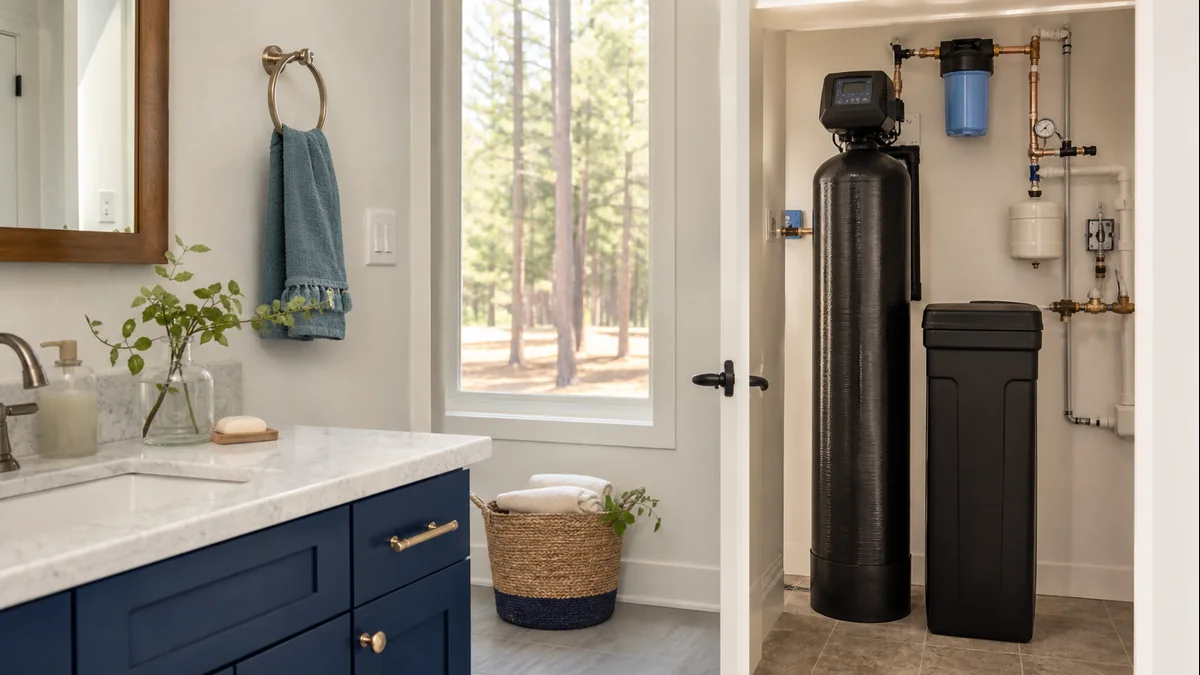
Direct answer: In almost every Clayton, NC HOA neighborhood, a whole-home water softening-and-carbon system is a non-issue for architectural review, because it installs indoors on the incoming water line — in a garage, basement, utility closet, or mechanical room — with nothing visible from the street and no change to the exterior of the home. The authority that actually governs your lot is your community's own recorded declaration and bylaws, not a blanket state rule, so the one concrete step is to read your declaration and, if you want certainty, send your architectural committee a one-line description of an interior plumbing installation before the installer arrives.
Where Does a Whole-Home Water System Actually Go?
A whole-home softening-and-carbon system ties into the main water line where it enters the house, almost always indoors. In Clayton neighborhoods that means a garage corner, a basement, a laundry room, or a small mechanical closet — the same kind of space that already holds a water heater or HVAC equipment. The unit needs three things: access to the main line, a nearby drain, and a standard power outlet. None of that touches the roofline, siding, windows, or yard.
What Actually Requires HOA Architectural Approval?
Architectural review committees exist to protect what a neighbor sees from the street or the adjoining lot — roof materials, paint colors, fences, sheds, satellite dishes, solar panels, driveway changes, exterior additions. A whole-home water system doesn't touch any of that. It doesn't sit on the roof like a satellite dish, it doesn't mount to an exterior wall like a solar array, and it doesn't change the footprint of the home. That's the honest reason this particular worry almost never turns into an actual rejection: the equipment simply isn't the kind of thing architectural review was written to catch.
Does My Clayton HOA's Authority Come From State Law or From My Own Neighborhood's Rules?
Neither North Carolina nor any state statute writes a blanket rule for every HOA in Clayton about interior plumbing equipment. Homeowners associations in North Carolina operate under the North Carolina Planned Community Act, N.C.G.S. Chapter 47F, but that law establishes the framework for how associations are formed and governed — it doesn't hand down a statewide list of approved or banned home equipment. The actual rules that apply to your lot come from your own community's recorded declaration, covenants, and bylaws, which vary from neighborhood to neighborhood across Clayton and Johnston County. That's why the reliable answer isn't "check state law" — it's "check your declaration," because that document, not a state rule, is what your association can actually enforce against you.
This is general information, not legal advice — your specific recorded covenants are what govern your lot, and if you want a definitive answer, your declaration and your architectural committee are the source to check.
What Does the Installer Actually Need?
A licensed plumber handles the installation, and the requirements are simple and entirely interior:
- Access to the home's main water line, typically where it enters the garage, basement, or a utility area
- Access to a nearby floor drain or drain line for routine operation
- A standard electrical outlet for the control valve
- Enough clearance around the unit for future service
None of that requires digging in the yard, changing the exterior of the home, or installing anything a neighbor would notice walking by.
What Should I Do If My Declaration Requires Notice?
Some declarations require homeowners to notify the architectural committee before any home improvement, even ones with no exterior impact — mostly so the association has a paper trail, not because the committee expects to object. If your declaration reads that way, a short note covers it. A workable architectural request says something like: "Installing an interior whole-home water treatment system on the main water line in the garage/basement/utility closet. No exterior work, no change to the home's exterior appearance, no structural changes." That's a complete, accurate description of the job, and it gives the committee everything it needs to sign off quickly.
HOA Architectural Concern vs. Whole-Home Water System
| Typical HOA architectural concern | Does a whole-home water system trigger it? |
|---|---|
| Visible from the street or a neighbor's lot | No — installed indoors, garage/basement/utility closet |
| Roof-mounted equipment (satellite dish, solar) | No — nothing is mounted on the roof |
| Exterior wall-mounted equipment | No — the unit sits inside, not bolted to siding |
| Changes to the home's footprint or structure | No — no addition, no structural change |
| Yard or landscaping disturbance | No — no digging or exterior plumbing work |
| Fence, shed, or accessory structure rules | Not applicable — not a structure |
| Interior-only equipment with recorded-declaration notice requirement | Sometimes — a one-line note to the architectural committee resolves it |
What About Clayton's Own Water Quality?
Clayton doesn't operate its own treatment plant. According to the Town of Clayton's 2025 annual water quality report, Clayton purchases treated surface water sourced from the Neuse River, supplied by Johnston County West. That same report shows TTHM at 47 ppb (with a reported range of 6.10 to 52.90) against an EPA limit of 80, and HAA5 at 37 ppb (range 4.50 to 42.10) against a limit of 60 — both compliant, no violations. The report also documents both a chlorine residual (running average 0.57 ppm) and a chloramine residual (running average 1.95 ppm) in the distribution system. Activated carbon — the carbon half of an all-in-one whole-home system — is effective at reducing disinfection byproducts like these, alongside chlorine and chloramine taste and odor.
One more thing worth knowing: Clayton's 2025 report doesn't publish a total hardness figure at all, and Clayton also publishes a separate report for another part of its system that covers different figures entirely. So there's no single town number you can look up and apply to your address. That's exactly why a free water test matters more than a published town average — your own tap is the only source of truth for what a system should be sized to handle, and it costs you nothing to find out.
None of this is a reason to wait. The HOA question is answerable in an afternoon by reading your declaration, and the water-quality question is answered for free at your own address. Both point the same direction: toward booking the test and moving forward with the all-in-one system, not toward hesitating.
If you're comparing what a local, custom-configured install looks like against a big-box or national-brand quote, big-brand-vs-local-water-treatment walks through that difference. If you're still narrowing down which system fits your home, how-to-choose-a-water-softener is a good next read, and water-softener-north-carolina covers what NC homeowners generally need to know before installing. If your neighborhood has broader water-quality questions beyond HOA rules, see hoa-neighborhood-water-quality-raleigh. And if you want to see what installation day itself typically looks like, water-softener-installation-raleigh covers the process step by step.
Frequently Asked Questions
I live in a Clayton HOA neighborhood — will they reject a water softener installation?
It's very unlikely. Architectural review committees are set up to govern what's visible from the street or affects the exterior of the home — roofing, siding, fences, solar panels, satellite dishes. A whole-home system installs indoors on the main water line and changes nothing about how your home looks from outside, which is why it typically falls outside what the committee reviews at all.
Do I need to submit an architectural request before installing a whole-home system?
Check your community's declaration first. Some declarations require notice for any home improvement regardless of visibility, mostly to keep a paper trail. If yours does, a short note describing an interior plumbing installation with no exterior work is normally enough to satisfy it.
I can't find my HOA declaration — where do I look?
Start with your closing documents, your HOA management company (if your community has one), or the Johnston County Register of Deeds, where recorded declarations are filed. Your architectural committee or HOA board can also point you to the current governing documents if the original paperwork isn't handy.
Will the installer drill through an exterior wall or mount anything outside?
No. The installation ties into the main water line inside the home — typically in a garage, basement, or utility closet — and needs access to that line, a nearby drain, and a power outlet. Nothing about the job involves the roof, siding, or yard.
I just bought a home in a Clayton HOA and want to install before move-in — is that a problem?
Not typically. The same logic applies whether you've lived there for years or just closed: the equipment is interior and invisible from outside, so it isn't the kind of change architectural committees are built to flag. Reading your declaration and, if it calls for notice, sending a short description to the committee covers you either way.
What does Clayton's own water quality report say about hardness?
Clayton's 2025 annual water quality report doesn't publish a total hardness figure at all, and Clayton has more than one system report covering different parts of town. Since there's no single published number for your address, a free water test is the only way to know what your home's water actually measures — and it's the fastest way to get a system sized correctly.
Ready to move forward? Book your free water analysis — it settles the water-quality question for your exact address, and the HOA question is answered by your own declaration, not a reason to wait on either one.
Answer nine practical questions, then request a written quote or well-water analysis.
Start My Water Analysis