
How to Choose a Water Treatment Company in Johnston County, NC
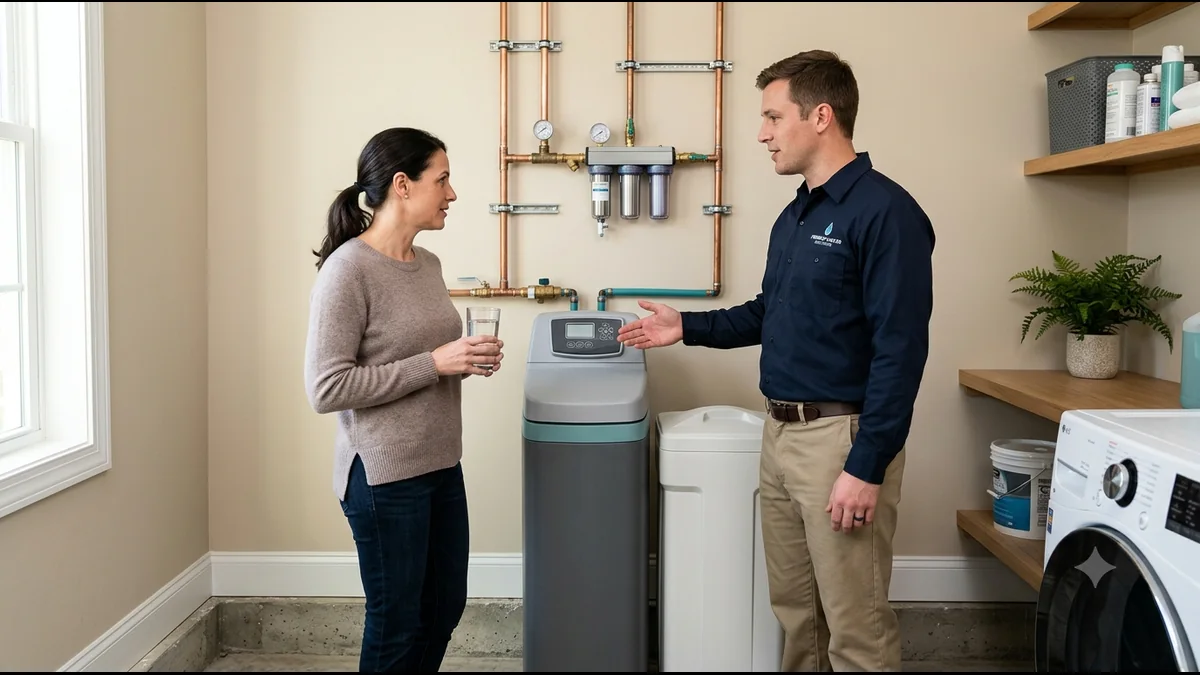
Direct answer: In Johnston County, the sharpest vetting question is whether a company tests your actual address before quoting — the county has no single published countywide hardness number, so a catalog quote is a guess dressed up as a figure. Beyond that, check for a valid NC plumbing license with the permit included, a quote covering both softening and carbon (not just one), warranty and service terms in writing, and whether you're dealing with a local installer or a national lead-buyer. City-water homes route to an all-in-one softening-and-carbon system; well homes get sized after a free water analysis.
Johnston County is harder to research before you call anyone than most of the Triangle. Towns here draw from different systems, some rely on purchased rather than self-treated water, and a real share of homes sit on private wells instead of any municipal supply. The usual shortcut — look up your town's published hardness number — doesn't reliably work here the way it does in Raleigh or Apex. Here's what to check before you hire anyone.
What Should I Check Before Hiring a Water Treatment Company in Johnston County?
Start with whether the company tests your water before naming a price, then work through licensing, scope of treatment, warranty, and service commitments. Testing is the one that exposes whether the rest of the quote is built on a real number or an assumption. A company that's straightforward on all five, in writing, is one worth getting a quote from.
Does the Company Test My Actual Address, or Quote From a Catalog?
Ask this first, because in Johnston County there usually isn't a countywide number to fall back on if a company skips the test. Clayton is the clearest example: per Clayton's own 2025 annual water quality report, the town purchases treated surface water sourced from the Neuse River, supplied by Johnston County West, and doesn't operate its own treatment plant. That 2025 report publishes no total hardness figure, and Clayton actually publishes more than one system report covering different parts of town — there's no single number a company could hand you as your household's reading.
A real share of Johnston County homes also aren't on municipal water at all. Private wells are more common here than in Wake County, and North Carolina does not regulate private well water quality after a well is constructed, so a well household's reading can differ from a neighbor's on the same road.
A company quoting a Johnston County address off a chart or "what we usually see around here" is guessing. A company that reads your actual tap is measuring — that's the whole ballgame in a county with no published number to check either one against.
Is the Installer Licensed for Plumbing Work in NC — and Does the Quote Include the Permit?
It should be, and the quote should say so. North Carolina treats a whole-home water treatment installation as licensed plumbing contracting work: N.C. Gen. Stat. § 87-21 states that the article applies to those engaged in "the installation or replacement of … whole-house water purification or treatment systems," putting this job in the same license category as any tie-in to your home's water line. Ask for the license number up front — a legitimate company gives it without hesitation, since it's public information regardless. Then ask whether the quote includes pulling the required plumbing permit and scheduling the inspection, or whether that's left for you to sort out afterward. A properly run installation includes both.
Is the System Sized to My Measured Numbers, Not a Chart?
It should be, and the right system type depends on whether you're on municipal water or a private well. A system built from a genuine test of your water performs differently than one sized off a generic chart, and Johnston County's mixed supply picture is exactly why that matters more here than in a town with one uniform system.
- City water (Clayton and other municipal customers) routes to an all-in-one softening-and-carbon system, sized to what's actually measured at your address.
- Private well water routes to an iron removal plus carbon/resin system, since wells commonly carry iron, sulfur, or a different pH than municipal supply — sized only after a free water analysis.
See a fuller comparison of how city water and well water are treated differently if you're not sure which category your address falls into.
Does the Quote Cover Both Softening AND Carbon — Or Just One?
Ask specifically, because plenty of quotes only cover one half. Softening resin removes calcium and magnesium through ion exchange — the hardness side, the scale on fixtures and inside a water heater. It does nothing about chlorine or chloramine taste, disinfection byproducts, or PFAS, which is a separate job handled by a carbon stage certified for what it targets — NSF/ANSI 53 or P473 for PFAS. Boiling water does not remove PFAS and can concentrate it, so it's never a substitute. Ask directly: "does this quote include carbon filtration, and what is it certified for?"
Is the Warranty Stated in Writing?
Ask what's covered, for how long, whether it transfers if you sell the home, and what would void it — and get the answers in writing before any work starts. Here's a fuller breakdown of what to look for in a system warranty. A written warranty should separate parts from labor, name the components it covers, and state whether professional installation is a condition of coverage. A company that hesitates to put this on paper is telling you something before you've spent a dollar.
Who Services the System Afterward, and How Fast?
Ask this before you sign. Get specific: who do you call, is it the same company that installed the system or a subcontractor, and what response commitment will they put in writing? A system will eventually need salt, a filter change, or a service call, and "who shows up and how fast" should be stated plainly and put in the paperwork — not something you learn the first time you need it.
Local Installer or National Aggregator Lead-Buyer — How Do I Tell the Difference?
Ask directly whether the company doing your free water test is the one that will install and service the system, or whether your information gets passed to a subcontractor you haven't vetted. Some ads and quote forms are run by national lead-generation operations that collect your address and resell it to installers in your area, rather than a single company you can check references and licensing on directly. That's a different relationship than hiring a local installer you can verify start to finish — a fair question to ask before handing over your address.
See a fuller side-by-side of local installers versus national big-brand quotes for what else differs beyond who shows up at your door. National big-brand whole-home system quotes commonly run $6,000–$12,000 — cited as third-party context only, not a Triangle Waterworks price. Johnston County pricing is set the same way as everywhere else: after a free water analysis, once your system is sized to your actual water.
Johnston County Vetting Checklist
| What to Verify | Why It Matters Here | What to Ask For |
|---|---|---|
| Address-level water test | No single published Johnston County hardness figure exists to check against | A free water analysis, not a chart-based estimate |
| NC plumbing license | This is licensed plumbing contracting work under state law | The license number, before the quote |
| Permit and inspection | A whole-home install is plumbing work that requires a permit | Confirmation it's included in the quoted scope |
| Softening AND carbon | Many quotes price only one half of the treatment picture | Explicit confirmation both are included, with carbon's certification |
| Warranty terms | Verbal promises aren't enforceable later | Coverage, length, and transferability in writing |
| Service after install | You'll eventually need salt, a filter, or a service call | Who responds, and how fast, stated in writing |
| Local vs. lead-buyer | Determines who you can actually verify and hold accountable | A direct answer on who tests, installs, and services |
Frequently Asked Questions
I just moved to Clayton and can't find a hardness number for my water anywhere online — is that normal? Yes. Per Clayton's own 2025 annual water quality report, the town purchases treated surface water from the Neuse River through Johnston County West and doesn't publish a total hardness figure. The only way to get a real number for your address is a free water analysis.
I'm on a private well in Johnston County and don't know where to start — does the same checklist apply? The licensing, warranty, and service checks apply the same way, but the treatment recommendation differs. Well water isn't regulated by the state after construction and commonly carries iron or a different pH than municipal supply, so a well system is an iron removal plus carbon/resin setup sized after a free water analysis, rather than an all-in-one softening system.
How do I know if a company is a local installer or just a lead-generation site? Ask directly whether the company running the ad or quote form is the one that will show up, install, and service your system, or whether it resells leads to subcontractors. A straightforward answer tells you a lot about who you're actually accountable to after installation.
What's a reasonable warranty to expect? Rather than expecting a specific number, ask the company to put coverage, length, transferability, and anything that would void it in writing. A company that documents this clearly gives you what you need to compare offers fairly.
What if a company gives me a price without ever testing my water? That's a fair reason to keep looking, especially here, where there's no countywide number for them to be working from instead. A company willing to run a free water analysis before naming a price is showing you it's sizing to your actual home, not a guess.
Get Your Address Tested, Not Estimated
Skip the chart-based guess a catalog quote is built on. A free water analysis measures exactly what's in your water — whether you're on Clayton's system, another Johnston County supply, or a private well — and that reading is what a properly sized all-in-one or well system gets built around. Take the 60-second water quiz to get started, or book a free water analysis directly.
Answer nine practical questions, then request a written quote or well-water analysis.
Start My Water Analysis