
How to Fix Low Water Pressure Caused by Hard Water in Cary, NC
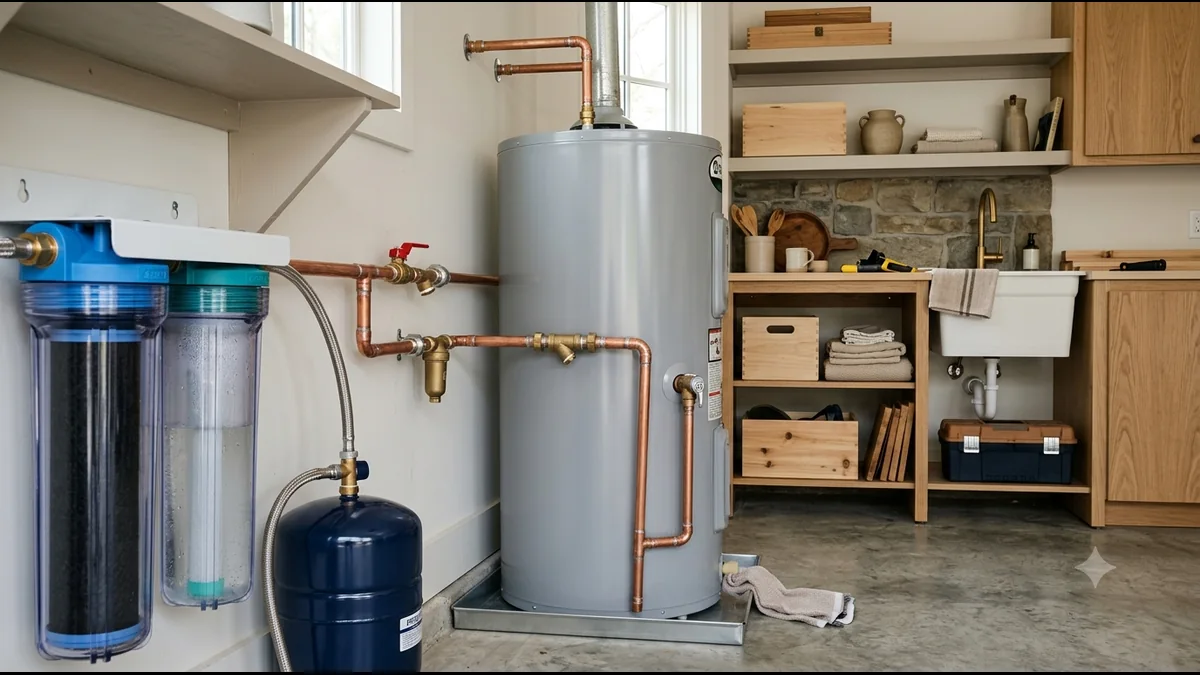
Direct answer: Low water pressure in a Cary home comes from one of four places: a clogged aerator or shower head at a single fixture, the water heater on the hot side only, a whole-house plumbing issue like the pressure-reducing valve, or gradual mineral buildup over years. Cleaning a fixture fixes that one spot. A whole-home system removing calcium and magnesium at the main line stops deposits re-forming on every fixture and appliance downstream.
Why Is the Water Pressure Low at Just One Faucet or Shower?
Because the problem is almost always sitting right at that fixture, not somewhere upstream. The aerator screen on a faucet and the nozzle holes on a shower head are the narrowest points water passes through, which makes them the first place mineral deposits show up and the easiest place to confirm it. Unscrew the part — a crusty white or gray buildup around the openings is calcium and magnesium scale, physically narrowing the path water squeezes through.
First rule out the simple mechanical causes: confirm the supply stop valve under the sink or behind the shower wall is fully open, and that the flow restrictor hasn't shifted out of place. If those check out and you see visible deposits, soak the part in vinegar or descaling solution and scrub the openings clean — flow should return to normal right away.
Why Is All My Hot Water Weak but the Cold Water Fine?
Because scale builds up preferentially on hot surfaces, and your water heater is the hottest surface in the house. In a tank-style heater, sediment and scale settle on the tank bottom and narrow the internal passages and outlet over time. In a tankless unit, scale deposits inside the heat exchanger, narrowing the channels water passes through to get heated.
Confirm this by comparing hot and cold flow at the same fixture — full-pressure cold with noticeably weaker hot is the tell. A plumber who drains or services the heater and finds visible scale inside confirms it. This is a genuine hot-side-only symptom, and one softening prevents going forward: water entering the heater without calcium and magnesium doesn't leave scale behind as it heats.
Why Is Water Pressure Low Throughout the Whole House?
Because this pattern points to plumbing, not water chemistry, and needs a licensed plumber rather than a filter or softener. A failing or too-low pressure-reducing valve (PRV), a main shutoff that isn't fully open, or a problem with the incoming service line will all drop pressure evenly across every fixture, hot and cold alike. Mineral scale builds up gradually inside individual fixtures — it doesn't cause a sudden, whole-house drop on its own.
If every tap is weak at the same time, have a licensed plumber check the PRV setting, confirm the main valve is fully open, and inspect the service line before assuming it's a water-quality issue — that diagnosis belongs to a plumber, not a water treatment system.
Why Has My Water Pressure Dropped Gradually Over the Years?
Because deposition is cumulative — calcium and magnesium leave a little behind every time water passes through, adding up across years of daily use. Aerators, shower heads, the water heater, and appliance supply lines all narrow gradually as scale accumulates layer by layer, which is why homeowners often don't notice until pressure has clearly dropped compared to when the house was new.
This is the pattern where whole-home softening does the most good: it doesn't undo scale already deposited, but it stops adding to it. Every gallon that passes through the softener before reaching a fixture, appliance, or the water heater carries the calcium and magnesium out at the main line instead of leaving it behind.
How Do I Diagnose Low Water Pressure by Where It Happens?
Start by noting the scope — one fixture, hot side only, or the whole house — the fastest way to narrow the cause.
| Symptom pattern | Likely cause | How to confirm it | Does whole-home softening prevent it recurring? |
|---|---|---|---|
| Low pressure at one faucet or shower only | Clogged aerator or shower-head nozzles, or a partly closed supply stop | Remove and inspect the aerator/shower head for mineral crust; confirm the stop valve is fully open | Yes — removes calcium and magnesium at the main line so deposits don't re-form on any fixture |
| Hot water weak, cold water normal at the same fixture | Sediment or scale inside a tank water heater, or a narrowed tankless heat exchanger | Compare hot vs. cold flow side by side; a plumber finds scale when the heater is drained or serviced | Yes — softened water entering the heater stops the scale that narrows it |
| Whole house, both hot and cold, uniformly weak | Pressure-reducing valve issue, main shutoff not fully open, or an incoming service line problem | A licensed plumber inspects the PRV setting, the main valve, and the service line | No — this is a plumbing issue, not a water-chemistry issue |
| Gradual decline noticed over several years, across multiple fixtures | Cumulative mineral deposition narrowing fixtures, valves, and appliance lines throughout the house | Compare current flow at several fixtures to how the house performed when it was newer | Yes — stops future buildup from accumulating, though it won't reverse deposits already in place |
That last column is worth reading twice: softening genuinely fixes three of these four patterns for good, and just as genuinely doesn't touch the fourth — that's the honest picture.
Is Cary's Water Actually Hard Enough to Cause This?
Yes, at least at the upper end of what shows up address to address. The Town of Cary's Public Works FAQ publishes finished-water hardness of 25 to 30 ppm, roughly 1.5 to 1.75 grains per gallon — a plant-wide average measured as water leaves the treatment facility. Our own testing across Cary, Apex, and Morrisville measures 1.6 to 3.7 grains per gallon depending on the address, using the WQA scale the Hach Total Hardness Test Kit is built around. On that scale, 1.6 gpg is slightly hard and 3.7 gpg — about 63 mg/L — crosses into moderately hard, since that band starts at 60 mg/L.
Neither figure is wrong; they're measuring different things. The town's number is a plant average, while what reaches your tap depends on where you sit in the distribution system — why our measured range runs higher at some addresses. Calcium and magnesium build up on fixtures and inside the water heater regardless of address, just faster at the top of the range. The only number that settles it for your house is a test at your own tap, and that test is free.
How Do I Stop Low Water Pressure From Coming Back?
By removing the minerals before they ever reach a fixture, rather than cleaning each fixture over and over. Descaling one aerator is a fifteen-minute job, but on untreated water it's a job you'll be repeating at every faucet and shower head, on a schedule that only gets shorter as deposits accumulate. Whole-home softening treats water at the main line instead, so calcium and magnesium never reach the aerator, shower head, water heater, or an appliance supply line — one point of treatment instead of a dozen fixtures to maintain separately.
The carbon half of an all-in-one system addresses the other half of what's in this water and has nothing to do with pressure: chlorine and chloramine taste, PFAS, and disinfection byproducts. Apex's 2024 Annual Drinking Water Quality Report — from the same Cary/Apex Water Treatment Facility that supplies this area — shows total trihalomethanes averaging 41 ppb and ranging as high as 53, comfortably under the EPA's 80 ppb limit. Activated carbon removes disinfection byproducts like these effectively, which is why an all-in-one system pairs a softening stage with a carbon stage rather than installing just one.
If the table above pointed you to "clogged aerator" or "hot side only," that's the pattern whole-home softening stops for good. Take the 60-second water quiz, or request a free water analysis for the exact hardness reading at your address.
Frequently Asked Questions
I clean my shower head every few months and it always clogs back up — is that normal? Yes, on untreated water that's the pattern to expect. Cleaning removes what's already deposited without stopping more from forming. A whole-home softening stage removes those minerals at the main line, so nothing is left for the shower head to accumulate.
I just moved into an older home in Cary — could the low pressure be from old galvanized pipes instead of mineral buildup? Possibly — that's a plumbing question, not a water-quality one. Older galvanized lines can corrode and narrow internally in ways that look similar to scale. If the pattern is whole-house and uniform, have a plumber inspect the pipe material before assuming it's scale-related.
I have low pressure only in the shower — could it be the flow restrictor rather than mineral deposits? Check that first. Some shower heads have a small flow-restricting disc behind the nozzle plate that can shift or clog on its own. Remove the head, check the disc and nozzle holes, and clean or reseat whichever is obstructed.
My kitchen faucet has fine cold water but weak hot water — does that mean my water heater needs to be replaced? Not necessarily. It's a sign of scale inside the heater or its outlet, but a plumber can often descale or service a tank heater, or clean a tankless heat exchanger, before replacement. Softened water going forward prevents the scale from returning.
Do I need to test my water before buying a system, or can I just guess based on Cary's published hardness number? Test your own address — the town's figure is a plant average, and our testing shows hardness varying 1.6 to 3.7 grains per gallon by ZIP. A free water analysis gives you the number that applies to your home.
What's the fastest way to find out which system fits my situation? Take the 60-second water quiz — it asks about your home and symptoms and points you to the configuration that fits, backed by a free water analysis to confirm your address's hardness.
Ready to stop chasing clogged fixtures? Take the quiz or request a free water analysis to find out what's in your water.
Related reading: Water Heater Scale Buildup in Cary, NC | Water Softeners in Cary, NC | How to Test Water Hardness at Home | Best Whole-Home System for Cary, Apex, and Morrisville | Soap Scum and Shower Door Buildup Fix
Answer nine practical questions, then request a written quote or well-water analysis.
Start My Water Analysis