
How to Maintain a Water Softener
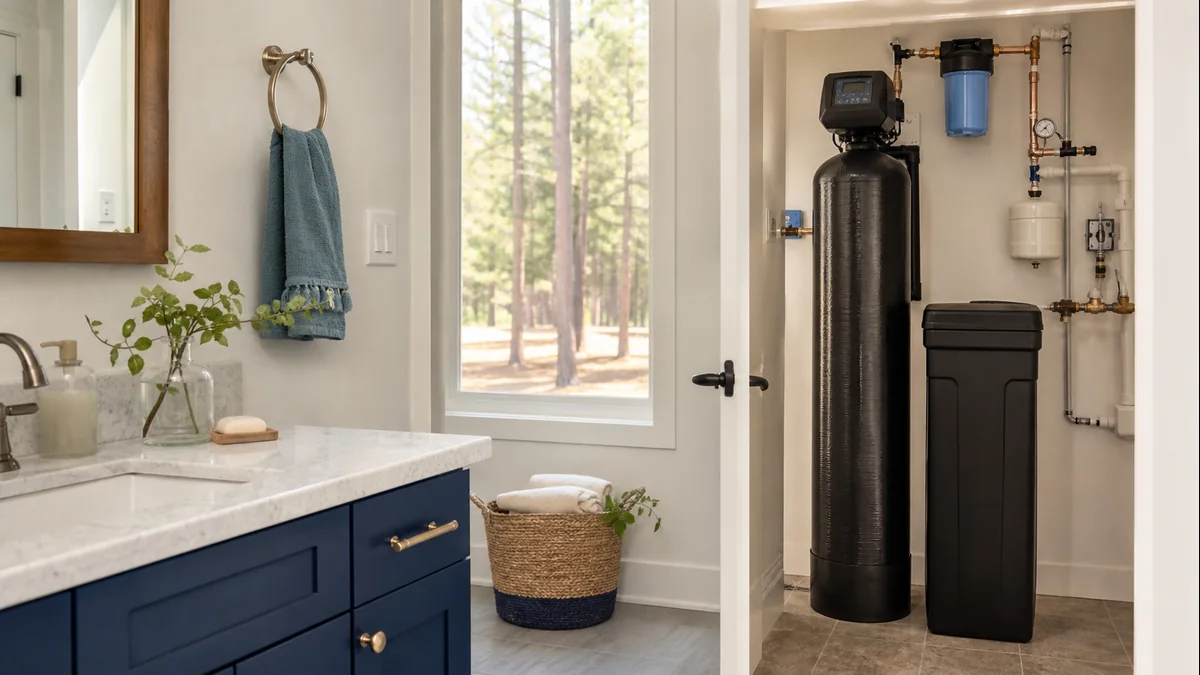
Direct answer: Owning a water softener asks very little of you: keep the brine tank stocked with clean water-softener salt, glance at it now and then, and keep the cabinet or closet it sits in reachable for service. A professional handles the annual checkup, the resin bed, and the control valve. In Raleigh, Cary, Apex, and Morrisville, softer starting water also means fewer regeneration cycles and less salt used than the same system would need in a genuinely hard-water region — an all-in-one softening-plus-carbon system stays low-maintenance here.
What does maintaining a water softener actually involve, day to day?
Almost nothing beyond checking the salt. The control valve tracks water use and triggers regeneration automatically, cycling brine through the resin bed on its own schedule. Your job is to keep clean salt in the tank, keep the area around the unit reachable for service, and notice if something looks obviously off. That's the entire owner side of the equation — the resin, the valve, and the settings are a professional's job, not yours.
How often do I need to check the salt?
Often enough that it doesn't run empty — for most households that means a quick glance whenever you're already near the unit, with no strict schedule to memorize. Look in the tank, see where the salt line sits relative to the water, and top it off if it's getting low. Because Raleigh Water runs slightly hard to begin with (around 1.6 grains per gallon on the WQA scale) and Cary, Apex, and Morrisville run moderately hard by comparison (1.6–3.7 gpg), a softener here doesn't have to regenerate as often as one working against genuinely hard incoming water — so the tank needs attention less frequently, too. For a full breakdown of what that salt actually costs over a year, see our water softener salt cost guide rather than guessing at a number.
What is salt bridging, and did I do something wrong if I see it?
No — bridging is a common, fixable salt-handling issue, not a sign you've damaged anything. A salt bridge is a hard crust that forms above the water line inside the brine tank, usually from humidity or temperature swings around the unit. From the outside the tank can look full, but the crust separates the salt above it from the water below, so nothing is actually dissolving into brine — and softening performance drops even though the tank "looks stocked." It's a common quirk of brine tanks generally, and a service visit resolves it; there's no need to diagnose or fix it yourself.
What is "mushing," and is it different from bridging?
Yes — it's a related but separate salt problem. Where bridging forms a crust near the top of the tank, mushing is a thick, sludgy layer of recrystallized salt that settles at the bottom and can partially block the tank. Like bridging, it traces back to how the salt is dissolving rather than anything wrong with the softener's mechanics, and a professional visit clears it up rather than something to troubleshoot yourself.
Does the type of salt I buy actually matter?
It affects how cleanly the tank runs, yes. Higher-purity salt dissolves more completely and leaves less insoluble residue behind, which is a meaningful factor in whether bridging and mushing show up at all. Beyond choosing a clean, water-softener-grade salt, there isn't much more decision-making required — this is a "buy it, add it, move on" task, not a research project.
Does the resin bed need anything from me?
No — the resin bed is the one part of the system that's entirely hands-off for the homeowner. It's the media inside the tank that exchanges calcium and magnesium for sodium every time water passes through, built to keep doing that for years of normal use without owner intervention. What it needs instead is a periodic professional look — a technician checking the bed's condition, the control valve, the seals, and the calibrated settings during a service visit. That's a specialist's job, which is exactly why the simple answer to almost every deeper maintenance question is "let the annual professional visit handle it."
Why do I need a professional visit at all if the system regenerates on its own?
Because automatic regeneration handles the routine cycle, but it can't diagnose itself. A professional visit is where someone opens the system up: inspecting the resin bed's condition, testing the control valve, checking seals and settings, and confirming the unit is calibrated to your household's water use. It's the difference between a system that's running and one that's been confirmed to be running well — and it's where any bridging, mushing, or valve drift gets caught before it turns into reduced performance you'd otherwise just live with. Our water softener lifespan guide covers how this ongoing care connects to how long a unit lasts.
Is the carbon side of an all-in-one system maintained the same way as the softening side?
They're related but run on their own separate cadence. An all-in-one system pairs softening resin with a carbon stage that handles what softening alone doesn't touch — chlorine and chloramine taste, and disinfection byproducts. The carbon media works differently than the resin bed and is serviced on its own schedule, separate from the salt-and-brine side. You don't need to track two routines yourself; a professional visit is where both sides of an all-in-one unit get checked together. If you're still deciding between a stand-alone softener and the combined system, our softener vs. all-in-one comparison lays out what each one covers.
How does Triangle water make this easier than it would be elsewhere?
Lower incoming hardness means the whole system works less to get the same result. Here's how the maintenance load compares conceptually:
| Maintenance factor | What it looks like on genuinely hard incoming water | What it looks like on Raleigh/Cary-area water |
|---|---|---|
| Regeneration frequency | More frequent, since more hardness has to be exchanged out of every gallon | Less frequent, since there's less hardness to remove per gallon |
| Salt consumption | Higher, tracking the more frequent cycles | Lower, tracking the lighter starting hardness |
| Bridging/mushing risk | Same underlying causes (humidity, salt purity) regardless of hardness | Same underlying causes — hardness level doesn't change this risk |
| Resin bed workload | Higher exchange volume over time | Lighter exchange volume over time |
| Owner effort | Same simple routine: check salt, keep area accessible | Same simple routine, checked less often |
A softener sized for Raleigh, Cary, Apex, or Morrisville isn't working against the kind of hardness that drives frequent regeneration in genuinely hard-water regions — a real, practical upkeep advantage of owning a system here. That's not a reason to think softening doesn't matter, though: slightly-to-moderately hard still isn't mineral-free, and calcium and magnesium keep accumulating on fixtures and inside the water heater over years of daily use even at these levels. For the local numbers behind this, see our Raleigh water hardness breakdown, and for what softened water changes day to day, our benefits of soft water guide covers that in full.
Frequently Asked Questions
I just bought a house that already has a water softener installed — what do I actually need to do? Start by locating the brine tank and checking the salt level, then keep an eye on it periodically going forward. Beyond that, the main thing worth doing early on is scheduling a professional visit so a technician can confirm the resin bed, valve, and settings are in good shape for your household before you settle into a routine.
My brine tank has a hard crust on top of the salt — did I mess something up? No, that's salt bridging, a common brine tank issue caused by humidity or temperature changes, not something you did wrong. It can make the tank look full while the salt underneath isn't dissolving properly, and a service visit clears it up without any special troubleshooting on your part.
How full should I actually keep the brine tank? Enough to stay ahead of it running dry, without needing to fill it to the very top. The exact routine varies by household, so treat it as a simple visual check — top it off when the level looks low rather than working from a fixed schedule.
I've never had my resin bed inspected — is that something I'm supposed to be doing myself? No, the resin bed isn't an owner task at all. It's designed to keep working through years of normal use, and checking its condition is exactly what the professional annual visit is for — there's nothing to inspect or adjust on your own.
Does keeping up with maintenance actually make a difference, or is it mostly optional? It's genuinely light either way, but staying on top of the salt and getting the annual professional visit is what keeps the system performing the way it's designed to over the long run. Combined with Triangle water's lower starting hardness, the overall upkeep here is minimal compared to what the same unit would need in a harder-water market.
I'm moving from a house with genuinely hard well water to Cary — will my new softener need way more attention? Less, if anything. Cary's municipal water runs 1.6–3.7 grains per gallon, which is slightly hard to moderately hard on the WQA scale the Hach test kit uses — a lighter starting point than most well water. That generally means fewer regeneration cycles and less frequent salt refills than a harder-water household is used to.
Ready to see what fits your home?
Take our 60-second water quiz to see which all-in-one system matches your household's water use — softening and carbon filtration together, with upkeep that stays as simple as it is on Triangle city water.
Answer nine practical questions, then request a written quote or well-water analysis.
Start My Water Analysis