
How to Read Your Water Quality Report in Wake Forest, NC
Direct answer: Wake Forest has no water report of its own — Raleigh Water treats and delivers the town's water, so Raleigh's Consumer Confidence Report is the one to read. It shows hardness averaging 1.3–2.1 gpg and TTHM up to 42.8 ppb, all plant-wide averages, not your tap. The fix is an all-in-one softening-and-carbon system, sized after a free water analysis.
Which Water Quality Report Is Actually Mine If I Live in Wake Forest?
Not a Wake Forest one — that document doesn't exist. Wake Forest doesn't run its own treatment plant; it's one of several towns supplied by Raleigh Water, alongside Garner, Knightdale, Rolesville, Wendell, and Zebulon. That means the Consumer Confidence Report covering your Wake Forest tap is published by the City of Raleigh, not the Town of Wake Forest, and searching for a "Wake Forest water report" by name will turn up nothing.
The document itself, Raleigh Water's 2025 CCR, is linked in the Sources section below.
Is My Water Hard? Which Row Answers That?
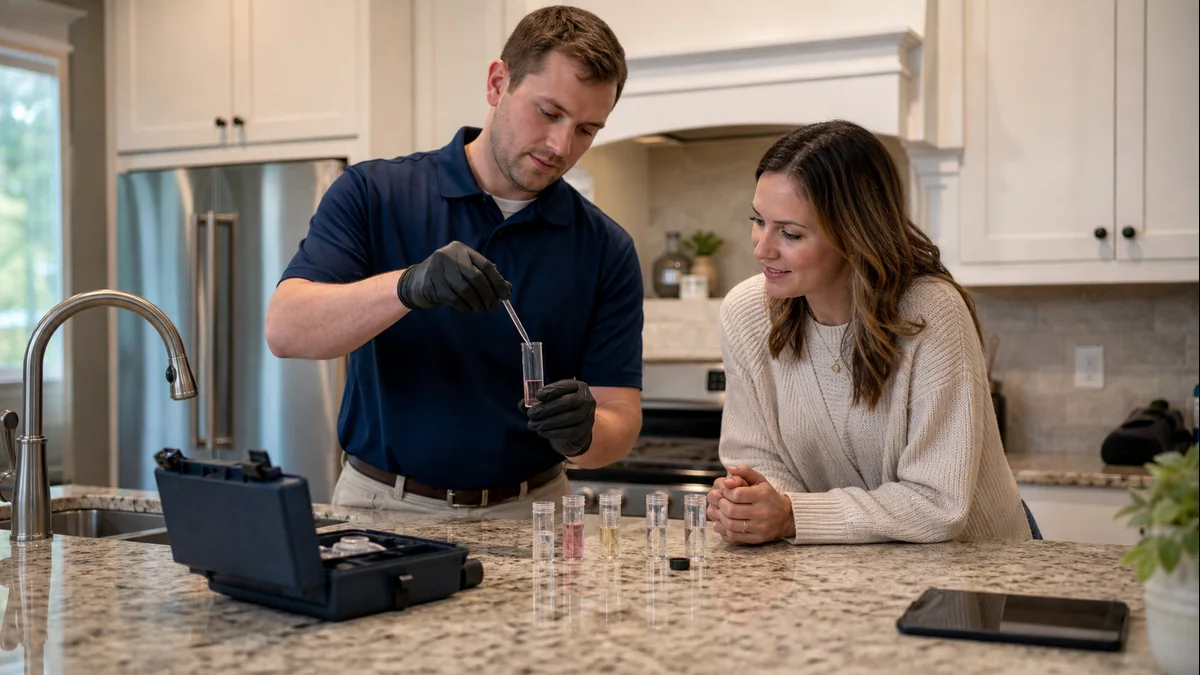
Raleigh Water's own 2025 report states average hardness of 25.2 ppm, with a system range of 21.9 to 35.3 ppm — roughly 1.3 to 2.1 grains per gallon (gpg). On the Water Quality Association scale the Hach Total Hardness Test Kit (Model 5-B) uses, that whole range falls in the "slightly hard" band. That's Raleigh's own published number, and it isn't in dispute.
Our own testing across the service area measures higher: 1.6 to 3.7 gpg by ZIP code, slightly hard to moderately hard on the same scale. Neither figure is wrong — Raleigh's is a plant-wide average, and ours is measured address by address. The gap between the two is exactly why the number that matters for your house is the one from your own tap, not either published average.
Are There Chlorine Byproducts in My Water? Which Row Covers That?
Look for TTHM and HAA5. Raleigh's 2025 report shows total trihalomethanes averaging 34.2 ppb, ranging up to 42.8, against a legal MCL of 80 ppb. Haloacetic acids (HAA5) average 22.0 ppb, ranging up to 33.6, against an MCL of 60 ppb. Both rows are fully compliant, with no violations reported.
EPA's National Primary Drinking Water Regulations table lists TTHM's potential health effect from long-term exposure above the MCL as "Liver, kidney or central nervous system problems; increased risk of cancer," and HAA5's as "Increased risk of cancer." Compliance here is real, and it should be taken at face value — Raleigh isn't violating anything.
But the MCL is a ceiling EPA set at the edge of its own acceptable risk, not a guarantee that everything under it is worth ignoring. A carbon filtration stage removes both compounds directly, rather than relying on staying under the legal number.
What About Pesticides Like Atrazine? Is There a Row for That?
No — and that absence is actually informative. Raleigh's 2025 report carries no atrazine, simazine, or other pesticide/herbicide line at all. Under a CCR's own disclosure rule, only detected substances get a row; something tested for and never found simply isn't listed. Read correctly, a missing pesticide row is a genuine non-detect, not a gap in the reporting.
Why Did My Water Taste Like a Swimming Pool for a Few Weeks This Spring?
That's a real, expected pattern, not a sign of a problem. Raleigh Water normally disinfects with chloramine, and once a year converts to free chlorine only, on the North Carolina Department of Environmental Quality's recommendation, flushing the distribution system as it goes. Free chlorine has a stronger, more noticeable smell and taste than chloramine, which is why plenty of Wake Forest residents notice it every spring.
The exact dates shift year to year — historically the conversion runs from the last week of February through the first week of April, and it ran February 26 through April 2 in 2026. Don't plan around a fixed calendar date; check the City of Raleigh's own current-year announcement instead.
Does the Report Tell Me What's Actually Coming Out of My Wake Forest Tap?
Not directly, and this is the honest limit of any CCR. Raleigh's hardness, TTHM, and HAA5 figures are plant-wide averages or system-wide ranges — they describe water leaving the treatment plant and moving through the whole distribution system, not a reading from any single Wake Forest address. Pipe age, distance from the plant, and how long water sits before a faucet opens all shift what actually reaches your glass.
| What you want to know | What Raleigh's CCR shows | What settles it for your address |
|---|---|---|
| Water hardness | 1.3–2.1 gpg average, plant-wide | A test (Hach Model 5-B) or free analysis |
| Chlorine byproducts (TTHM, HAA5) | Compliant averages, system-wide | Carbon filtration removes them regardless of the reading |
| Pesticides (atrazine, simazine) | No row — genuine non-detect | N/A — already a clean result |
| Spring chlorine taste | Documented annual event, dates vary | Check Raleigh's current-year announcement |
Is Wake Forest's Water Actually Different From Raleigh's?
Not in any way the report can show. Since Wake Forest and Raleigh share the same treatment and distribution system, the water reaching a Wake Forest kitchen is governed by the same CCR, the same hardness average, and the same disinfection numbers as anywhere else on Raleigh Water's system. What differs, address to address, isn't the plant — it's the distance the water traveled and the plumbing it passed through to get there.
What Should I Actually Do With This Report?
Use it for what it's built for: confirming Raleigh Water's compliance on hardness, disinfection byproducts, and pesticides, all measured against real legal limits. Then treat the plant-vs-tap gap as the actual next step, since no CCR, from any town, resolves it. A free water analysis gets you your own number, and it's exactly what sizing an all-in-one softening-and-carbon system for your Wake Forest address requires.
FAQ
I just moved to Wake Forest and can't find a "Wake Forest water report" anywhere — am I looking in the wrong place? Yes — Wake Forest doesn't publish its own report because it doesn't run its own treatment plant. Look for Raleigh Water's Consumer Confidence Report instead; that's the document covering your address.
My glasses come out spotty even though Raleigh's report calls the water "slightly hard" — is something wrong? No, both things are true at once. Raleigh's 25.2 ppm average is a plant-wide figure, and our own testing measures up to 3.7 gpg by ZIP — spotting is consistent with the higher end of that range, which an address-level test would confirm.
I noticed my water tasted stronger, almost like a pool, for a few weeks this spring — is that normal? Very likely, yes. Raleigh Water converts from chloramine to free chlorine once a year to flush the system, on the state's recommendation, and free chlorine has a more noticeable smell and taste than chloramine while it's in effect.
Does Raleigh's report say Wake Forest water is safe from pesticides? It shows no atrazine, simazine, or other pesticide line at all, which under the report's own disclosure rule means those substances weren't detected — a genuinely clean result, not an omission.
Why does Raleigh's hardness number look lower than what I've read elsewhere for the Triangle? Raleigh's published figure is a system-wide average measured at the plant; our own testing across the service area measures higher, up to 3.7 gpg, because it's read address by address instead of averaged. Both are accurate — they're just answering different questions.
Where can I actually read Raleigh Water's report myself? It's published as a PDF on the City of Raleigh's website — see the Sources section below for the direct link.
See What Your Own Wake Forest Tap Actually Shows
Raleigh's report is accurate about what it measures system-wide — it just can't tell you your own address's number. Take the 60-second water quiz or request a free water analysis to find out what's actually coming out of your Wake Forest tap, hardness included.
Sources
- City of Raleigh — Raleigh Water 2025 Consumer Confidence Report
- EPA — National Primary Drinking Water Regulations
Related reading: Water Treatment in Wake Forest, NC | Raleigh Water Hardness | Is Wake Forest, NC Water Hard? | Raleigh Water's Spring Chlorine Conversion | How to Test Water Hardness at Home
Answer nine practical questions, then request a written quote or well-water analysis.
Start My Water Analysis