
How to Get Rid of Chlorine Taste in Tap Water
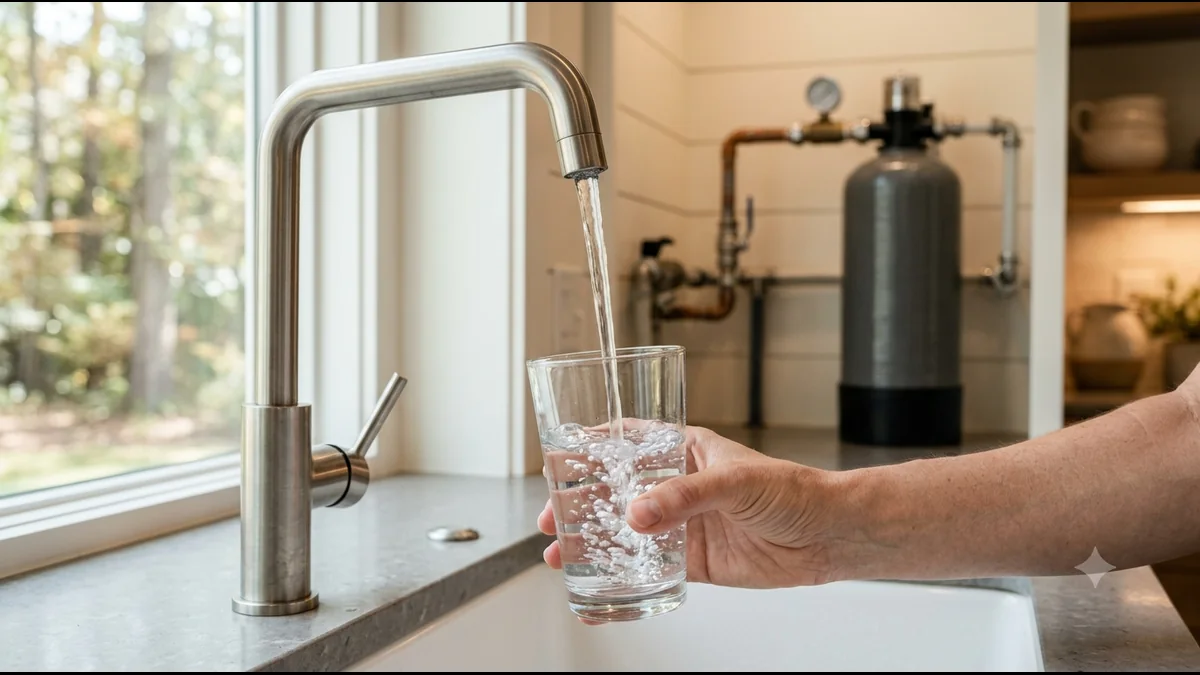
Direct answer: Raleigh Water's normal residual is chloramine, which the utility describes as having no taste or odor of its own — so if your tap suddenly tastes or smells like chlorine, you're most likely in Raleigh Water's brief, publicly announced annual conversion to free chlorine for system flushing. A pitcher filter helps at one faucet; a whole-home carbon system removes the taste at every tap, the shower, and the laundry, all year.
Why does my tap water sometimes taste like chlorine?
Because the disinfectant in your water changes for part of the year. Raleigh's Dempsey E. Benton Water Treatment Plant runs a process that, as the utility describes it, "begins with adding ozone to the raw water and ends with ultraviolet (UV) disinfection and chloramination," and "the filtered water is then disinfected with both ultraviolet light and chloramines." That means the normal, day-to-day residual moving through Raleigh's distribution system is chloramine, not free chlorine — and chloramine is the disinfectant Raleigh describes as having no taste or odor associated with it. When you do notice a distinct chlorine taste or smell, it's usually a sign that the disinfectant in your water has temporarily changed, not that something has gone wrong with your plumbing.
What is Raleigh Water's annual chlorine conversion, and does it mean something is wrong?
No — it's a normal, planned part of maintaining the distribution system. Raleigh Water runs a publicly announced annual temporary conversion to free chlorine to flush the pipes across its network, a standard maintenance step used by chloramine systems generally. Raleigh Water announces the period itself each year, and the exact timing and length vary, so the best source for current dates is Raleigh Water's own announcement rather than a fixed calendar. Free chlorine, unlike the chloramine residual that runs the rest of the year, does have a noticeable taste and smell to many people — which is exactly why this is the stretch when households most often notice it. It's a deliberate, compliant part of keeping the system clean, not a defect in your water.
Why is a disinfectant residual in my water at all?
Because it's what keeps treated water safe between the plant and your faucet. EPA sets the Maximum Residual Disinfectant Level (MRDL) at 4.0 mg/L, measured as Cl2, for both chlorine and chloramine — the highest level either disinfectant is allowed to reach. Utilities maintain a residual at or under that limit all the way through the distribution system on purpose, so water stays protected against recontamination for the entire trip from the plant to your tap. That's a feature of public water systems, not something to try to eliminate at the source — the goal at home isn't to stop the utility from disinfecting, it's to remove the taste and byproducts once the water reaches your own faucet.
Does a pitcher or fridge filter get rid of the taste?
Yes, at the one tap or dispenser it treats. A pitcher or fridge filter certified under NSF/ANSI 42 — the standard covering aesthetic effects like chlorine, chloramine, taste, and odor — can noticeably improve the water that passes through it. The catch is scope: that filter only treats the water poured through it. It does nothing for the shower, the kitchen faucet you didn't pour from, the ice maker, or the washing machine, all of which still carry the same residual. And because reduction claims vary by product even within the same NSF/ANSI 42 category, the specific certified claim on the package matters more than the phrase "NSF certified" by itself.
Why is chloramine harder to filter than chlorine?
Because it's a more chemically stable, more persistent compound. Free chlorine breaks down relatively quickly on contact with activated carbon. Chloramine is more resistant to that same reaction, which means removing it effectively takes more carbon contact time and more certified carbon capacity than a basic filter is built to provide. That's a meaningful distinction for anyone on Raleigh's system specifically, since chloramine is the day-to-day residual most of the year — a filter sized and certified for chlorine alone may underperform on chloramine, even if the taste seems similar.
What's the real difference between a pitcher filter and a whole-home carbon system?
Scope and capacity are the two things that separate them.
| Feature | Pitcher or fridge filter | Whole-home carbon (all-in-one system) |
|---|---|---|
| Taps covered | One tap or dispenser | Every tap in the house |
| Shower and laundry | Not covered | Covered |
| Chlorine and chloramine taste | Reduced at that one tap, if certified for it | Reduced house-wide |
| Disinfection byproducts (HAA9, TTHM) | Limited, product-dependent | Removed effectively by activated carbon |
| Certification to check | NSF/ANSI 42 (aesthetic effects: chlorine, chloramine, taste, odor) | Same standard, sized for whole-home contact time and capacity |
Does removing the chlorine taste also deal with disinfection byproducts?
Yes, and it's worth handling both at once. Disinfection byproducts — haloacetic acids (HAA9) and trihalomethanes (TTHM) — form as a normal result of disinfecting water, and both are documented in Triangle systems: Raleigh reports HAA9 at 19.9 ppb and TTHM at 21.7 ppb; Cary reports HAA9 at 27.5 ppb and TTHM at 38.2 ppb. Both utilities are compliant with EPA's legal limits. Activated carbon removes HAA9 and TTHM effectively, the same media doing the work on chlorine and chloramine taste. A single whole-home carbon stage addresses the taste complaint and the byproduct question together, rather than treating them as separate problems.
How do I know a filter will actually work on my specific water?
Check the certified claim, not just the certification name. NSF/ANSI 42 covers aesthetic effects — chlorine, chloramine, taste, and odor. NSF/ANSI 53 covers health effects. Both apply to adsorption and filtration media, including carbon, and both apply to point-of-use products (pitchers, under-sink units) as well as point-of-entry, whole-house systems — but the specific reduction claim is what's certified, and that claim varies by product. The most reliable way to know what your own water needs is a free water analysis rather than a guess from a product label, since that tells you what's actually in your water before you choose a system sized to handle it.
Frequently Asked Questions
I only notice the chlorine smell for a couple of weeks each year — is that normal? Yes. That window lines up with Raleigh Water's publicly announced annual conversion to free chlorine for system flushing. The rest of the year, the normal chloramine residual runs with little to no taste or odor, which is why the change stands out when it happens.
My tap water smells fine most of the year — why does it change? Raleigh's day-to-day disinfectant is chloramine, described by the utility as having no taste or odor of its own. During the brief annual conversion to free chlorine, the residual changes to a disinfectant that many people can taste and smell, then returns to chloramine once flushing is complete.
Does a pitcher filter remove chloramine, or only chlorine? Some do, but not all — check the package for a chloramine-specific reduction claim under NSF/ANSI 42, since chloramine is more chemically stable and harder to reduce than free chlorine. A filter rated only for chlorine may not perform the same way on chloramine.
What's the difference between NSF/ANSI 42 and NSF/ANSI 53? NSF/ANSI 42 covers aesthetic effects — chlorine, chloramine, taste, and odor. NSF/ANSI 53 covers health effects. Both can apply to carbon filtration, and both cover point-of-use and whole-house products, but the specific certified claim on a given product is what tells you what it actually reduces.
I have a whole-home carbon system — do I still need a separate pitcher filter? No. A whole-home carbon stage already treats water at every tap, the shower, and the laundry, which is the coverage a pitcher filter can't provide on its own. The all-in-one system adds softening on top of that, handling scale and taste together.
Will removing the chlorine taste also help with the disinfection byproducts I've read about? Yes. Activated carbon that reduces chlorine and chloramine taste is the same media that removes HAA9 and TTHM effectively, so a whole-home carbon stage addresses both at the same time rather than requiring a separate step.
Ready to fix it at every tap?
Take our 60-second water quiz to see which all-in-one system fits your home, or request a free water analysis to see exactly what's in your water before you choose.
Related reading: NSF Certifications for Water Filters Explained | Best Whole House Filter for City Water | Is a Whole House Water Filter Worth It? | Does Activated Carbon Remove PFAS? | Water Softener vs. All-in-One System
Answer nine practical questions, then request a written quote or well-water analysis.
Start My Water Analysis