
How to Tell If Your Water Softener Is Broken in Cary, NC
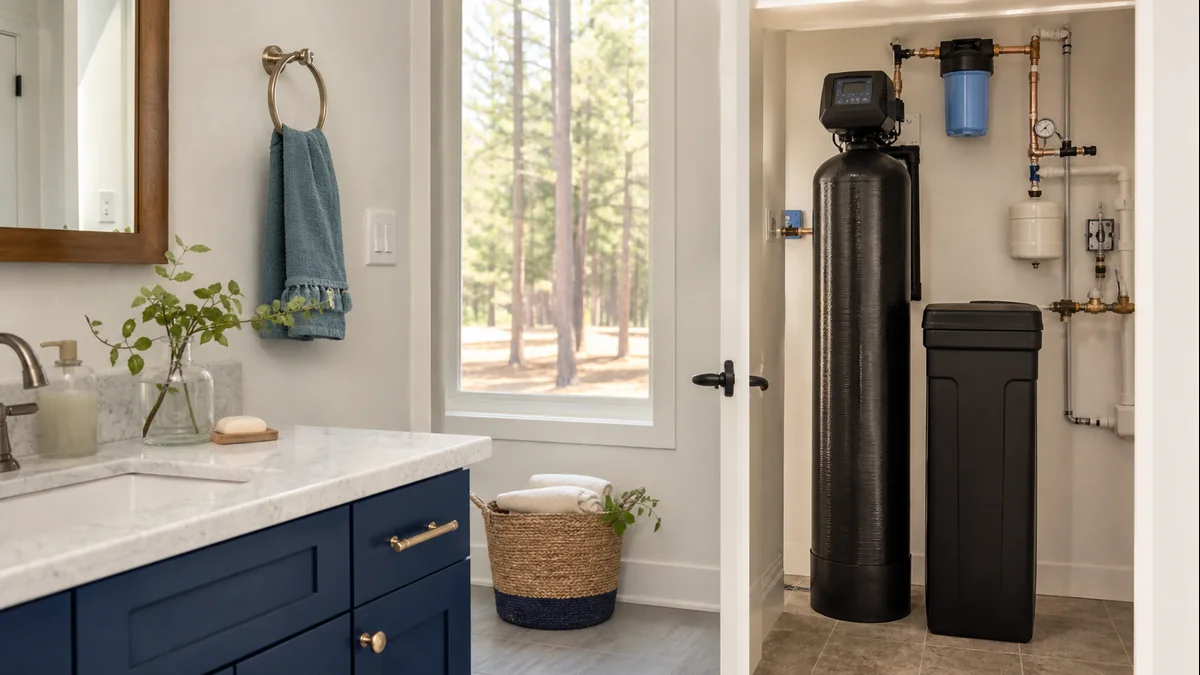
Direct answer: Watch for soap that won't lather like it used to, spotting returning on glassware, scale reappearing on fixtures, salt sitting untouched in the brine tank, or regeneration behavior that's shifted from its own normal pattern. Triangle Waterworks installs new all-in-one systems rather than repairing existing units, so once your softener changes from its own baseline, the next step is a free water analysis and a replacement built for Cary's water.
What Are the Signs My Water Softener Has Stopped Working the Way It Used To?
A softener that's failing shows up in your water before it shows up on the machine itself. The signals worth paying attention to:
- Soap and shampoo that used to lather easily and now don't
- Spotting or a cloudy film returning on glasses and shower doors after it had been gone for a while
- Scale building back up on faucets, showerheads, or fixtures that had stayed clear
- Salt in the brine tank barely moving between refills, or moving in a way that doesn't match how it used to
- Regeneration timing, frequency, or water use that's shifted noticeably from how your unit has always run
One of these on its own is worth noticing. Several showing up together, especially on a system that's been in place for years, is a stronger signal that the unit is reaching the end of what it can reliably do.
Why Would My Softener Suddenly Stop Using Salt?
Salt that isn't moving usually means it's no longer reaching the resin bed the way it should during regeneration. That can happen for a few different reasons inside an aging unit, and diagnosing which one applies isn't something Triangle Waterworks does for equipment we didn't install and don't service.
What matters for a Cary homeowner is simpler: if salt consumption has changed from what's normal for your household, and hardness symptoms are showing up alongside it, that combination is worth acting on rather than watching for another billing cycle.
Why Does My Water Feel Different Even Though the Softener Still Seems to Be Running?
A softener can keep cycling and still stop delivering the result it used to. The unit powering on, making noise, or going through its regeneration schedule doesn't confirm it's actually removing calcium and magnesium the way it was when it was new — those are two separate questions, and only a water test answers the second one.
If your water feels or behaves differently than it did — stiffer laundry, spots you hadn't seen in years, soap that won't cut through the way it should — trust what you're noticing over the fact that the machine still appears to be running.
Why Doesn't Triangle Waterworks Repair or Service Existing Softeners?
Because our business is installing and standing behind new all-in-one systems, not diagnosing or servicing equipment — ours or another brand's — that's already in the ground. We can't verify the condition of a valve, resin bed, or internal part we didn't install, and we're not positioned to guess at it. What we can do is test your current water directly and tell you honestly what it shows.
For a Cary household noticing softener symptoms, that means the practical next step isn't a repair call — it's a water test that confirms what's actually happening, followed by a decision about whether an upgrade makes sense.
What Should Replace an Aging Softener in a Cary Home?
An all-in-one system that pairs softening resin with a carbon filtration stage covers more ground than the softener it replaces ever did. A standalone softener only ever did one job — exchanging calcium and magnesium out of the water. It never touched chlorine or chloramine taste, and it never addressed the disinfection byproducts documented in Cary's own water quality report.
Staying under an EPA limit is a genuine pass, not a reason to stop there — the limit is simply the point EPA decided long-term exposure becomes a real risk, and Cary's reported levels sit below it. A softener never touched either compound; the carbon stage in a replacement system does.
What the upgrade adds on top of what your old unit used to do:
- Removes chlorine and chloramine taste and odor at every tap in the house
- Addresses disinfection byproducts that softening resin was never built to touch
- Still protects your water heater, dishwasher, washer, and plumbing from mineral buildup
- Installs and runs as one system, sized to your specific address after a free water analysis
Signs and What They Point Toward
| What you're noticing | What it usually points to | What we recommend |
|---|---|---|
| Soap won't lather like before | Softening performance has dropped from baseline | Free water analysis |
| Spotting or film returning on glassware | Hardness minerals no longer being fully removed | Free water analysis |
| Salt barely moving in the brine tank | A change in how the unit is regenerating | Free water analysis |
| Scale reappearing on fixtures | Softening capacity declining | Free water analysis |
| Regeneration pattern shifted from normal | Unit behavior no longer matches its own baseline | Free water analysis |
| Several of the above together, on an older unit | Softener reaching the end of reliable service | Replacement quote |
How Do I Confirm What's Actually Happening With My Cary Water?
The most reliable way to confirm a softener issue is to test the water itself rather than guess from symptoms alone. An at-home hardness test using the Hach Total Hardness Test Kit, Model 5-B, tells you your current grains-per-gallon reading, which you can compare against how your water used to feel. From there, a free water analysis confirms the fuller picture and shows what a replacement system would be sized to handle. See water softener quote in Cary, NC for what goes into that number.
Ready to Replace Rather Than Guess?
If your Cary softener isn't performing the way it used to, the answer isn't a repair call — it's a free water analysis that shows exactly what's happening and what an all-in-one replacement would cover. Take the 60-second water quiz or book your free analysis to see what's next for your home.
For more on Cary's water and what a system built for it actually covers, see water softener Cary, NC. For a closer look at timing, see when to replace a water softener in Cary, NC, and for the broader case on upgrading, see is a water softener worth it in Cary, NC?
FAQ
I noticed spots on my glasses again after years of clear dishes — does that mean my softener is broken? Spotting returning after a long stretch of clear glassware is one of the clearest signs softening performance has dropped from where it used to be. Rather than guessing at the cause, a water test confirms what your softener is actually delivering right now, and a free water analysis shows what a replacement system would be sized to handle.
My salt tank still has most of a bag left over from last month — is that normal? If that's a real change from how your household normally uses salt, it's worth paying attention to rather than assuming it will resolve on its own. Combined with any other symptom — spotting, less lather, scale coming back — it's a reasonable trigger for a free water analysis.
Why does my softener seem to be regenerating more often than it used to? A change in regeneration frequency from your unit's own normal pattern is a sign worth taking seriously, especially alongside other symptoms. Since Triangle Waterworks doesn't service existing equipment, the most useful next step is a water test that shows what's actually happening rather than trying to interpret the machine's behavior alone.
Is it worth calling someone to fix my old softener, or should I just replace it? Triangle Waterworks installs new all-in-one systems rather than repairing units already in the ground, so we can't speak to what a repair on your specific unit would involve. What we can do is test your water directly, and if softening performance has dropped, a replacement built around a free water analysis covers both the hardness and the chlorine and disinfection byproducts your original softener never addressed.
How do I know if it's really my softener and not just Cary's water changing? A water test settles that directly — if your hardness reading matches what Triangle Waterworks measures across Cary addresses generally, the water itself hasn't shifted and the change is in your equipment's performance. A free water analysis makes that comparison for you.
If I replace my softener, does the new system fix more than just hardness? Yes — an all-in-one system replaces the softening function your old unit provided and adds a carbon stage that addresses chlorine, chloramine taste, and the disinfection byproducts documented in Cary's own water quality report, none of which a standalone softener ever covered.
Sources
Answer nine practical questions, then request a written quote or well-water analysis.
Start My Water Analysis