
How to Tell If Your Water Softener Is Broken in Raleigh, NC
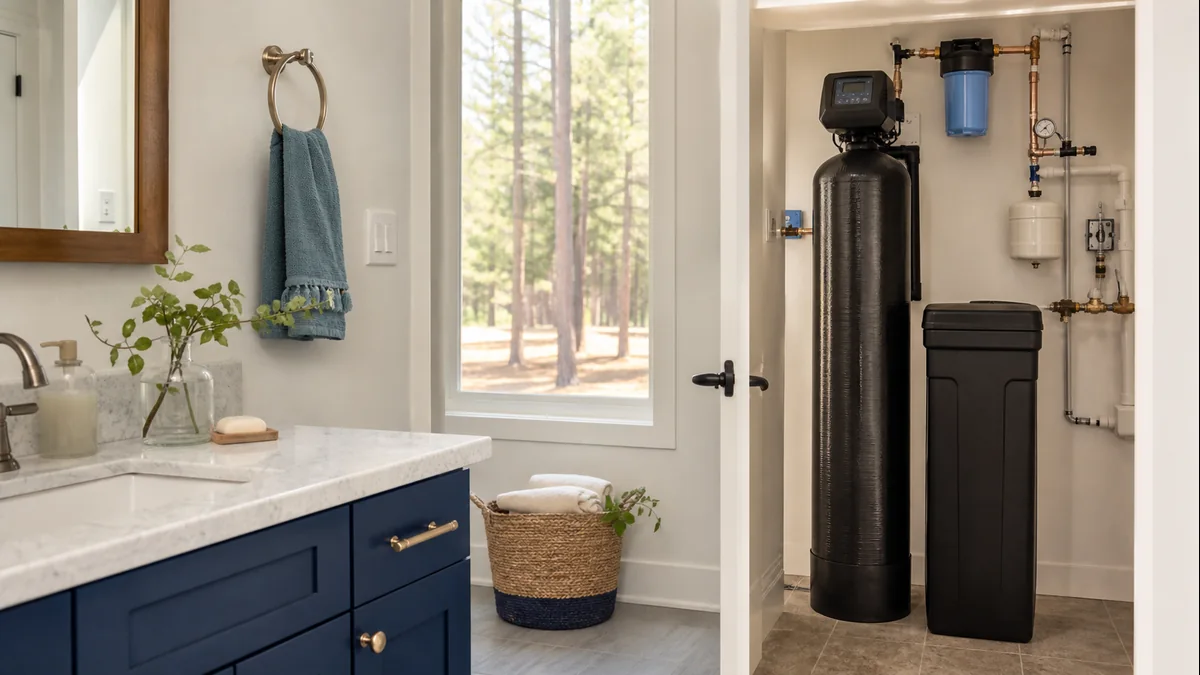
Direct answer: The clearest signs are spotting on glassware, soap that won't lather, scale returning on fixtures, a brine tank that isn't using salt, or a unit that runs and regenerates constantly. Most of these trace to a fixable cause — a salt bridge, salt mush, or a stuck control valve — while an exhausted resin bed on an aging unit usually signals it's time to upgrade to an all-in-one system that softens water and filters out chlorine and disinfection byproducts in one pass.
What Are the Signs a Water Softener Has Stopped Working Properly?
A failing softener shows up first in the water itself, not the machine. Watch for:
- Spotting or a cloudy film reappearing on glassware and shower doors after months or years of it being gone
- Soap and shampoo suddenly not lathering the way they used to
- Scale building back up on faucets, showerheads, or inside the coffee maker
- Laundry coming out stiffer or duller than usual
- Salt in the brine tank not going down between refills
- The unit running, cycling, or regenerating far more often than normal, sometimes multiple times a day
Any one of these on its own can have a simple explanation. Several showing up together is the strongest signal something in the system needs attention — and worth diagnosing before assuming a full replacement is the only option.
Why Is My Softener Not Using Salt?
Salt sitting untouched in the brine tank almost always points to a blockage between the salt and the resin, not a broken machine. The two most common causes are a salt bridge (a hard crust forming above the water line, leaving an air gap underneath) and salt mush (a thick sludge settling at the bottom, usually from lower-quality salt or humidity in the tank). Both physically prevent the brine solution from reaching the resin bed during regeneration, so the softener keeps running its cycle without actually recharging the resin — which is why hardness symptoms can return even though the tank still shows plenty of salt.
What's the Difference Between a Salt Bridge and Salt Mush?
A salt bridge is a solid crust across the tank, usually from humidity or old salt clumping together, and it can typically be broken up by pressing gently down through it and letting the salt below dissolve normally. Salt mush is a wet, sludge-like buildup at the bottom rather than a crust up top, and it usually needs to be scooped or vacuumed out along with any leftover water before adding fresh salt. Both are maintenance issues, not mechanical failures, and both are worth ruling out before assuming the unit itself has a bigger problem. How to maintain a water softener walks through routine brine tank care that helps prevent either one from building up again.
Could the Control Valve Be Stuck or Failing?
A control valve that's stuck or failing usually shows up as a unit that won't regenerate on schedule, won't regenerate at all, or cycles at random times regardless of actual water use. The valve tells the softener when to regenerate and how much water and salt to use, so when it sticks — from age, mineral buildup, or a worn seal — the schedule can go out of sync with your household's actual needs. A valve failing outright, rather than sticking occasionally, is one of the stronger signals a unit is nearing the end of what's reasonably repairable.
Is Resin Bed Exhaustion Fixable, or Does It Mean Replacement?
Resin bed exhaustion means the resin has lost its ability to exchange calcium and magnesium for sodium, and it's the one failure mode here that isn't something you clean or reset — it's a media issue, not a mechanical one. Resin naturally loses capacity over years of regeneration cycles, and iron or other minerals in the water can foul it faster than plain hardness alone would. When exhausted resin is the cause, hardness symptoms return even with a clean brine tank, working salt, and a properly cycling valve. As a unit ages, resin performance is worth having checked rather than guessed at. Water softener lifespan: how long do they last? covers how resin condition factors into a unit's overall service life.
What's Fixable vs. What Signals It's Time to Upgrade?
Most single-issue symptoms are fixable with routine attention, while multiple issues together on an older unit make the stronger case for replacing it.
| Symptom | Likely Cause | Typically Fixable? |
|---|---|---|
| Salt tank not going down | Salt bridge or salt mush | Yes — clear the blockage, resume normal regeneration |
| Occasional off-schedule regeneration | Valve needs adjustment or minor part wear | Often — worth having checked |
| Spotting returns after a bridge/mush is cleared | Resin losing exchange capacity | Sometimes — depends on resin condition and unit age |
| Valve won't cycle at all | Valve failure | Sometimes — depends on parts availability for the unit's age |
| Hardness symptoms plus constant running plus salt use issues, all together | Aging system nearing end of service life | Usually the point to plan a replacement |
Seeing one item on this list is almost always worth troubleshooting first. Seeing several at once on a system that's been in place for years is what points toward planning a replacement rather than another repair.
What Should I Upgrade To If My Old Softener Needs Replacing?
The strongest replacement for an aging single-purpose softener is an all-in-one system that combines softening resin with a carbon filtration stage, because it fixes the mineral problem your old unit handled and adds coverage for everything it never touched. A standalone softener only ever did one job: exchanging calcium and magnesium out of the water through ion exchange. It never addressed chlorine or chloramine taste and odor, and it never touched the disinfection byproducts — haloacetic acids (HAA9) and trihalomethanes (TTHM) — that show up in any chloraminated municipal supply, our own area included. That's not a flaw in your old unit; it's simply outside what a softening-only system was ever built to do.
What an all-in-one system covers that a standalone softener never did:
- Removes chlorine and chloramine taste and odor at the tap
- Addresses documented disinfection byproducts that softening resin has no effect on
- Still protects your water heater, dishwasher, washer, and plumbing from mineral buildup
- Runs as one system instead of managing separate equipment for softening and filtration
- Sized to your home's actual water after a free water analysis, rather than guessed at
Replacing a unit that's served you well for years with an all-in-one setup is an upgrade in coverage, not just a swap. See water softener vs. all-in-one system for a fuller side-by-side.
How Do I Confirm What's Actually Going On With My Water?
The most reliable way to confirm a suspected softener problem is to test your water directly rather than guess from symptoms alone. A simple at-home hardness test using the Hach Total Hardness Test Kit (Model 5-B, drop-count titration) tells you exactly how many grains per gallon are coming out of your tap right now, which you can compare against how your softener was originally performing. How to test water hardness at home walks through that process. From there, a free water analysis or the 60-second water quiz can confirm whether the issue is a fixable maintenance item or a sign it's time to plan a replacement — and if so, water softener installation in Raleigh covers what that looks like.
Frequently Asked Questions
I noticed spots on my glasses again after years of clear dishes — did my softener break? Returning spots after a long stretch of clear glassware usually means the softener has stopped effectively removing calcium and magnesium, whether from a salt bridge, a stuck valve, or resin that's lost capacity. Check the brine tank first, since a bridge or mush is the most common and easiest fix. If the tank is clear and salt is being used normally, a water test will confirm whether resin is the underlying cause.
My salt tank still has most of a bag left over from last month — is that a problem? Salt barely moving usually means it isn't reaching the resin bed during regeneration, most often because a salt bridge or salt mush is blocking the brine from draining properly. Both are maintenance issues you can typically clear yourself, and normal salt usage should resume once the blockage is gone.
Why does my softener seem to regenerate every single day instead of every few days? Regenerating far more often than usual points to either a valve cycling on the wrong schedule or a household using more water than the unit is set for. A control valve issue is common on older units and is worth having checked, since constant regeneration also burns through salt and water faster than necessary.
Can a stuck control valve be repaired, or do I need a whole new system? A stuck or worn valve can often be adjusted or have a part replaced, especially on a unit otherwise in reasonable shape. On an older system already showing other wear, a valve failure often tips the decision toward replacing the whole unit.
How do I tell the difference between a salt bridge and my resin actually being worn out? Clear any bridge or mush first, add fresh salt, and let the softener run a normal cycle — if symptoms disappear, the blockage was the whole problem. If spotting or poor lathering persist with a clean tank and working salt, that points toward the resin, and a water test will confirm it.
Is it better to keep repairing my old softener or upgrade to an all-in-one system? A single, isolated issue like a salt bridge is almost always worth clearing rather than replacing the unit. But once several symptoms show up together on a system that's been in service for years, upgrading to an all-in-one system that adds carbon filtration alongside softening gets you ahead of the next repair. A free water analysis is the fastest way to see where your system stands.
Answer nine practical questions, then request a written quote or well-water analysis.
Start My Water Analysis