
How to Test Your Tap Water for PFAS in Rolesville, NC
Direct answer: Rolesville is served by Raleigh Water, and its annual water quality report and the EWG Tap Water Database both show system-wide results, not a number for your specific address. The only way to get an actual PFAS reading for your own tap is a certified laboratory test, sampled exactly to the lab's instructions. Once you have that number, the fix is carbon certified for PFAS reduction or reverse osmosis — which is why Triangle Waterworks builds its whole-home system as softening resin plus a carbon stage, not a softener alone.
Where Do I Start Looking for PFAS Information About My Water?
Start with what's already published. Raleigh Water — the utility that serves Rolesville, along with Raleigh, Garner, Knightdale, Wake Forest, Wendell, and Zebulon — issues an annual water quality report summarizing what it tested for and found across the whole system. That report is a real, useful starting point, and it's public. What it can't do is tell you what's coming out of your specific faucet. It's built from samples taken at a handful of monitoring points across an entire distribution network, not an address-by-address readout. Two homes on the same utility, a few streets apart, can see different results depending on plumbing and where they sit in the distribution line.
What Does the EWG Tap Water Database Add That the Utility Report Doesn't?
The EWG (Environmental Working Group) Tap Water Database pulls together utility-reported testing results nationwide and compares them against two different bars: the EPA's legal limit and EWG's own stricter, non-regulatory health guideline. It's a genuinely useful tool, and it's worth searching by utility name before you do anything else. But it carries the same limitation as the utility's own report — it's aggregated at the system level, built from what the utility tested and reported. If a compound wasn't tested for, or wasn't tested recently, the database can't show a number that doesn't exist. Neither source substitutes for a reading taken at your own tap.
How Do I Get an Actual PFAS Number for My Own Tap?
A certified laboratory test is the only way to get a PFAS result specific to your address. PFAS — a large family of synthetic compounds that persist in the environment and are often called "forever chemicals" — aren't something a home hardness kit or a chlorine test strip can measure. Testing for them requires a laboratory equipped and certified for PFAS analysis specifically, using methods sensitive enough to detect the compounds at the concentrations they're actually present in.
That sensitivity is the whole reason sampling instructions matter so much. PFAS results are reported in parts per trillion (ppt) — a unit a thousand times smaller than parts per billion (ppb), which is itself already a very small measurement. At that scale, something as ordinary as touching the inside of the sample bottle, using the wrong container, or letting the tap run for the wrong amount of time before collecting the sample can skew the result. A certified lab sends exact collection instructions — bottle type, flush time, how to handle the cap — and following them precisely is what makes the number you get back trustworthy. Skipping a step doesn't just risk an inaccurate result; it can produce a false positive or false negative that sends you in the wrong direction entirely.
What Does Triangle Waterworks' free Water Analysis Actually Check?
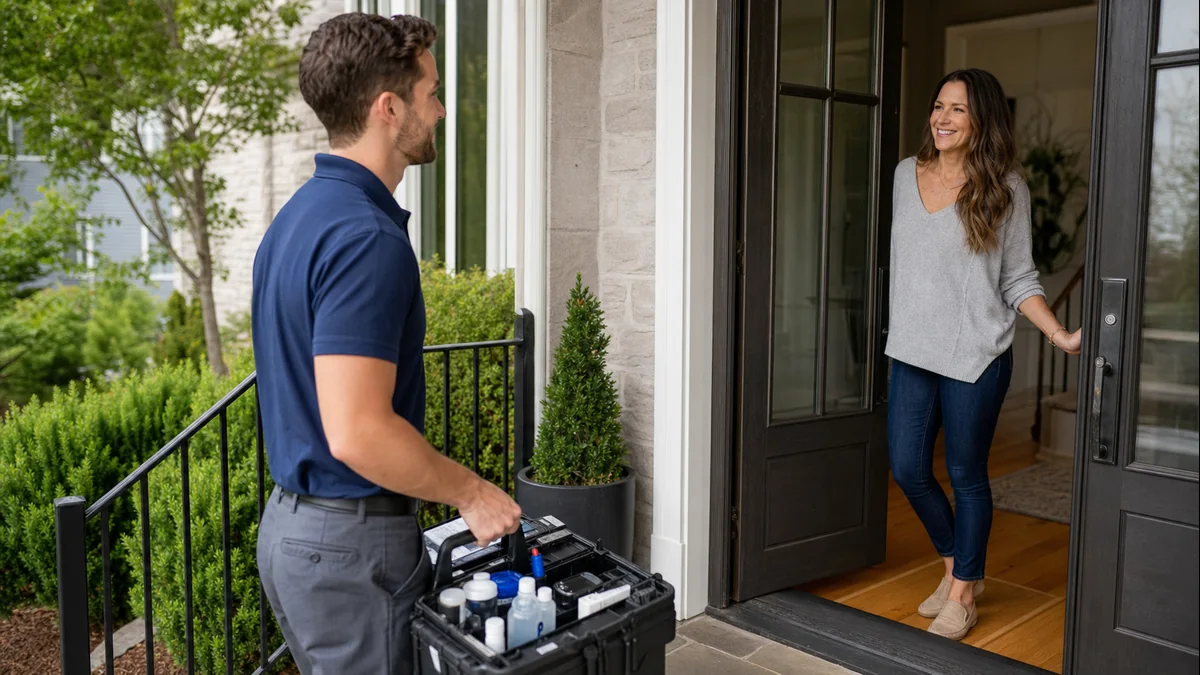
A free water analysis from Triangle Waterworks looks at hardness, chlorine, and what your home's plumbing and fixtures actually need — it's the tool for sizing a softening and filtration system correctly for your address. It is genuinely useful, and it's free. It is not, however, a certified PFAS lab test, and we want to be straightforward about that distinction. Our visit tells you what a whole-home system should be built to handle in general; a certified lab test tells you a specific PFAS number for your tap. They answer different questions — for the second one, a certified lab is the source, not a visit from any water treatment company, including us.
| Method | What It Tells You | What It Can't Tell You | Gives a PFAS Number? |
|---|---|---|---|
| Utility's annual water quality report | System-wide testing summary, published yearly | Results for your specific address | Only if the utility tested for it |
| EWG Tap Water Database | Utility-reported results compared to EPA limits and EWG's guideline | Same system-level limitation as the report above | Only if the utility tested for it |
| Certified laboratory test | An actual ppt reading for your own tap, if sampled correctly | Nothing beyond what you test for | Yes — the only source for a real number |
| Free water analysis (Triangle Waterworks) | Hardness, chlorine, and what your home needs for sizing a system | A certified PFAS ppt result | No |
Does Boiling My Water Get Rid of PFAS?
No. Boiling does not remove PFAS, and it can actually concentrate it. Boiling works on some contaminants by evaporating water or killing microorganisms, but PFAS compounds don't break down or evaporate that way. As water boils off, the PFAS that was dissolved in it stays behind in a smaller volume of liquid — so the concentration can go up, not down. It's an understandable assumption, since boiling is the go-to fix for a lot of water concerns. PFAS just isn't one of the contaminants it addresses.
What Actually Removes PFAS From Tap Water?
PFAS removal requires activated carbon certified specifically for PFAS reduction (NSF/ANSI 53 or P473) or reverse osmosis (NSF/ANSI 58). Not every carbon filter qualifies — the certification confirms the media has been tested and verified to reduce PFAS specifically, not just chlorine taste or sediment. Reverse osmosis works through a different mechanism, forcing water through a membrane fine enough to block PFAS molecules along with a wide range of other dissolved contaminants.
A water softener does neither of these things. Softening is ion exchange for calcium and magnesium — the minerals that cause scale — and it has no effect on PFAS. That's exactly why Triangle Waterworks builds its whole-home system as softening resin paired with a carbon stage, rather than a softener sold alone. The softening side protects your water heater, dishwasher, washer, and plumbing from mineral buildup; the carbon side handles chlorine and chloramine taste, documented disinfection byproducts, and PFAS when the carbon is certified for it. Raleigh Water measures slightly hard water, at roughly 1.6 grains per gallon (gpg) on the Water Quality Association scale the Hach Total Hardness Test Kit uses — genuinely low, and a real reason a softener sized for Rolesville runs efficiently. But low hardness has nothing to do with PFAS; that's a separate contaminant handled by a separate stage, which is the logic behind pairing the two in one system rather than installing either alone.
It's also worth naming the two bars in play. The EPA sets a legal, enforceable limit for PFOA and PFOS in drinking water at 4 parts per trillion each. EWG's health guideline for the same compounds is a separate, stricter, non-regulatory benchmark — a tool for judging risk conservatively, not a legal standard. A result can be under the EPA's limit and still sit above EWG's guideline; that's two different bars measuring two different things, not a contradiction. Either way, the only way to know where your own tap falls is a certified lab result.
Frequently Asked Questions
I just moved to Rolesville — how do I even find out if PFAS are in my water? Start with Raleigh Water's published annual water quality report and the EWG Tap Water Database, both of which show system-wide results for the utility that serves Rolesville. If you want a number specific to your own address, the next step is a certified laboratory test — that's the only source for an actual reading at your tap.
Is my water automatically fine if I can't find a PFAS violation on record? Not testing positive on a compliance report and having a specific number for your tap are two different things. Utility reports are system-wide and don't cover every address individually, so the only way to know your own number is a certified lab test.
I got a free water analysis from Triangle Waterworks — did that already test for PFAS? No — our free analysis checks hardness, chlorine, and what your home's plumbing needs for sizing a system correctly. It is not a certified PFAS lab test, and we want to be clear about that: for an actual PFAS ppt reading, a certified laboratory is the source.
What's the difference between ppb and ppt, and why does it matter for PFAS? Parts per trillion (ppt) is a thousand times smaller a unit than parts per billion (ppb). PFAS is measured and regulated in ppt because it's typically present, if at all, at extremely low concentrations — which is also why sample handling has to follow a certified lab's instructions exactly to get a reliable result.
Can I just boil my water to get rid of PFAS before I drink it? No. Boiling doesn't remove PFAS, and because boiling reduces the water's overall volume through evaporation, it can actually concentrate whatever PFAS was already there. Removing PFAS requires carbon certified for PFAS reduction or reverse osmosis.
Will a water softener take care of PFAS along with my hardness problem? No — a water softener is ion exchange for calcium and magnesium and has no effect on PFAS. That's why a whole-home system pairs softening resin with a separate carbon stage: one handles scale, the other handles chlorine taste, disinfection byproducts, and PFAS when the carbon is certified for it.
Related Reading
For the fuller picture on what "compliant" does and doesn't cover, see is Raleigh tap water safe — do I still need a filter? To read your own utility's published numbers with more context, see how to read your water quality report. If hardness is part of what you're weighing too, how to test water hardness at home covers the at-home GPG kit we recommend, and water softener vs. all-in-one system breaks down why softening alone doesn't cover taste or PFAS. For chlorine taste specifically, see how to remove chlorine taste from tap water.
Take the free 60-second quiz to see what an all-in-one system would look like for your Rolesville home, or book a free water analysis to get your hardness and chlorine numbers — and a clear next step if you also want a certified PFAS test for your own tap.
Answer nine practical questions, then request a written quote or well-water analysis.
Start My Water Analysis