
How to Test Tap Water Hardness in Holly Springs, NC
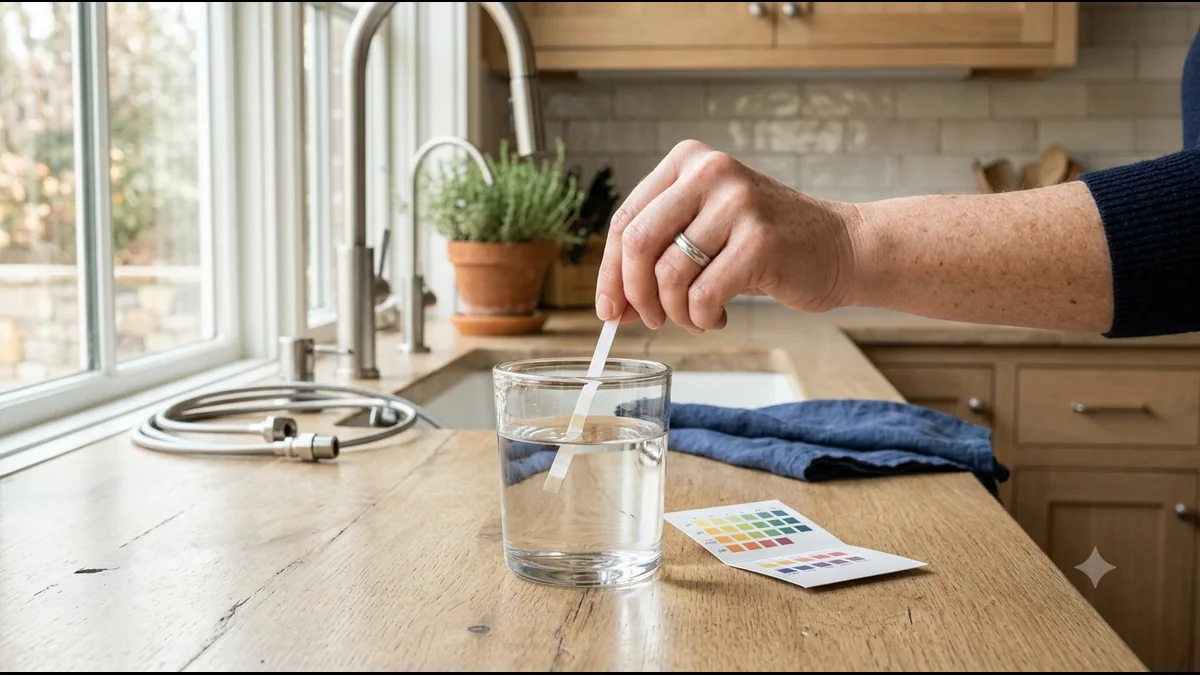
Direct answer: Test your Holly Springs tap directly — with a GPG titration kit, a test strip, a certified lab, or a free water analysis — because no verified hardness figure has been published for Harnett Regional Water's Cape Fear River supply. For the most accurate at-home read, use the Hach Total Hardness Test Kit, Model 5-B, which reads out in grains per gallon on the same Water Quality Association scale water-treatment systems are sized against. Whatever the number turns out to be, hardness is only part of the picture — the free analysis also checks for what a hardness test can't, and typically lands on an all-in-one softening-and-carbon system.
Why Can't I Just Look Up Holly Springs' Water Hardness?
Because no verified hardness number for Harnett Regional Water has been published anywhere we can point to. Holly Springs is supplied by Harnett Regional Water, which draws from the Cape Fear River — a surface-water source, different from the reservoir-fed systems some neighboring towns use. Some neighboring utilities publish a hardness figure in their annual reports; Harnett Regional Water is not one of them, at least not in a verified form. For most nearby towns there's at least a starting number to compare against. For Holly Springs, testing isn't the second-best option — it's the only honest one.
What's the Most Accurate Way to Test My Water at Home?
The most accurate at-home method is a GPG titration kit, and the one we recommend by name is the Hach Total Hardness Test Kit, Model 5-B (Drop Count Titration). It works by adding a reagent to a measured water sample drop by drop until the color changes — the number of drops needed corresponds to the water's hardness. What makes it the right choice for sizing decisions, not just curiosity, is that it reads out directly in grains per gallon (gpg) on the Water Quality Association (WQA) scale — the same scale the water-treatment industry classifies hardness against. The number you get from the kit and the classification you look up afterward speak the same language, with no unit conversion or guesswork in between.
What About Test Strips — Are They Good Enough?
Test strips are fast, inexpensive, and fine for a rough sense of where your water falls, but they're not built for precision. You dip a strip in a water sample, wait for a color change, and compare it against a printed chart — the result is a color-band estimate rather than an exact figure. That's useful for a quick sense of soft, moderate, or hard. It's less useful once the number is going to size a system, where the difference between two nearby bands changes how a softener should be configured. Strips are a reasonable first pass; a titration kit or lab test is the better source for a number you're going to act on.
Should I Send a Sample to a Certified Lab Instead?
A certified laboratory test is the most rigorous option, and the route to take if you want more than just a hardness number. A lab can test the same sample for a broader panel and returns a documented result rather than a self-read color match — a solid way to get a hardness figure alongside everything else in one report.
How Should I Actually Collect the Sample?
A few practical habits make any of these methods more reliable:
- Test from a tap you actually drink from — usually the kitchen sink — rather than an outdoor spigot or a rarely-used tap.
- Run the cold water briefly before sampling. Water sitting in the line doesn't reflect the actual supply; a short flush clears it so you're testing the real feed.
- Use the cold line, not hot. Water that's passed through a water heater can read differently than what arrives at your house.
Skipping this is a common way to get a misleading result.
What Do the Hardness Numbers Actually Mean Once I Have One?
Every method above maps to the same five-tier scale — the Water Quality Association scale the Hach Total Hardness Test Kit, Model 5-B, reads out on:
| Classification | gpg | mg/L (ppm) |
|---|---|---|
| Soft | <1.0 | <17 |
| Slightly hard | 1.0–3.5 | 17–60 |
| Moderately hard | 3.5–7.0 | 60–120 |
| Hard | 7–10.5 | 120–180 |
| Very hard | >10.5 | >180 |
Wherever your Holly Springs result lands on this scale tells you how the softening side of a system should be sized — how much resin capacity is needed and how often it should regenerate. It's a real, useful number, but not the whole story.
Comparing the Testing Methods
| Method | How it works | Reads out in | Precision |
|---|---|---|---|
| Test strips | Dip, wait for color change, compare to chart | mg/L or gpg, color bands | Rough estimate |
| Titration kit (Hach Model 5-B) | Add reagent drop by drop until color changes | gpg, WQA scale | Precise, direct GPG reading |
| Certified lab test | Sample sent out for lab analysis | Full lab report | Most rigorous |
| Free water analysis | Technician tests your actual tap | Hardness plus other readings | Sizes your system |
Why Doesn't a Hardness Number Alone Tell Me Everything?
Because a hardness test — by strip, titration kit, or lab — measures calcium and magnesium and nothing else. It gives you zero information about chlorine or chloramine taste and smell, PFAS, or disinfection byproducts. A softener is ion exchange built to remove calcium and magnesium; it does nothing about those other issues, since none of them are hardness minerals. That's the carbon half of an all-in-one system, and precisely the gap a hardness test can't close on its own.
This matters for a Holly Springs address. Harnett Regional Water treats and disinfects Cape Fear River water before it reaches your tap, and a hardness test tells you nothing about that side of your water — taste, smell, or disinfection byproducts, which a carbon stage is built to handle. That's why sizing a system starts with a full analysis rather than a GPG figure alone.
How Is This Different From Testing Water in Raleigh or Cary?
It's different because those towns have a number to start from, even though a published figure is still just a plant average, not a guarantee for any one address. Raleigh Water, for comparison, measures slightly hard water at about 1.6 gpg on the WQA scale — a verified figure from a different utility, on a different source, at a different address than yours. Holly Springs, on Harnett Regional Water's Cape Fear River supply, has no equivalent number to lean on, so there's nothing to borrow from a neighboring town and apply here. That's the reason testing your own tap is the only honest way to answer the question for a Holly Springs home.
Frequently Asked Questions
Is Holly Springs water hard? There's no verified hardness figure published for Harnett Regional Water at this time, so the honest answer is that nobody can say without testing. A GPG test kit, a lab test, or a free water analysis gives you your home's actual reading.
I just moved to Holly Springs and want to test my water before buying anything — where do I start? Start with a quick test strip or a titration kit like the Hach Model 5-B for a baseline hardness number, sampled from your cold kitchen tap after a brief flush. From there, a free water analysis fills in everything a hardness test alone can't — chlorine, taste, and other readings — before anything gets sized.
My titration kit gave me a reading in grains per gallon — what do I do with that number? Compare it against the WQA five-tier scale to see where your water falls, then bring that number to a free water analysis. The visit confirms the hardness reading and checks for what a hardness test can't — chlorine, chloramine, and disinfection byproducts — before a system gets sized.
Does a hardness test tell me if my water is safe to drink? No. A hardness test measures only calcium and magnesium; it says nothing about chlorine, chloramine, disinfection byproducts, or PFAS. Those require a separate check, which is part of what a full water analysis covers.
Why won't Triangle Waterworks just tell me a hardness number for my neighborhood? Because no verified figure exists for Harnett Regional Water, and borrowing a number from Raleigh or another utility on a different source would be a guess presented as fact. Testing your own tap is the only way to get a real answer for your address.
Can test strip results replace a full water analysis? They're a useful starting point, not a substitute. A test strip gives you a rough hardness estimate on one scale; a free water analysis builds the fuller picture — hardness plus chlorine, chloramine, and disinfection byproducts — that's actually used to size and spec a system.
Ready to Find Out What Your Holly Springs Water Actually Needs?
Take the 60-second water quiz to get pointed toward the right starting point for your home, or book a free water analysis so a technician can test your actual tap water — hardness and beyond — since no published number exists for Harnett Regional Water to fall back on. For most Holly Springs homes, that testing leads to one all-in-one system that handles softening and carbon filtration together, sized to your real numbers instead of a guess.
Related Reading
For the fuller picture on your water supply, see water treatment in Holly Springs, NC. For the general testing methods this guide draws on, see how to test water hardness at home. Getting a system installed? Preparing your home for a water softener install in Holly Springs covers what comes next. To see how hardness varies across the wider area, see water hardness by town in the Triangle, and for the fuller comparison between a softener and a combined system, see water softener vs. all-in-one system.
Answer nine practical questions, then request a written quote or well-water analysis.
Start My Water Analysis