
How to Test Water Hardness at Home in Cary, NC
Direct answer: Cary's Public Works FAQ puts finished-water hardness at 25–30 ppm (about 1.5–1.75 gpg); Triangle Waterworks measures 1.6–3.7 gpg across Cary addresses, depending on ZIP. The Hach Total Hardness Test Kit, Model 5-B, reads your own tap in grains per gallon on the same Water Quality Association scale — the number that actually sizes an all-in-one softening-and-carbon system for your home.
What Does Cary's Own Water Report Say About Hardness?
Cary doesn't leave this number out. Its Public Works FAQ states finished water hardness runs 25 to 30 parts per million (ppm), which works out to roughly 1.5 to 1.75 grains per gallon (gpg). The Town describes that reading as very soft, and it's a genuine figure pulled straight from its own utility documentation.
That number describes water as it leaves the Cary/Apex Water Treatment Facility, though — not water as it arrives at any one kitchen sink. What happens between the plant and your faucet is the part worth understanding next.
Why Would My Own Tap Read Differently From the Town's Number?
Because a treatment-plant average and an address-level reading are two different measurements, not two competing claims. Triangle Waterworks' own in-home testing across the service area, Cary included, measures a range of 1.6 to 3.7 gpg, and that range shifts by ZIP code depending on where a given home sits in the distribution system.
On the Water Quality Association (WQA) scale — the same scale the Hach Model 5-B test kit reads out on — that range runs from slightly hard at 1.6 gpg up to moderately hard at 3.7 gpg, which works out to roughly 63 mg/L, just over the 60 mg/L line into that next band. Neither number contradicts the other. They're simply answering different questions: what leaves the plant, and what actually reaches a specific address.
So Which Number Actually Applies to My House?
There's only one way to know for certain: test the water coming out of your own faucet. A plant average can't tell you where your particular street sits in Cary's distribution network, how far the water traveled to reach you, or how your own home's plumbing factors in. An address-level test replaces all of that guesswork with an actual number.
What Are My Realistic Options for Testing at Home?
Three practical paths exist, and they differ mainly in precision:
- A color-comparison test strip — dip it in a water sample and match the resulting color to a printed chart. Cheap and immediate, but reading a color against a chart is a judgment call, especially near a band boundary.
- The Hach Total Hardness Test Kit, Model 5-B — a drop-count titration kit that reads out directly in grains per gallon on the WQA scale. This is the kit Triangle Waterworks recommends, because the number it produces is the same scale used to classify hardness and size a whole-home system.
- A free water analysis — Triangle Waterworks tests your address directly, on the same scale, and looks beyond hardness at the rest of what's in your water.
How Does the Hach Model 5-B Kit Actually Work?
It works by drop-count titration. A reagent is added to a measured water sample one drop at a time, and each drop is counted until the sample reaches a visible color-change endpoint. That drop count converts into a grains-per-gallon reading on the Water Quality Association scale — the same scale this article, and a whole-home system, are built around.
That's the general mechanism. For exact sample volumes and step-by-step handling, follow the instructions printed on the kit itself; those specifics are set by the manufacturer, not something worth guessing at here.
Where Does My Result Actually Land on the Scale?
Once you have a number — from a strip, the Hach kit, or a free analysis — this table shows where it falls:
| Classification | Grains per gallon (gpg) | mg/L CaCO₃ (ppm) |
|---|---|---|
| Soft | <1.0 | <17 |
| Slightly hard | 1.0–3.5 | 17–60 |
| Moderately hard | 3.5–7.0 | 60–120 |
| Hard | 7–10.5 | 120–180 |
| Very hard | >10.5 | >180 |
A Cary address anywhere in the measured 1.6–3.7 gpg range sits between the slightly hard and moderately hard bands on this table. Wherever your own reading lands, calcium and magnesium are present and depositing on fixtures, glassware, and inside your water heater a little more every year — that buildup is cumulative, not a one-time event.
What Won't a Hardness Kit Tell Me About My Cary Water?
Nothing about chlorine, chloramine, or disinfection byproducts — a hardness test, strip or titration, measures exactly one thing: dissolved calcium and magnesium. Cary's own 2025 water quality report shows total trihalomethanes (TTHM) at 37 ppb (ranging 17 to 43) and haloacetic acids (HAA5) at 17 ppb (ranging 9 to 17), both under their respective EPA limits of 80 and 60 ppb.
EPA's National Primary Drinking Water Regulations table lists TTHM's potential health effect from long-term exposure above the MCL as "Liver, kidney or central nervous system problems; increased risk of cancer," and HAA5's as "Increased risk of cancer."
Compliant is a real distinction — Cary met the federal limit for both — but the limit itself marks where EPA decided long-term risk becomes unacceptable, not a line below which no action is worth taking. A hardness kit was never built to see TTHM or HAA5 in the first place; carbon filtration is what actually pulls them out.
What Do I Do Once I Have My Number?
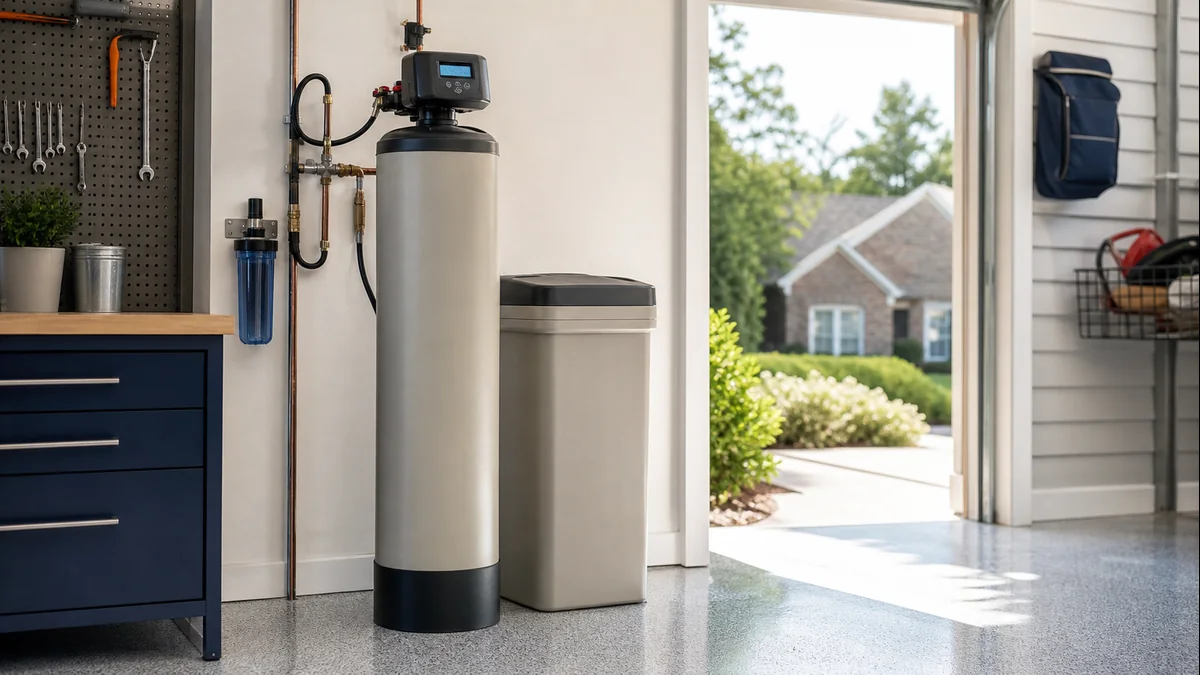
An all-in-one system covers both sides of what your test can and can't show you. The softening half handles whatever grains-per-gallon number you measured, protecting your water heater, dishwasher, and plumbing from mineral buildup while getting glassware and laundry genuinely cleaner. The carbon half handles what a hardness kit never touches — chlorine and chloramine taste, and the disinfection byproducts Cary's own report documents.
Because it installs as a single system, your whole home gets covered from one point, not room by room. Pricing depends on your home's plumbing and your address's actual hardness reading, which is why a free water analysis — not a number published here — is how a system gets sized for your house.
For more on how a whole-home system is built for Cary's specific water, see water softener Cary, NC. For the general version of this same at-home test, see how to test water hardness at home. To see how Cary compares to other Triangle towns on the same scale, see water hardness by town in the Triangle, NC, and for a closer look at whether "very soft" tells the whole story, see is Cary, NC water actually soft?.
Find Out What Your Own Cary Address Reads
A town-wide figure can't tell you what's coming out of your specific faucet — only a test at your own address can. Take the 60-second water quiz or book a free water analysis to get your actual grains-per-gallon number and see what an all-in-one system built for it would look like.
FAQ
I just moved to Cary and want to know if I actually need to worry about hard water — where do I start? Start with a test at your own tap rather than relying on Cary's plant-average figure alone. A test strip gives a fast rough read, and the Hach Total Hardness Test Kit, Model 5-B, gives a precise grains-per-gallon number on the same scale a whole-home system is sized against. A free water analysis does the same test at no cost.
My test strip's color landed between two bands on the chart — which one is it? That's a common limitation of strip testing; the color bands require a judgment call, and it's genuinely hard to tell near a boundary like slightly hard versus moderately hard. A drop-count kit like the Hach Model 5-B gives you an actual number instead of a shade to interpret, which removes that guesswork entirely.
Cary's FAQ calls the water "very soft" — so why does Triangle Waterworks measure it differently? Both figures are accurate; they're measuring different things. Cary's number is a plant average leaving the treatment facility, reported on a different scale than the one the Hach kit uses. Our address-level testing across Cary measures 1.6 to 3.7 gpg, which is slightly hard to moderately hard on the WQA scale the kit reads out on — the range varies by where in Cary you actually live.
Does a hardness test also check for chlorine or the disinfection byproducts I've read about? No — a hardness kit only measures calcium and magnesium. Cary's own water quality report documents TTHM and HAA5 separately, both compliant with EPA limits, and those require a different kind of testing to see. A free water analysis looks at more than hardness alone.
If my Cary address only tests slightly hard, is a whole-home system still worth having? Yes — even at the lower end of the measured range, mineral buildup is cumulative over the life of a water heater and fixtures, and the carbon stage of an all-in-one system still addresses chlorine, chloramine, and disinfection byproducts that hardness testing can't see at all. A system sized for lower hardness also runs efficiently and uses less salt.
How accurate is the Hach kit compared to what Triangle Waterworks would find during a free analysis? Used as directed, a drop-count kit like the Hach Model 5-B gives an accurate reading on the same WQA scale a professional analysis uses, so the numbers should land close together. The advantage of a free analysis is that it also looks at chlorine, chloramine, and disinfection byproducts — everything a hardness kit alone can't measure.
Sources
- Town of Cary — Water Quality Report
- Town of Cary — Public Works FAQ (finished water hardness)
- EPA — National Primary Drinking Water Regulations
Answer nine practical questions, then request a written quote or well-water analysis.
Start My Water Analysis