
How to Test Water Hardness at Home in Durham, NC
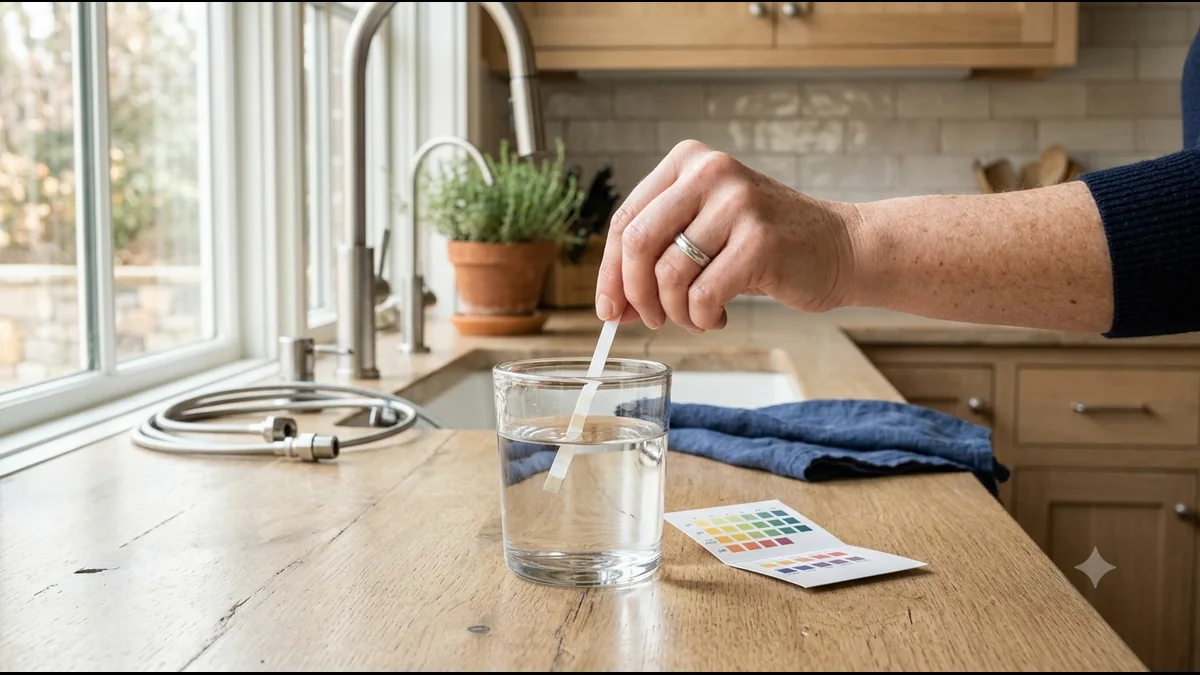
Direct answer: Durham publishes no citywide hardness figure, so the only way to know your number is to test your own tap. Test strips give a fast, rough read; the Hach Total Hardness Test Kit, Model 5-B, gives an accurate grains-per-gallon reading on the Water Quality Association scale a whole-home system is sized against; a certified lab or free water analysis fills in what a hardness test alone can't see — and points to the all-in-one softening-and-carbon system built for Durham's water.
How Hard Is Durham's Water?
There isn't a published answer — Durham's own water quality reporting covers testing, PFAS monitoring, and treatment, but it does not state a hardness value in parts per million, milligrams per liter, or grains per gallon. That's not an oversight on Durham's part; some utilities simply don't publish that specific number the way Raleigh Water or Cary's Public Works FAQ do. For a Durham homeowner, it means the usual shortcut — looking up your town's number — doesn't work here. You have to measure it, and that's a genuinely useful thing to know before deciding what kind of system, if any, fits your home.
Would a Plant Average Even Settle It?
No, and this matters even for towns that do publish a number. Durham draws surface water from Lake Michie and the Little River Reservoir, treats it at the Williams and Brown treatment plants, and also purchased water from the Town of Cary during the report year — so homes on different parts of the distribution system, or served from different blended sources at different times, can see genuinely different water at the tap. Even a published citywide average is a plant reading, not a reading from your kitchen faucet. What comes out of your tap depends on where your house sits in that system, which is why the only number that answers your question is one measured at your own address.
What Are My Options for Testing Water Hardness at Home?
You have four realistic options, in order of how much they tell you:
- Test strips — dip-and-read strips that change color based on hardness. Fast and inexpensive, useful for a rough first read, but coarse: colors are hard to judge precisely between bands, and results vary reader to reader.
- The Hach Total Hardness Test Kit, Model 5-B — a drop-count titration kit. You add a reagent to a water sample drop by drop and count the drops needed to reach a color-change endpoint; each drop corresponds to a set amount of hardness. This is the test we recommend, because it reads out in grains per gallon on the Water Quality Association (WQA) scale — the same scale a whole-home softening system is sized against.
- A certified laboratory test — mail-in or drop-off testing that reports hardness precisely, and can test for things a hardness kit was never built to detect.
- A free water analysis — Triangle Waterworks tests your hardness at your address, on the same WQA scale, at no cost, and looks at what a hardness test alone doesn't cover.
How Do I Read the Result Once I Have a Number?
Once you have a grains-per-gallon (gpg) reading, classify it on the WQA scale — the same scale the Hach Model 5-B kit is built around:
| Classification | Grains per gallon (gpg) | mg/L CaCO₃ (ppm) |
|---|---|---|
| Soft | <1.0 | <17 |
| Slightly hard | 1.0–3.5 | 17–60 |
| Moderately hard | 3.5–7.0 | 60–120 |
| Hard | 7–10.5 | 120–180 |
| Very hard | >10.5 | >180 |
Whatever your address reads, the table tells you where it lands — no need to compare against a Durham-wide figure that doesn't exist. If your number is anywhere above the "soft" band, calcium and magnesium are accumulating on fixtures, glassware, and inside your water heater a little more every day, and that buildup is cumulative over the life of the equipment.
Why Recommend a Titration Kit Over Test Strips?
Because a titration kit measures a continuous number instead of asking you to match a color. Test strips compare a treated pad against a printed color chart, and the boundary between one shade and the next is a judgment call — two people reading the same strip can land on different bands, especially near an edge like "slightly hard" versus "moderately hard." A drop-count kit like the Hach Model 5-B counts reagent drops to a visible endpoint instead, giving a specific gpg number that maps directly onto the WQA scale above.
What Can't a Hardness Test Tell Me?
Everything that isn't calcium and magnesium. A hardness kit — strip or titration — measures one thing: dissolved mineral hardness. It says nothing about chlorine or chloramine levels, disinfection byproducts, or PFAS, all of which hardness testing was never designed to touch.
That's a real gap for a Durham household, because Durham's own reporting does cover disinfectant levels precisely: chlorine running at a running annual average of 0.63 ppm and chloramines at 1.5 ppm, both comfortably under the EPA's 4.0 ppm limit and legally compliant. A hardness test — even a precise one — tells you nothing about either number. A certified lab test can look at a broader panel, and a free water analysis covers both sides of your water, not just the mineral content.
Home Hardness Testing Compared
| Test strips | Hach Model 5-B titration kit | Certified lab test | Free water analysis | |
|---|---|---|---|---|
| What it measures | Hardness (rough) | Hardness (precise gpg) | Hardness + broader panel | Hardness + whole-house water profile |
| Precision | Low — color-match judgment | High — drop-count number | High | High |
| Reads on WQA scale | Approximately | Exactly | Can be requested | Yes |
| Covers chlorine/chloramine/PFAS | No | No | Often, for a fee | Yes |
| Cost | Low | Low, one-time purchase | Varies, per sample | Free |
| Where to get it | Hardware/home stores | Hardware/home stores, online | County health dept. or private lab | Book with Triangle Waterworks |
What Fixes Hard Water Once I Know My Number?
An all-in-one whole-home system — softening resin and carbon filtration in a single install — addresses both sides of what a Durham home's water can carry. The softening side removes calcium and magnesium by ion exchange, which stops mineral buildup on fixtures and inside your water heater, improves lather from soap and shampoo, and leaves dishes and glassware cleaner. The carbon side is what the hardness test can't see: it's built to reduce chlorine and chloramine taste and odor, along with disinfection byproducts and PFAS — exactly the category of water quality that a titration kit or test strip was never designed to catch, and that Durham's documented chlorine and chloramine levels sit squarely inside.
Because it's one system instead of two, every fixture in the house gets the same benefit at once. Pricing depends on your home's plumbing and the hardness number at your address, which is why it isn't published here — a free water analysis is how a system gets sized and quoted for your house. For context, national big-brand installers commonly quote $6,000 to $12,000 for comparable whole-home coverage.
For more on how a whole-home system pairs with Durham's water specifically, see water softener Durham, NC. For the same testing question in a nearby town on a different supply, see how to test tap water hardness in Holly Springs, NC. For a Triangle-wide view of how hardness varies town to town, see water hardness by town in the Triangle.
See What's at Your Durham Address
Take the 60-second water quiz to see which all-in-one system fits your home, or book a free water analysis to get your actual hardness number and a look at what a hardness kit alone can't measure — chlorine, chloramine, and beyond.
Frequently Asked Questions
I just moved to Durham and want to know if my water is hard — where do I even start? Start with a test at your own tap, since Durham doesn't publish a citywide hardness figure the way some neighboring towns do. A test strip gives a quick rough read, and the Hach Total Hardness Test Kit, Model 5-B, gives you a precise grains-per-gallon number on the same scale a whole-home system is sized against. A free water analysis does the same test at no cost and looks at the rest of your water quality too.
I tested with a strip and it landed between two colors on the chart — how do I know which one it actually is? That's a common limitation of strip testing — the color bands are a judgment call near a boundary. A drop-count titration kit like the Hach Model 5-B gives a specific number instead of a color match, which removes the guesswork. If you want a precise reading without buying a kit, a free water analysis measures it directly.
Does Durham's water come from the same source as Raleigh's? No. Durham runs its own system, drawing from Lake Michie and the Little River Reservoir and treating at the Williams and Brown plants, and it also purchased water from the Town of Cary during the report year. Raleigh Water draws from Falls Lake and treats separately, so Durham's hardness shouldn't be assumed to match Raleigh's or any other town's — testing your own tap is the only way to know.
What's the actual number for Durham's chlorine and chloramine levels? Durham's most recent reporting shows chlorine running at a running annual average of 0.63 ppm and chloramines at 1.5 ppm, both under the EPA's 4.0 ppm limit and legally compliant. Neither number shows up on a hardness test — that's a separate part of water quality that carbon filtration, not softening, addresses.
Is a lab test worth paying for if I've already used a hardness test kit? It depends what you're trying to learn. A hardness kit like the Hach Model 5-B gives an accurate gpg number but only measures hardness. A certified lab test can cover a broader panel if you have concerns beyond hardness. A free water analysis combines a hardness reading with a look at the rest of your water profile at no cost.
If I find out my Durham water is only slightly hard, is a whole-home system still worth having installed? Even at the lower end of the hardness scale, calcium and magnesium buildup is cumulative over the life of a water heater and fixtures, and an all-in-one system's carbon stage still addresses chlorine, chloramine, and disinfection byproducts that hardness testing doesn't touch. A system built for slightly-to-moderately hard water also runs efficiently and uses less salt, so lower hardness works in the system's favor rather than against it.
Answer nine practical questions, then request a written quote or well-water analysis.
Start My Water Analysis