
How to Test Water Hardness at Home
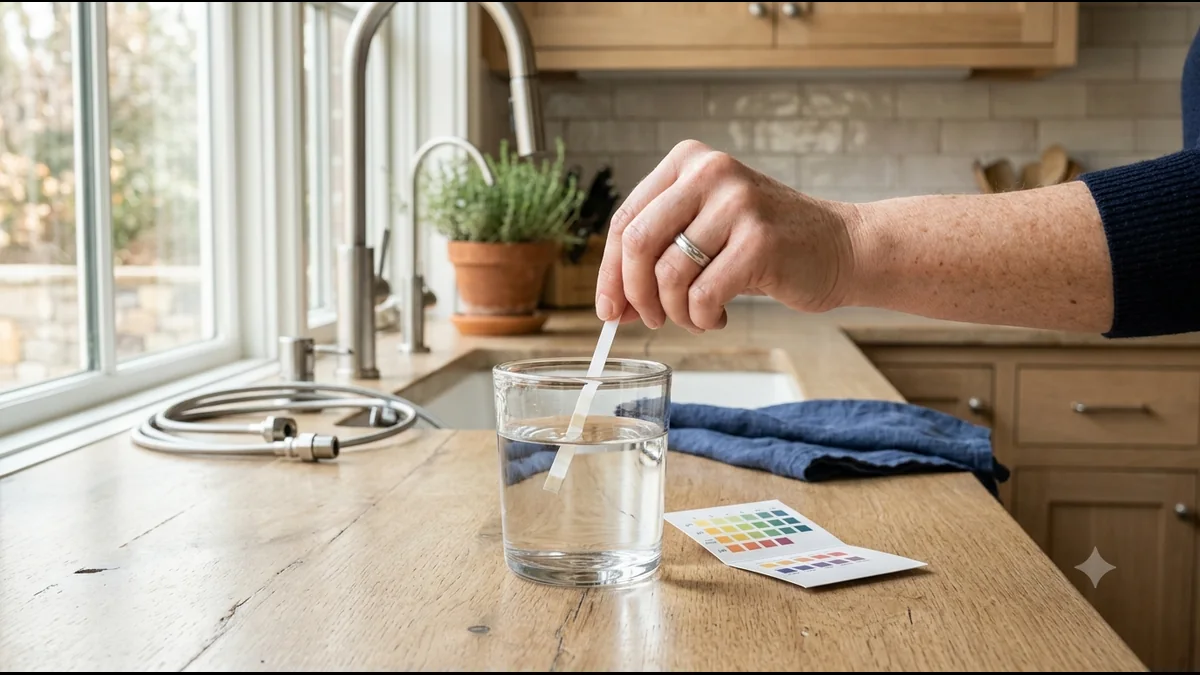
Direct answer: Test your water with an inexpensive strip (~$15 for 50), a titration kit such as the Hach Total Hardness Test Kit, Model 5-B (~$40 for about 50 tests), or an accredited lab test (~$20) — each reads hardness a little differently, and any of them gives you a real number to work from. Treat that number as an input for sizing, not a verdict on whether to treat your water: a hardness test alone says nothing about chlorine, chloramine, disinfection byproducts, or PFAS, which is why the free water analysis is the step that actually specifies your all-in-one softening-and-carbon system (or, on a well, your iron and carbon/resin system).
What's the easiest way to test water hardness at home?
For most households, a test strip is the fastest option. You dip the strip in a water sample, wait for the color change, and compare it to the chart that comes with the kit. Strips read out in mg/L and typically cost around $15 for a set of 50 — cheap enough to test more than once, which matters if you want to check a few taps around the house or retest after a plumbing change.
What's a titration kit, and how is it different from strips?
A titration kit works by adding a reagent to a water sample drop by drop until the color changes — the number of drops needed tells you the hardness. Titration kits read out directly in grains per gallon (gpg) of calcium carbonate, which is the unit softeners are sized in, so you can skip a conversion step. A titration kit costs around $40 and includes enough reagent for about 50 tests. The Hach Total Hardness Test Kit, Model 5-B (Drop Count Titration) is a widely used option for this: it reads directly in gpg on the Water Quality Association (WQA) scale — the same scale a softener is sized against — so the number you get maps straight to a sizing decision with no conversion step.
Should I send a sample to a lab instead?
An accredited-lab hardness test is the most precise of the three options and runs about $20. It's a good choice if you want a documented number — for example, alongside other well-water results — rather than a read-it-yourself color match. None of the three methods is "more correct" than the others in a meaningful way for sizing purposes; they simply differ in convenience, unit, and cost.
What do the hardness numbers actually mean?
Every method above ultimately maps to the same five-tier scale the Water Quality Association (WQA) uses to classify water hardness — the same scale the Hach Total Hardness Test Kit, Model 5-B, reads out on — based on dissolved calcium and magnesium:
| Classification | ppm (mg/L) | gpg |
|---|---|---|
| Soft | <17 | <1.0 |
| Slightly hard | 17-60 | 1.0-3.5 |
| Moderately hard | 60-120 | 3.5-7.0 |
| Hard | 120-180 | 7-10.5 |
| Very hard | 180+ | 10.5+ |
Where your number falls on this scale tells you how the softening side of a system should be sized — how much resin capacity you need and how often it should regenerate. It doesn't tell you anything else about your water, which is the point covered below.
How do I convert between mg/L and gpg?
Test strips read in mg/L; titration kits and softener sizing both use gpg. Penn State Extension's conversion is straightforward: 1 gpg is about 17 mg/L. To go from mg/L to gpg, divide by 17. To go the other direction, multiply by 17.
Here's how that works with a real utility figure: Raleigh Water tests at about 1.6 gpg — slightly hard on the WQA scale. Multiply by 17 and that converts to roughly 27 mg/L — so if your test strip or utility report gives you a number in mg/L instead, dividing by 17 puts it on the same gpg scale used for sizing.
Comparing the three testing methods
| Method | How it works | Reads out in | Approx. cost |
|---|---|---|---|
| Test strips | Dip, wait for color change, compare to chart | mg/L | ~$15 for 50 strips |
| Titration kit (e.g. Hach Model 5-B) | Add reagent until color changes | gpg (as CaCO3), WQA scale | ~$40 for ~50 tests |
| Accredited lab test | Sample sent out for lab analysis | Varies by lab report | ~$20 |
Can I just read my hardness off my utility's water report?
If you're on city water, yes — that's a legitimate second source. Community water systems are required to deliver an annual Consumer Confidence Report to customers by July 1 each year, covering the previous calendar year's data, including where the water comes from and what's been detected in it. That report is a useful reference alongside — or instead of — running your own strip or titration test.
Private well owners don't have this option. There's no utility and no annual report, because North Carolina does not regulate private well water once a well has been constructed. For a well, a direct test — strip, titration kit, or lab — is the only source of hardness information you have, which is exactly why testing matters more, not less, on well water.
What can't a hardness test tell me?
This is the part worth being clear-eyed about. A hardness test — strip, titration, or lab — measures calcium and magnesium and nothing else. It gives you zero information about chlorine or chloramine taste and odor, disinfection byproducts, iron, or PFAS. A low hardness reading is good news for how efficiently a softener will run; it says nothing about whether those other, separate issues are present in your water.
That's precisely why a full water analysis is the step that actually specifies a system, rather than a strip result on its own. The water analysis picks up the rest of what a hardness-only test structurally can't detect, and the result is what determines whether your household needs the softening side, the carbon side, or — as is typical for Triangle city water — both in one all-in-one system.
What do I do with my test result?
Whatever number you get — from a strip, a titration kit, a lab, or your utility's report — bring it to your free water analysis. That visit confirms the hardness reading, checks for chlorine, chloramine, disinfection byproducts, and (on a well) iron and pH, and uses all of it together to size and spec the right system for your actual water, rather than a catalog estimate.
Frequently Asked Questions
I just moved to Apex and want my water tested before choosing a system — what should I do first? Start with a quick test strip or titration kit to get a baseline hardness number, then schedule a free water analysis. Apex runs on the higher end of Triangle city water's hardness range, so a direct reading helps confirm exactly where your household falls before anything is sized.
My well water tested at 8 grains per gallon — what does that number mean for sizing? An 8 gpg reading falls in the hard tier on the WQA scale and is a real, useful data point. It isn't the whole picture, though — well water sizing also depends on iron, pH, and household usage, which is why the full water analysis, not the hardness number alone, is what determines the final iron and carbon/resin system spec.
Are drugstore test strips accurate enough to trust? Strips are accurate enough to tell you which tier your water falls in — soft, slightly hard, moderately hard, hard, or very hard — which is what matters for an initial read. For a more precise number, a titration kit — such as the Hach Total Hardness Test Kit, Model 5-B — or an accredited lab test is the next step up.
What test kit reads out in grains per gallon on the same scale used for sizing? The Hach Total Hardness Test Kit, Model 5-B (Drop Count Titration) reads directly in grains per gallon (gpg) on the Water Quality Association (WQA) scale — the same scale a softener is sized against — so the number you get from the kit maps straight to a sizing decision without a unit conversion.
Does a hardness test tell me anything about chlorine, chloramine, or PFAS in my water? No. A hardness test — by strip, titration, or lab — measures only calcium and magnesium. Chlorine, chloramine, disinfection byproducts, and PFAS require separate testing or a full water analysis to identify.
How often should I retest my water? There's no fixed schedule that applies to every household, but it's reasonable to retest after any noticeable change — a new well pump, nearby construction, or a change in taste or feel — and to retest as part of scheduling your free water analysis if it's been a while since your first check.
Can a hardness test result replace a full water analysis? It's a helpful starting point, not a substitute. A hardness test gives you one number on one scale; the free water analysis builds the complete picture — hardness plus chlorine, chloramine, disinfection byproducts, and (for wells) iron and pH — that's actually used to size and spec your system.
Ready to see what your water needs?
Take our 60-second water quiz to get pointed toward the right system for city water, or request a free water analysis to get your well water fully tested and properly specified.
Related reading: Raleigh Water Hardness | What Size Water Softener Do I Need? | How Often Should You Test Well Water in NC? | Water Softeners in North Carolina | NSF Certifications for Water Filters, Explained
Answer nine practical questions, then request a written quote or well-water analysis.
Start My Water Analysis