
How to Test Water Hardness at Home in Wendell, NC
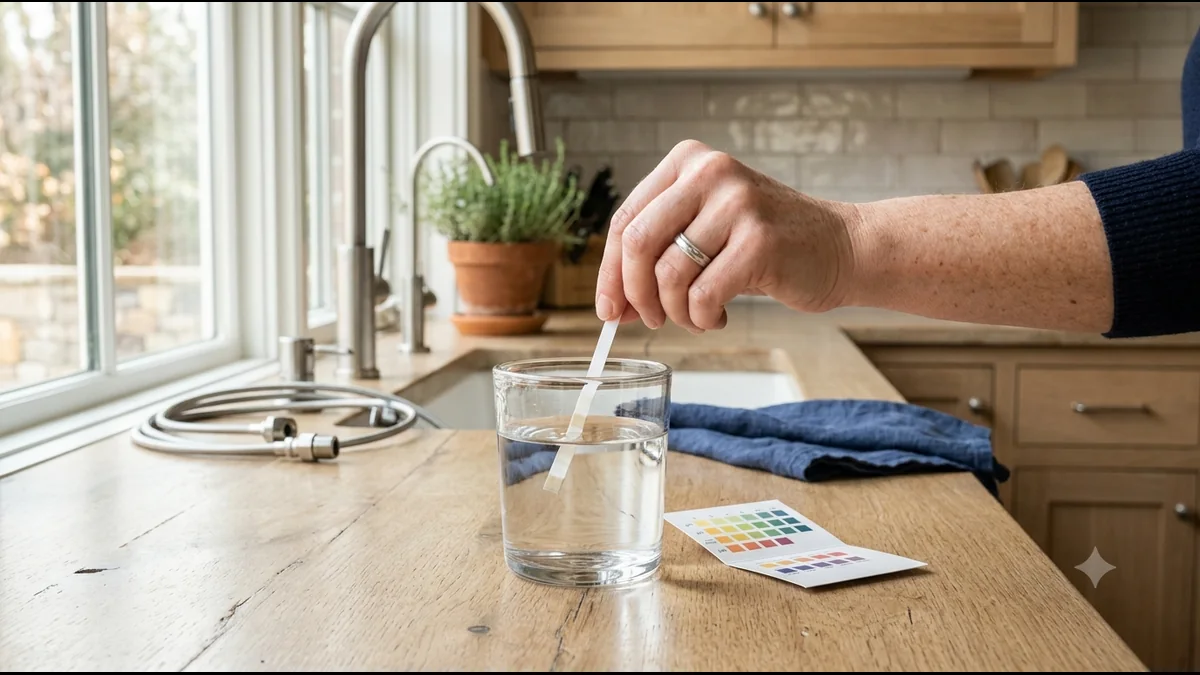
Direct answer: The fastest option is a color-comparison test strip; the most reliable at-home option is the Hach Total Hardness Test Kit, Model 5-B, which reads in grains per gallon on the Water Quality Association scale. Wendell runs on Raleigh Water, measured around 1.6 gpg — slightly hard — but Triangle Waterworks measures 1.6 to 3.7 gpg by ZIP code, so only a test at your own address tells you your number, and a free water analysis measures it and sizes the all-in-one system to fit.
How Do I Test Water Hardness at Home in Wendell, NC?
You have four realistic options, in order of how much each one tells you: a color-comparison test strip for a fast rough read, a drop-count titration kit like the Hach Total Hardness Test Kit, Model 5-B, for a precise grains-per-gallon number, a certified laboratory test for the broadest panel, or a free water analysis at your actual address. Each one places your water on the Water Quality Association (WQA) scale — the same scale a whole-home softening system is sized against.
Is Wendell's Water Actually Hard to Begin With?
It carries real, measurable hardness, though it doesn't sit in the "hard" band on the WQA scale. Wendell is served by Raleigh Water — the same utility that supplies Raleigh, Garner, Knightdale, Rolesville, Wake Forest, and Zebulon — sourced from Falls Lake and treated at the E.M. Johnson Water Treatment Plant. That supply runs around 1.6 grains per gallon (gpg), which classifies as "slightly hard" on the Water Quality Association scale the Hach Total Hardness Test Kit, Model 5-B, uses. Slightly hard isn't the same as soft: calcium and magnesium are still present in every gallon, and they still accumulate on fixtures, glassware, and inside a water heater over years of use.
Why Doesn't Raleigh Water's Published Number Just Answer This for Me?
Because a utility-wide figure is a plant average, not a reading from your kitchen faucet. Triangle Waterworks' own testing across the service area measures a range of 1.6 to 3.7 gpg by ZIP code — a Wendell address can sit meaningfully higher than the utility's headline number depending on where it falls in the distribution system. On the WQA scale, the low end (1.6 gpg) is slightly hard, and the high end (3.7 gpg, roughly 63 mg/L) crosses into moderately hard, over the 60 mg/L line. The only way to know where your specific house lands in that spread is to test your own tap.
What Are My Testing Options, From Fastest to Most Precise?
- Test strips — dip-and-read strips that change color based on hardness. Fast, inexpensive, and useful for a rough first read, but coarse: the color bands are a judgment call, especially near a boundary like slightly hard versus moderately hard, and two people reading the same strip can land on different answers.
- The Hach Total Hardness Test Kit, Model 5-B — a drop-count titration kit. It reads out directly in grains per gallon on the Water Quality Association scale, which is exactly why Triangle Waterworks recommends it: the number the kit gives you and the classification used to size a whole-home system are the same scale, so there's nothing to convert or reconcile.
- A certified laboratory test — mail-in or drop-off testing that reports hardness precisely and can screen for a broader panel than any home kit is built to detect.
- A free water analysis — Triangle Waterworks tests hardness at your address on the same WQA scale, at no cost, and looks at the parts of your water a hardness test alone can't see.
How Does the Hach Model 5-B Drop-Count Kit Actually Work?
It works by titration: you add a reagent to a water sample a drop at a time and watch for a color change that marks the endpoint. Each drop added before that color change corresponds to a set amount of hardness, so the drop count converts directly into a grains-per-gallon reading. That's the mechanism in general terms — for exact sample sizes and reagent handling, follow the instructions that come with the kit itself, since accuracy depends on the manufacturer's procedure.
How Do I Read My Result on the WQA Scale?
Once you have a grains-per-gallon number — from a strip, the Hach kit, a lab, or a free analysis — classify it against the same five-tier scale Triangle Waterworks uses:
| Classification | Grains per gallon (gpg) | mg/L CaCO₃ (ppm) |
|---|---|---|
| Soft | <1.0 | <17 |
| Slightly hard | 1.0–3.5 | 17–60 |
| Moderately hard | 3.5–7.0 | 60–120 |
| Hard | 7–10.5 | 120–180 |
| Very hard | >10.5 | >180 |
A Wendell address testing anywhere from roughly 1.6 to 3.7 gpg lands in the slightly hard to moderately hard range on this table — a genuine, measurable amount of hardness, whichever end of it your specific tap comes back at.
Test Strips vs. the Hach Model 5-B — Which Should I Actually Use?
| Test strips | Hach Model 5-B titration kit | |
|---|---|---|
| What it measures | Hardness (rough estimate) | Hardness (precise gpg) |
| How it works | Color-match against a printed chart | Drop-count to a color-change endpoint |
| Precision near a band boundary | Low — judgment call | High — specific number |
| Reads on the WQA scale | Approximately | Exactly |
| Cost | Very low | Low, one-time purchase |
| Where to get it | Hardware and home stores | Hardware and home stores, online |
Both are useful for a first look. The strip is faster and cheaper; the titration kit is the one to trust when the reading actually matters, because it hands you a specific number instead of a shade of blue.
What Won't a Hardness Test Tell Me About My Wendell Water?
A hardness test — strip or titration — measures exactly one thing: dissolved calcium and magnesium. It says nothing about chlorine or chloramine taste and odor, or about disinfection byproducts, and those are real, documented parts of Raleigh Water's supply. Raleigh Water normally disinfects with chloramine, which the City describes as having no taste or odor associated with it, and documented disinfection byproducts on that supply run HAA9 at 19.9 ppb and TTHM at 21.7 ppb — both legally compliant with EPA limits. A gpg number tells you nothing about either figure, because a hardness kit was never built to measure them. That's the gap a certified lab panel or a free water analysis fills, and it's exactly what the carbon side of an all-in-one system is built to address — the half of your water a hardness test can't see at all.
What Fixes Hard Water Once I Know My Number?
An all-in-one whole-home system — softening resin paired with carbon filtration in a single install — addresses both sides of what a Wendell home's water can carry, whatever your test comes back at:
- Softening resin removes calcium and magnesium by ion exchange before water reaches any fixture, so nothing is left to deposit on glassware, fixtures, or inside your water heater. It also improves lather from soap and shampoo and leaves laundry and dishes cleaner.
- Carbon filtration reduces chlorine and chloramine taste and odor and addresses disinfection byproducts — the part a hardness test never measures and softening resin alone never touches.
Because it's one system instead of two, every fixture in the house gets the same treated water at once. Pricing depends on your home's plumbing and where your specific address falls in the 1.6–3.7 gpg range, which is why it isn't published here — a free water analysis is how a system gets sized and quoted for your house. For comparison, national big-brand installers commonly quote $6,000 to $12,000 for comparable whole-home coverage.
For more on getting your water tested and treated locally, see water treatment near me in Wendell, NC and water softener installation in a Wendell crawl space. For the source numbers behind the range measured here, see Raleigh water hardness, and for how Wendell compares to other towns on the same scale, see water hardness by town in the Triangle.
See What's Actually Coming Out of Your Wendell Tap
Take the 60-second water quiz to see which all-in-one system fits your home, or book a free water analysis to get your actual hardness number and a look at what a hardness test alone can't measure — chlorine, chloramine, and disinfection byproducts.
Frequently Asked Questions
I just moved to Wendell and want to know if I need to worry about hard water — where do I start? Start with a test at your own tap rather than assuming Raleigh Water's published average applies to your specific address. A test strip gives you a quick rough read, and the Hach Total Hardness Test Kit, Model 5-B, gives a precise grains-per-gallon number on the same scale a whole-home system is sized against. A free water analysis does the same measurement at no cost and checks the rest of your water quality too.
My test strip landed right between two color bands — how do I know which one it actually is? That's a known limitation of strip testing — the color bands require a judgment call, and it gets harder right at a boundary like slightly hard versus moderately hard. A drop-count kit like the Hach Model 5-B gives a specific number instead, which removes the guesswork. A free water analysis gives you the same precision without buying a kit.
Is Wendell's water on the same supply as Raleigh's, or is it different? It's the same utility. Wendell is served by Raleigh Water, along with Raleigh, Garner, Knightdale, Rolesville, Wake Forest, and Zebulon, all sourced from Falls Lake and treated at the E.M. Johnson Water Treatment Plant. The utility-wide figure runs around 1.6 gpg, but the number at any individual address still depends on where it sits in the distribution system.
What's actually in Wendell's water besides hardness? Raleigh Water normally disinfects with chloramine and documents disinfection byproducts of HAA9 at 19.9 ppb and TTHM at 21.7 ppb, both compliant with EPA limits. None of that shows up on a hardness test — it's addressed by the carbon stage of a whole-home system rather than the softening side.
If my Wendell address only tests slightly hard, is a whole-home system still worth having installed? Even at the lower end of the measured range, calcium and magnesium buildup is cumulative over the life of a water heater and fixtures, and the carbon stage of an all-in-one system still addresses chlorine, chloramine, and disinfection byproducts a hardness test doesn't touch. A system sized for slightly-to-moderately hard water also runs efficiently and uses less salt, so a lower number works in the system's favor.
How accurate is the Hach kit compared to what a lab or Triangle Waterworks would find? Used correctly, a drop-count kit like the Hach Model 5-B gives an accurate grains-per-gallon reading on the same WQA scale a lab or an analysis uses, so the numbers should agree closely. The advantage of a lab test or a free analysis is breadth — they also cover the chlorine, chloramine, and byproduct side of your water a hardness kit was never designed to measure.
Answer nine practical questions, then request a written quote or well-water analysis.
Start My Water Analysis