
How to Unclog a Scaled Shower Head in Raleigh, NC
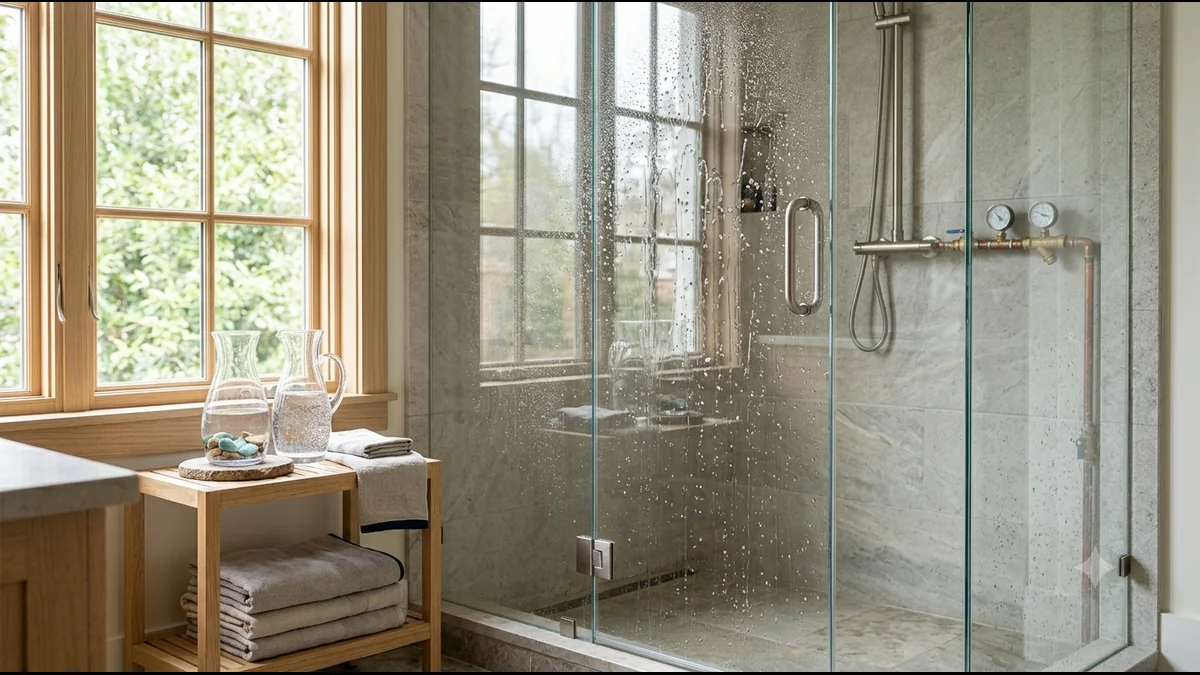
Direct answer: A sputtering or sideways-spraying shower head usually has mineral deposits blocking its nozzle holes. Soak it in undiluted white vinegar for an hour or more, then scrub and rinse — the acid dissolves the calcium carbonate clogging each opening. That clears what's already there, but Raleigh's slightly hard water keeps adding more. Whole-home softening removes minerals at the source so every fixture stays clear, not just the one you soaked.
What's Actually Clogging My Shower Head?
Look closely at a struggling shower head and you'll usually see a crusty, off-white ring around each nozzle hole. That's calcium carbonate — dissolved minerals from your water supply that turned solid once they hit air and stopped moving. Every gallon that passes through carries a small amount of calcium and magnesium, and a portion of it deposits on the nozzle plate each time.
Small nozzle holes clog faster than almost anything else in a house, because the opening is so narrow that even a thin mineral ring restricts flow noticeably. That's why a shower head is often the first fixture where hard water shows up as a visible problem, ahead of faucets or the water heater.
How Do I Descale a Shower Head With Vinegar?
Fill a sandwich bag with plain white vinegar, slip it over the shower head so the nozzle plate is fully submerged, and twist a rubber band or zip tie around the neck to hold it in place. Let it sit — most household buildup loosens within an hour, and a head that hasn't been cleaned in years may need to soak overnight. Vinegar is acetic acid, and acetic acid dissolves calcium carbonate on contact, which is the entire mechanism behind this fix.
Once the soak is done, remove the bag and run the shower on hot for thirty seconds to a minute to flush the loosened mineral debris out of each hole. If any holes are still weak, a toothpick or a soft-bristle toothbrush worked gently into the opening usually clears the rest — never a metal pin, which can widen or damage the hole and change the spray pattern permanently.
Can I Clean a Shower Head Without Removing It From the Wall?
Yes, and for most fixed and handheld heads the bag method above works fine without unscrewing anything. If your head has a self-cleaning rubber nozzle style, rub the tips with your thumb partway through the soak — this physically breaks apart deposits the vinegar has already softened, and it works faster than soaking alone.
For a head that's severely clogged, removing it gives more control. Wrap the connection point with a cloth before using pliers, so you don't scratch the finish, then submerge the entire head in a bowl of vinegar for the same soak time. This lets you inspect every nozzle individually before reattaching.
Is It Safe to Soak Any Shower Head Finish in Vinegar?
Mostly, but not universally. Chrome and stainless steel tolerate an occasional vinegar soak without issue. Some brushed nickel, oil-rubbed bronze, and matte black finishes can dull or discolor with repeated acid exposure, and a few manufacturers explicitly warn against extended acid contact in their care instructions.
Check your fixture's own documentation before an overnight soak, especially on a finish other than plain chrome. When in doubt, run a shorter one-hour soak and check the result before committing to anything longer.
Why Does the Clog Come Back a Few Months Later?
Because vinegar treats the fixture, not the water flowing through it. The soak dissolves everything currently deposited, but the moment the head goes back on the wall, Raleigh Water starts delivering the same calcium and magnesium it always has, and a new layer begins forming immediately.
That's the ceiling on any at-fixture fix. Cleaning one shower head doesn't touch the faucet aerators, the ice maker line, or what's accumulating inside your water heater — every one of those is fed by the same water and running the same buildup clock, just on its own schedule.
Vinegar Soak vs. Whole-Home Softening
| Vinegar soak | Whole-home softening | |
|---|---|---|
| What it removes | Mineral deposits already formed on that one fixture | Calcium and magnesium before they reach any fixture |
| Fixtures covered | One shower head at a time | Every faucet, shower head, and appliance on the line |
| Repeat schedule | Every few months, indefinitely | None — treatment happens continuously at the main line |
| Tools needed | Vinegar, a bag, a soft brush | A water analysis and a one-time install |
| Cost over 10 years | Vinegar is cheap, but your time isn't | One system, ongoing low-salt operation |
Is Raleigh's Water Actually Hard Enough to Cause This?
Yes — modestly, and it's worth being precise about how much. Raleigh Water's 2025 Consumer Confidence Report puts average finished-water hardness at 25.2 mg/L, ranging up to 35.3 mg/L. Converted to grains per gallon, that's roughly 1.3 to 2.1 gpg, which lands in the "slightly hard" band (1.0–3.5 gpg) on the WQA/Hach scale — the same scale the Hach Total Hardness Test Kit, Model 5-B reads out in at home.
Raleigh's own hardness figures are a plant average measured as water leaves the treatment facility, not what arrives at your specific address. Triangle Waterworks' own in-home testing across the service area measures 1.6 to 3.7 gpg by ZIP code — the top of that range, about 63 mg/L, crosses into "moderately hard." Neither figure contradicts the other; they're measuring different points in the system, and a free water analysis at your address is what settles which end applies to your shower.
Does Cleaning the Shower Head Fix Other Mineral Problems Too?
Not on its own. The same calcium and magnesium clogging your nozzle holes is also depositing inside your water heater, leaving soap scum on shower doors, and building up on faucets throughout the house. A vinegar soak solves the one symptom you can see; it doesn't touch the others, because they're all fed by the same untreated supply.
Buildup like this is cumulative — it doesn't reset itself, and small deposits from years of daily showers add up whether or not you notice them right away. That's the honest case for treating the water once rather than descaling fixtures repeatedly for as long as you own the house.
It's also worth saying plainly: even at the slightly-hard end of Raleigh's range, a softener runs cheaply here. It regenerates less often and uses less salt than it would on genuinely hard water, so lower hardness is a reason to install one, not a reason to skip it.
FAQ
I just moved into a Raleigh rental and the shower head barely trickles — is scale really the cause? It's the most common one, especially in a home with an original or older fixture. A quick way to check: unscrew the head and look at the nozzle plate for a crusty white ring around the holes. If you see it, a vinegar soak should restore flow within an hour or two.
How often should I expect to clean my shower head in Raleigh? There's no fixed schedule — it depends on your fixture, your water usage, and where your address falls in the local hardness range. Many households notice buildup returning within a few months on untreated water; softened water stops that cycle going forward.
Can I use anything besides vinegar to descale a shower head? Lemon juice works through the same acid mechanism but is weaker and slower. Commercial descaling products formulated for plumbing fixtures work faster than vinegar but cost more. Vinegar remains the standard household choice because it's cheap, safe on most finishes, and effective.
My shower head is only a year old and it's already clogging — is that normal? Yes, if the water feeding it hasn't changed. A new fixture starts with clean nozzle holes, but it's exposed to the same minerals as the one it replaced, so buildup begins on the same timeline. Replacing the fixture doesn't change what's in the water.
Will a shower filter attachment stop this from happening? A shower filter can reduce some scale-forming minerals reaching that one head, but it only protects the fixture it's attached to. Every other tap, the water heater, and any appliance on the line keeps accumulating deposits the same as before.
Is it worth soaking the shower head myself, or should I just get a softener? Both have a place. The vinegar soak is free and fixes the immediate problem in an hour, so there's no reason not to do it now. A whole-home system is the step that stops you from doing it again in six months — most homeowners do the soak once while they look into the longer-term fix.
Get the Fix That Actually Lasts
A vinegar soak clears today's clog. If you're tired of it becoming a recurring chore, take the 60-second water quiz to see how an all-in-one softening and carbon system fits your Raleigh home, or book a free water analysis to get the exact hardness reading for your address. Curious whether the investment makes sense for your house first? See is a water softener worth it in Raleigh, NC.
Sources
Answer nine practical questions, then request a written quote or well-water analysis.
Start My Water Analysis