
Why Your Humidifier Leaves White Dust and Crusted Pads in Knightdale, NC Homes
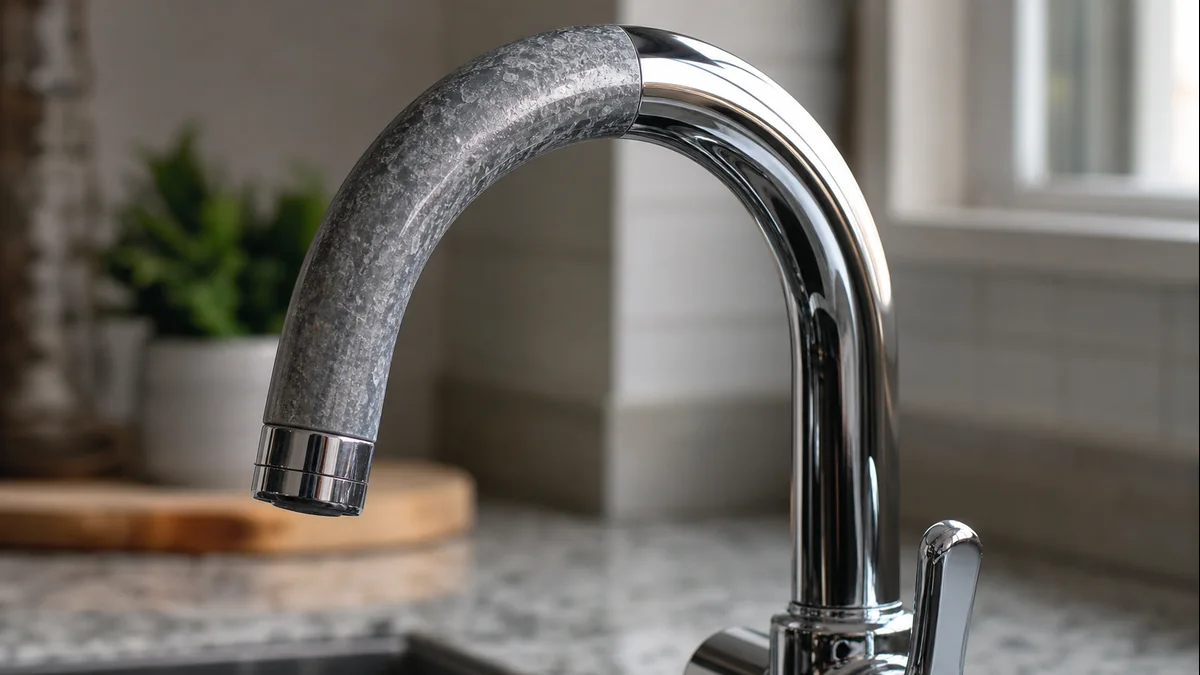
Direct answer: White dust settling on furniture near a portable humidifier and a crusted, stiff pad in a whole-house unit are the same underlying problem showing up two different ways — dissolved minerals left behind as the machine processes tap water. Ultrasonic and impeller humidifiers aerosolize those minerals straight into the mist; evaporative and whole-house units leave them on the pad, tray, and solenoid instead. Per-unit fixes help, but a whole-home system that removes hardness minerals at the main line stops the buildup in every humidifier — and every appliance — at once.
Why Is White Dust Collecting on Furniture Near My Humidifier?
That fine white powder is mineral residue, and it shows up because of how ultrasonic and impeller humidifiers work: a vibrating plate or spinning disk breaks the tank water into a fine mist without heating or filtering it first. Whatever is dissolved in that water — mostly calcium and magnesium — rides along in the mist, and when the water evaporates off a nearby surface, the minerals stay behind as dust. Furniture, TV screens, dark countertops, and electronics near the unit show it first because the fine particles are easiest to see on flat, dark, or glossy surfaces. It isn't mold, and it isn't a sign the unit is broken — it's a direct readout of how much dissolved mineral content was in the tank to begin with.
Why Does My Whole-House Humidifier Pad Get Crusted with Scale?
Evaporative portables and whole-house flow-through or bypass humidifiers work on a different principle: air is drawn across a wet wick or evaporator pad, and only the water vapor leaves with the airstream — the minerals stay put. Over a heating season, that means the pad itself hardens and crusts, the distribution tray develops a scale ring, and the solenoid valve that meters water into the system can gum up with deposits. The practical symptoms are a pad that turns stiff instead of staying pliable, noticeably reduced humidity output, and a replacement pad that needs swapping more often than the manufacturer's schedule assumes. Steam humidifiers have their own version of the same story — the heating element scales the way a kettle does, since only water vapor leaves and everything dissolved in it stays on the metal.
Is This Because Knightdale's Water Is a Problem?
Not exactly — it's a matter of degree, not a defect. Knightdale is served by Raleigh Water, the utility supplying Knightdale, Wendell, Garner, Rolesville, and Wake Forest from Falls Lake, treated at the E.M. Johnson Water Treatment Plant, with Lake Benson in Garner as a secondary source treated at the Dempsey E. Benton plant. Raleigh Water runs at roughly 1.6 grains per gallon (gpg) — slightly hard on the WQA/Hach scale — and our own testing across the service area measures 1.6 to 3.7 gpg depending on the exact address. That's genuinely lower than many U.S. cities. But "slightly hard" isn't "mineral-free," and a humidifier is one of the few appliances in a home that runs for hours a day, every day, all season — evaporating water continuously and leaving its dissolved minerals behind every single time. Buildup is cumulative, and a humidifier concentrates it faster than almost anything else in the house, even when the water going in has less mineral content than a harder-water region would supply.
Does Distilled Water or a Demineralization Cartridge Fix It?
Both work, and neither is a bad choice for the humidifier itself. Filling a portable's tank with distilled water instead of tap water removes nearly all the dissolved mineral content before it ever reaches the mist, so the white dust stops. A demineralization cartridge does something similar for units designed to accept one, pulling minerals out of the water as it passes through before it hits the wick or plate. The tradeoff with both is that they're recurring: distilled water means buying and hauling jugs for as long as you run the humidifier, and cartridges are a consumable that needs replacing on its own schedule, on top of whatever pad-replacement cadence the unit already requires. More frequent pad and cartridge changes reduce the crusting problem in a whole-house unit the same way — they manage the symptom, refreshed on a repeating basis, rather than changing what's in the water supplying the machine.
What's the Fix That Stops Buildup at the Source Instead?
Removing calcium and magnesium at the point where water enters the house — with a whole-home water softener — means every fixture and appliance downstream, including every humidifier in the home, is fed water with nothing left to deposit. That's one piece of equipment and one maintenance schedule instead of a running tab of distilled water jugs, demineralization cartridges, and early pad swaps spread across a portable in the bedroom, a console unit in the living room, and a whole-house unit tied into the furnace. It's also one of the more cost-effective places to have low local hardness working in your favor: at 1.6 to 3.7 gpg, a correctly sized softener regenerates infrequently and uses relatively little salt, so protecting every water-using appliance in the house — not just the humidifier — costs very little to run.
Does Softening Handle Everything Else in Knightdale's Water Too?
No — and this is the other half of the picture. A water softener is ion exchange for calcium and magnesium; it does nothing about chlorine or chloramine taste and smell, PFAS, or disinfection byproducts, because those aren't hardness minerals. Raleigh Water's documented figures show HAA9 at 19.9 ppb and TTHM at 21.7 ppb — both legally compliant with EPA limits, and both compounds that activated carbon removes effectively while softening resin leaves untouched. Raleigh Water also normally disinfects with chloramine and converts to free chlorine once a year on the North Carolina Department of Environmental Quality's recommendation, flushing the distribution system during the changeover — the exact dates shift year to year, so check the City's own announcement rather than a fixed calendar. That's the reason an all-in-one system pairs a carbon stage with the softening resin: the softening side stops mineral buildup everywhere in the house, humidifiers included, and the carbon side handles what softening can't.
Humidifier Type vs. Mineral Buildup vs. the Fix
| Humidifier type | How minerals show up | Point fix | What whole-home softening does |
|---|---|---|---|
| Ultrasonic / impeller portable | Fine white dust on furniture, screens, and floors near the unit | Distilled water in the tank | Removes hardness minerals at the main line, so tap water fed to the tank has nothing left to aerosolize |
| Evaporative portable | Stiff, crusted wick pad; reduced humidity output | Demineralization cartridge or more frequent pad changes | Same water reaches the pad already softened, so it stays pliable longer |
| Whole-house flow-through / bypass | Scale in the tray, on the pad, and around the solenoid | Pad and cartridge changes on a shorter cycle | Feeds the humidifier from the same treated line as the rest of the house |
| Steam humidifier | Scale on the heating element, the same way a kettle scales | More frequent element descaling | Prevents the calcium buildup that causes the scale in the first place |
Frequently Asked Questions
I keep wiping white dust off my nightstand every few days — is my humidifier broken? No, that's mineral residue from an ultrasonic or impeller humidifier aerosolizing dissolved minerals along with the mist, not a malfunction. Switching that unit's tank to distilled water stops it almost immediately, since distilled water has essentially nothing dissolved in it left to deposit.
I just bought a whole-house humidifier for the furnace — how often will the pad really need replacing? It depends on your household's water use and the water's mineral content, but expect it more often than a generic "once a season" estimate if nobody addresses hardness at the source. A correctly sized whole-home softener feeding the furnace humidifier extends pad life by removing the calcium and magnesium that cause the crusting in the first place.
I noticed my portable humidifier's output has dropped a lot this winter — is that mineral buildup too? Very likely, especially in an evaporative or wick-style unit — a crusted or stiffened pad can't wick and evaporate water as efficiently as a clean one, so output drops even though the fan and settings haven't changed. Replacing the pad restores output temporarily, but the pad will crust again on the same schedule unless the water feeding it changes.
Does a demineralization cartridge work as well as distilled water? Both address the same mechanism — removing dissolved minerals before they reach the mist or the pad — and either one will stop new white dust or slow new pad crusting. The difference is convenience and ongoing cost: distilled water means buying and carrying jugs, while a cartridge needs periodic replacement of its own, so neither is a one-time fix.
My humidifier scale looks white and chalky — is that the same thing as what builds up in my water heater? Yes, it's the same calcium and magnesium mineral deposit, just visible faster in a humidifier because the appliance evaporates water continuously for hours at a time. A whole-home softener protects both at once, since it treats the water before it ever reaches either appliance.
Will a water softener also get rid of the chlorine smell from my tap? No — a softener only addresses calcium and magnesium through ion exchange, not chlorine, chloramine, or disinfection byproducts like HAA9 and TTHM measured in Raleigh Water's supply. Removing those requires an activated carbon stage, which is why an all-in-one system combines both rather than installing a softener alone.
Related Reading
See water treatment in Knightdale, NC for the full picture on what's in the local supply, how to test water hardness at home if you want to confirm your own address's numbers before deciding, and white residue on faucets and glasses if the same mineral buildup is showing up elsewhere in the house. For the carbon side of the equation, haloacetic acids in drinking water covers what softening alone won't remove, and water softener cost in Raleigh covers what a correctly sized system runs.
Take the 60-second water quiz to see what an all-in-one system would look like for your Knightdale home — most homes on Raleigh Water get the most value from pairing softening resin (to stop mineral buildup in humidifiers, water heaters, and fixtures) with a carbon stage (to handle chlorine taste and disinfection byproducts softening can't touch).
Answer nine practical questions, then request a written quote or well-water analysis.
Start My Water Analysis