
Is a Water Softener Worth It in Morrisville, NC?
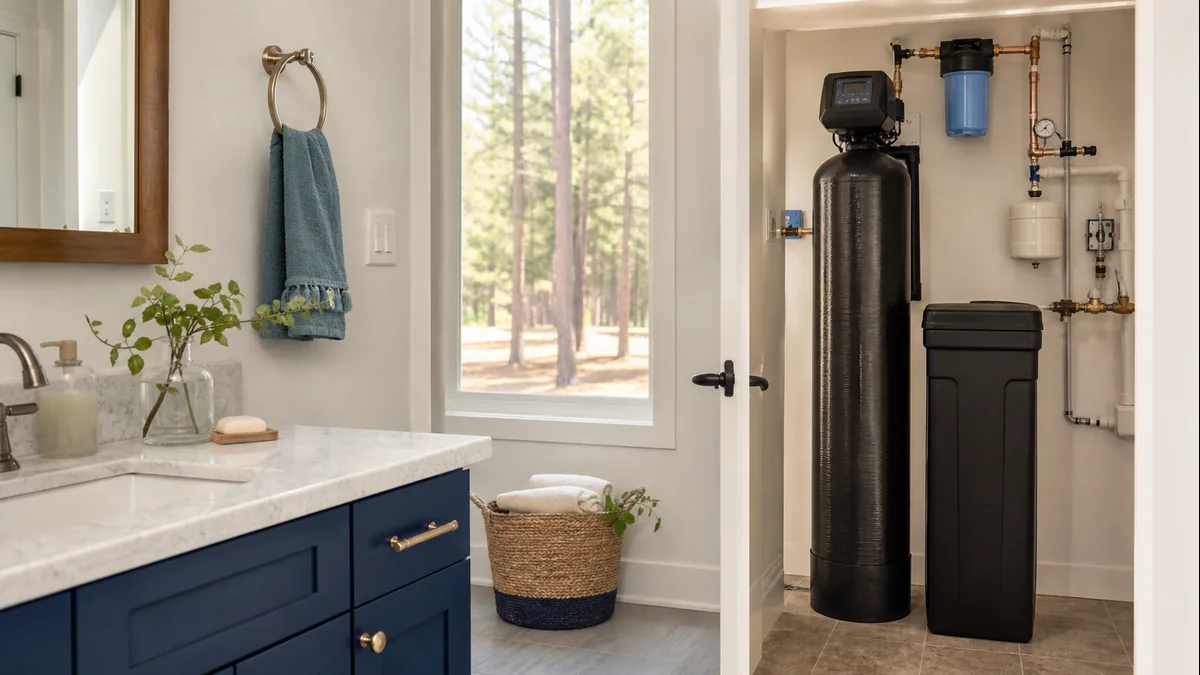
Direct answer: Yes. Cary has operated Morrisville's water since 2006, so Morrisville homes receive Cary's finished water — Cary's own figure is 25–30 ppm hardness, and our in-home testing across the area measures 1.6–3.7 gpg, slightly hard to moderately hard on the Water Quality Association scale. An all-in-one softening and carbon system addresses both the minerals and the disinfection byproducts softening alone leaves behind.
Does Morrisville Have Its Own Water Supply?
No. Morrisville does not operate a water utility. The Town of Cary has run Morrisville's water and sewer system since April 2006, which means Morrisville households are on Cary's distribution network and receive the same finished water Cary customers do.
That water originates at B. Everett Jordan Lake and is treated at the Cary/Apex Water Treatment Facility, co-owned by Apex and Cary with Cary as the lead agency, at a capacity of 56 MGD. Any hardness or water-quality figure discussed for Morrisville is therefore a Cary figure, attributed to Cary — never presented as something Morrisville itself measured or published.
What Does Cary's Own Water Data Say About Hardness?
Cary's Public Works FAQ states finished water hardness runs 25 to 30 ppm, which converts to roughly 1.5–1.75 grains per gallon — a figure Cary itself calls "very soft." That's the town's own number, and there's no reason to dispute it.
On the Water Quality Association scale — the same scale the Hach Total Hardness Test Kit, Model 5-B reads out on — that range actually falls in the slightly hard band (1.0–3.5 gpg). Both labels are accurate. They come from two different classification scales measuring the same water, not a disagreement about the underlying numbers.
Why Do Our Own Measurements Run Higher Than Cary's Figure?
Cary's 25–30 ppm is a plant average measured at the treatment facility before the water travels through miles of distribution piping to individual homes. What actually reaches a given tap can vary by where that home sits in the system.
Our own in-home testing across the Triangle service area measures 1.6–3.7 gpg, varying by ZIP code. On the WQA/Hach scale, 1.6 gpg is slightly hard and 3.7 gpg (about 63 mg/L) crosses into moderately hard territory — past the 60 mg/L line.
Neither figure is wrong; they're measuring different points in the same system. The number that actually matters for a Morrisville household is the one from that household's own address, which is exactly what a free water analysis provides.
Is Cary/Morrisville Water Hard Enough for a Softener to Matter?
Yes, on the scale the water treatment industry actually uses. Even at the low end of the range, minerals are present in every gallon that reaches a Morrisville tap, and calcium/magnesium buildup is cumulative — it doesn't reset itself between uses.
At the top of the measured range, 3.7 gpg is genuinely moderately hard, meaning scale accumulates faster inside a water heater, on fixtures, and in glassware. A softener addresses that mineral load directly through ion exchange, regardless of exactly where in the 1.6–3.7 gpg range a specific home falls.
What Does Softening Actually Protect in a Morrisville Home?
Ion-exchange softening pulls calcium and magnesium out of the water before it reaches appliances and fixtures. That has several practical effects that compound over years of daily use:
- Protects the water heater, dishwasher, and washing machine from scale buildup
- Leaves dishes and glassware cleaner, without the spotting hard minerals cause
- Improves lather from soap and shampoo, using less product for the same result
- Softens the feel of skin and hair after a shower
- Prevents gradual mineral deposits from narrowing pipes and fixtures over time
Every one of these benefits scales with how much calcium and magnesium is in the water — which is why an address-level test, not just the town average, is worth getting before deciding what to install.
Is Hardness the Only Thing Worth Treating in Cary/Morrisville Water?
No. Softening resin only removes calcium and magnesium — it does nothing about chlorine, chloramine, or disinfection byproducts, which are present in Cary/Morrisville's water regardless of hardness.
The treatment train includes powdered activated carbon, ozonation, alum and polymer coagulation, and sand and carbon filtration, but chlorine and ammonia are added separately in the clearwell to form chloramines as the finished disinfectant.
Cary's 2025 water report shows TTHM averaging 37 ppb (ranging 17–43) and HAA5 averaging 17 ppb (ranging 9–17), both within EPA's legal limits, plus PFOA averaging 1.3 ppt. These are compounds a standalone softener never touches — which is the whole case for pairing softening with a carbon stage.
What Do TTHM and HAA5 Actually Mean for Long-Term Exposure?
Being under the legal limit doesn't mean zero risk — it means the level is below the ceiling EPA set based on its own risk tolerance for long-term exposure. EPA's own regulations table lists specific health effects tied to exposure above the MCL over the long term, and those are worth knowing even for water that is currently compliant.
For TTHMs, EPA's listed effect from long-term exposure above the MCL is "Liver, kidney or central nervous system problems; increased risk of cancer." For HAA5, it's "Increased risk of cancer." Cary's reported levels are below the legal limits, and no violation has occurred — but a carbon filtration stage removes these compounds at the source rather than relying on staying under a legal ceiling. That's the honest, still-strict case for pairing carbon with softening rather than treating hardness alone.
Softener Alone vs. All-in-One System: What's the Difference for Morrisville?
| Softener Alone | All-in-One System | |
|---|---|---|
| Hardness (calcium/magnesium) | Removed via ion exchange | Removed via ion exchange |
| Chlorine/chloramine taste and odor | Not addressed | Removed via carbon stage |
| Disinfection byproducts (TTHM, HAA5) | Not addressed | Reduced via carbon stage |
| PFAS | Not addressed | Addressed by carbon certified for PFAS |
| Installation | One system | One system, both jobs |
A standalone softener solves the mineral half of the problem. An all-in-one system pairs that same softening resin with a carbon filtration stage in a single install, so a Morrisville home gets both the scale protection and the taste/contaminant filtering without stacking two separate purchases.
Is a Water Softener Worth the Cost in Morrisville?
Yes — and the math favors buying rather than waiting. Buildup from hardness is cumulative, so every year without treatment is another year of scale accumulating in a water heater and on fixtures, while chlorine/chloramine exposure continues unfiltered at every tap in the meantime.
Rather than publishing a fixed price here, Triangle Waterworks sizes and prices every system after a free in-home water analysis, because the right configuration depends on the actual hardness and contaminant profile at that specific address — not a town-wide average. That analysis is the fastest way to know exactly what a Morrisville home needs and what it costs to fix it.
FAQ
I just moved to Morrisville and my old house had a softener — does this house need one too? Almost certainly yes, since Morrisville receives the same Cary-sourced water as the rest of the system, with hardness running 1.6–3.7 gpg by our own address-level testing. A free water analysis will tell you exactly where your specific address falls in that range.
My water bill says "Cary" but I live in Morrisville — why? Cary has operated Morrisville's water and sewer utility since April 2006. Morrisville doesn't run its own water system, so every figure about hardness, chlorine, or treatment for Morrisville is actually a Cary figure applied to Morrisville's connection.
Does Cary call its water "very soft" — so why would I need a softener? Cary's own FAQ label uses a different classification scale than the water treatment industry's. On the Water Quality Association scale — the one the Hach test kit uses — that same range falls in the slightly hard band, and our own address-level testing runs higher still, up to moderately hard at the top of the range.
Is the chlorine taste in my water actually something to worry about? Cary's reported TTHM and HAA5 levels are within EPA's legal limits, so there's no current violation. But EPA ties long-term exposure above those limits to real health effects, which is exactly why a carbon filtration stage — not just a softener — is worth having alongside the mineral treatment.
How do I know how hard my specific water actually is before buying anything? The most reliable way is a free in-home water analysis, since the town figure is a plant average and your tap can run differently depending on where you sit in the distribution system. You can also test at home with the Hach Total Hardness Test Kit, Model 5-B, which reads out in grains per gallon on the same scale we classify by.
Is it worth combining a softener with a filter, or should I just get one or the other? An all-in-one system installs both in a single unit, so you're not paying for two separate installs or maintaining two separate pieces of equipment. It's sized to your home's actual hardness and contaminant profile through the same free water analysis, covering both the mineral side and the chlorine/disinfection byproduct side at once.
Get a Free Water Analysis for Your Morrisville Home
The clearest way to know whether — and how much — a water softener is worth it for your specific Morrisville address is a free in-home water analysis. Take the 60-second water quiz to see how an all-in-one system fits your home, or book a free in-home water analysis with Triangle Waterworks.
Sources
- Town of Cary — Public Works FAQ
- Town of Cary — Water Quality Report
- EPA — National Primary Drinking Water Regulations
Related reading: Is Morrisville, NC Water Hard? | Water Softener Cost in Morrisville, NC | Water Softener vs. All-in-One System | Best Whole-Home System for Cary, Apex & Morrisville | Soft Water for Cleaner Dishes in Morrisville, NC
Answer nine practical questions, then request a written quote or well-water analysis.
Start My Water Analysis