
Is a Water Softener Worth It in Raleigh, NC?
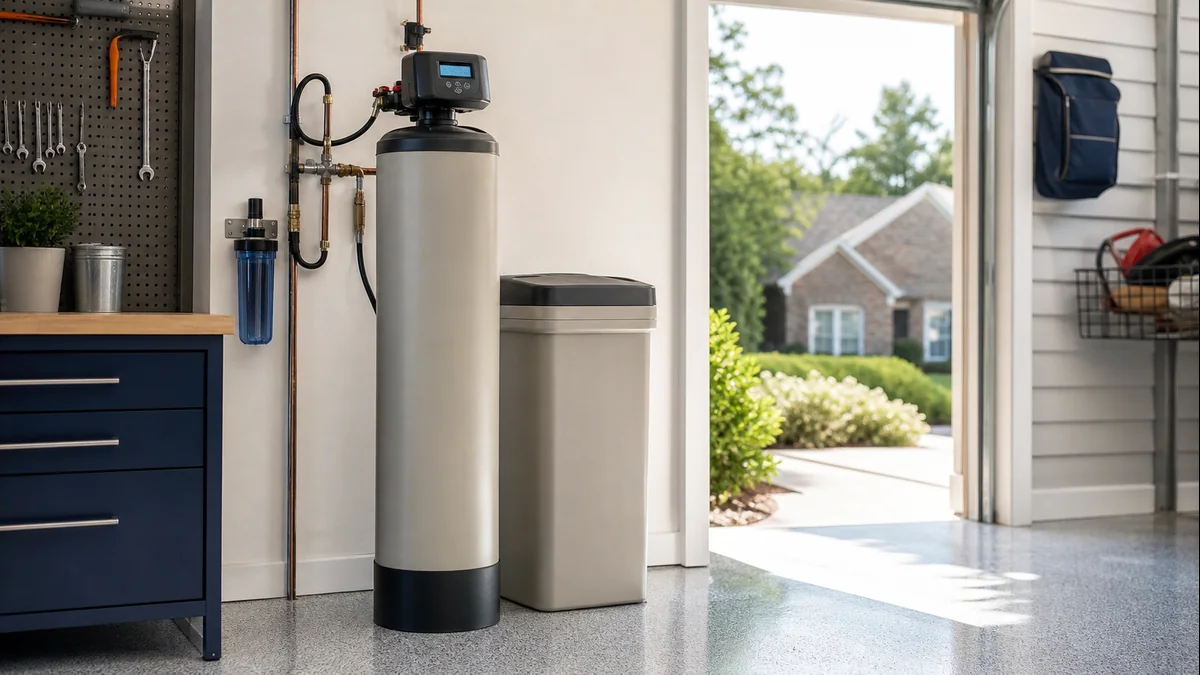
Direct answer: Yes. Raleigh's own water is only slightly hard at 1.6 grains per gallon, but hardness is a fraction of the case — the same 2025 report shows chlorine, chloramine, PFAS, and disinfection byproducts a softener never touches. That combination is exactly why the honest answer for a Raleigh home is an all-in-one system pairing softening resin with a carbon stage, not softening alone.
Is a water softener worth it in Raleigh, NC — even though the water here isn't very hard?
Yes, and the reason isn't really the hardness number. Raleigh Water's own testing puts hardness at an average of 25.2 ppm, or roughly 1.3 to 2.1 gpg — slightly hard on the Water Quality Association (WQA) scale, the mildest verified figure anywhere in our service area. Cary's water is measurably harder, reaching moderately hard at the top of its own range.
What makes Raleigh a genuine "yes" is everything else in the same report: chlorine and chloramine, measurable disinfection byproducts, and detectable PFAS — none of which a softener does anything about. The honest recommendation for a Raleigh home is a whole-home system that pairs softening with a carbon stage, addressing both halves of what's actually in the water.
What does Raleigh Water's own 2025 report show about chlorine and disinfection byproducts?
It shows real, measured levels that are legally compliant but still worth filtering out. Raleigh Water's 2025 Consumer Confidence Report puts total trihalomethanes (TTHM) at an average of 34.2 parts per billion, ranging up to 42.8, and haloacetic acids (HAA5) at an average of 22.0 ppb, ranging up to 33.6 — against legal limits of 80 and 60 ppb.
EPA's National Primary Drinking Water Regulations table lists TTHM's potential health effect from long-term exposure above the legal limit as "Liver, kidney or central nervous system problems; increased risk of cancer," and HAA5's as "Increased risk of cancer." Raleigh's water is legally compliant with both limits.
But "compliant" is a ceiling EPA set at the edge of its own acceptable risk, not a guarantee that everything under it is worth ignoring. Those are the exact compounds EPA had in mind when it drew that line, and a carbon stage removes them directly rather than relying on staying under a legal number.
Older third-party data from EWG's Tap Water Database put Raleigh's TTHM at 21.7 ppb — noticeably lower than the city's own 2025 figure. Both numbers are verified; they come from different years and datasets, not a contradiction. The more current figure is the one worth acting on today.
Why does Raleigh switch from chloramine to straight chlorine once a year?
Because chloramine systems benefit from an annual flush, and free chlorine does that job better than chloramine alone. Raleigh Water normally disinfects with chloramine, which the city describes as having no notable taste or odor, then converts to free chlorine only for several weeks on the N.C. Department of Environmental Quality's recommendation, flushing the distribution system while it does.
Chlorine residual runs higher system-wide during that period, and flushing can cause temporary discoloration. Raleigh's conversion typically falls in late winter through early spring — the 2026 period ran February 26 through April 2 — but exact dates shift every year, so check the City's own announcement rather than a fixed calendar. A carbon stage handles the taste and odor spike either way, chloramine or straight chlorine.
Does Raleigh's water carry PFAS along with the chlorine?
Yes, at low but measurable levels, and Raleigh Water is transparent about it. The utility's own 2025 Perfluorinated Compounds Data Results show finished water at both treatment plants running PFOS at 1.15 to 2.98 ppt and PFOA at 2.21 to 2.94 ppt across all four quarters — every single result under the EPA's 4.0 ppt limit for both compounds.
That's a genuinely good compliance record, but present and compliant are two different things. Raleigh's full PFAS breakdown covers what's detected and what removes it — softening resin has no effect on PFAS at all; only carbon certified to NSF/ANSI 53 or P473, or reverse osmosis, does that job.
What is 1.6 gpg of hardness actually doing inside a Raleigh home over time?
It's depositing minerals on everything the water touches repeatedly, even at a mild level. Calcium and magnesium don't pass through unnoticed — they build up on fixtures, inside the water heater, and on glassware, and that buildup compounds year after year rather than resetting on its own.
Homeowners on Raleigh's water typically notice:
- Dishes and glassware come out of the dishwasher without spotting or film
- Soap and detergent lather more easily, so less of both gets used per load
- Skin and hair feel less dry and tight after a shower
- Laundry stays softer, and colors hold longer over repeated washes
- Faucets and glass shower doors stay clearer instead of building scale
Softening resin vs. the carbon stage — which half of an all-in-one system solves what in Raleigh?
They solve two completely different problems, which is exactly why the honest answer for Raleigh is both together, not one or the other.
| Issue in Raleigh's water | Softening resin | Carbon stage |
|---|---|---|
| Hardness / mineral buildup (1.6 gpg avg) | Addressed | Not addressed |
| Water heater & appliance scale protection | Addressed | Not addressed |
| Chlorine / chloramine taste and odor | Not addressed | Addressed |
| TTHM (avg 34.2 ppb, up to 42.8) | Not addressed | Addressed |
| HAA5 (avg 22.0 ppb, up to 33.6) | Not addressed | Addressed |
| PFAS (PFOS 1.15–2.98 ppt, PFOA 2.21–2.94 ppt) | Not addressed | Addressed via carbon certified for PFAS or RO |
A softener-only system leaves the entire right-hand column untouched. That's the reasoning behind an all-in-one build, not an upsell tacked onto a softener quote.
Does lower hardness mean a softener is worth less here, and how do you find out what's really at your tap?
No — lower hardness is a reason to buy, not a reason to wait. At Raleigh's end of the measured range, the softening side of an all-in-one system regenerates less often and uses less salt to run, so the mineral half of the system is genuinely inexpensive to operate here.
A free water analysis is the only way to get a number specific to your own address rather than a citywide average. If you want a DIY read in the meantime, the Hach Total Hardness Test Kit, Model 5-B, reads out in grains per gallon on the same WQA scale used throughout this article.
Take the 60-second water quiz to see how an all-in-one system fits your Raleigh home, or book the free analysis directly to get an exact reading from your own tap.
FAQ
I just moved to Raleigh from a place where the minerals were obviously heavier — is a softener even worth installing here? Yes. Raleigh's hardness is genuinely milder than many other markets, but the same 2025 water report shows chlorine, chloramine, TTHM, HAA5, and PFAS — none of which relate to hardness at all. An all-in-one system addresses both the mild mineral side and the documented contaminant side in one install.
My glasses come out of the dishwasher spotted even though Raleigh's water is only slightly hard — why? Spotting is a classic sign of calcium and magnesium reacting with detergent residue during the dry cycle, and it happens at Raleigh's hardness level too — slightly hard still means measurable minerals, not mineral-free water. A softener addresses the spotting directly, and a free water analysis confirms your exact reading.
Is Raleigh's PFAS level something to actually worry about? Every result in Raleigh Water's 2025 testing came in under the EPA's 4.0 ppt limit, so there's no violation. But PFOS and PFOA showed up in all four quarters at both treatment plants — present and compliant at the same time — which is exactly the case a PFAS-certified carbon stage is built to close.
Does the annual chlorine switch mean I need different filtration for those few weeks? No — the same carbon stage that handles chloramine taste year-round also handles the free-chlorine period. The main difference for a homeowner is that taste and odor can be more noticeable during the switch, not that the treatment approach changes.
Why is Raleigh's TTHM number different between the city's 2025 report and older data I've seen online? Because they're different datasets from different years, not a contradiction. Raleigh's own 2025 CCR reports TTHM averaging 34.2 ppb; an older EWG dataset reported 21.7 ppb for the same system. Both are accurate for when they were measured — the 2025 figure is the more current one.
Will a softener actually pay off in Raleigh if the hardness here is the mildest in the area? The mechanism doesn't depend on the label — calcium and magnesium are present at 1.6 gpg, and deposits build up gradually wherever that water evaporates or is heated. At the mild end, the softening side of the system also costs the least to run day to day, which makes it an easier "yes," not a weaker one.
Sources
- City of Raleigh — Water Consumer Confidence Report 2025
- Raleigh Water — Perfluorinated Chemicals Data and Information
- City of Raleigh — 2025 Perfluorinated Compounds Data Results
- EPA — National Primary Drinking Water Regulations
Related reading: Raleigh Water Hardness | Is a Water Softener Worth It in Cary, NC? | Water Softener Cost in Raleigh, NC | PFAS "Forever Chemicals" in Raleigh, NC Water | Raleigh's Annual Chlorine Conversion, Explained
Answer nine practical questions, then request a written quote or well-water analysis.
Start My Water Analysis