
Is Cary, NC Tap Water Safe to Drink With All That Chlorine Taste?
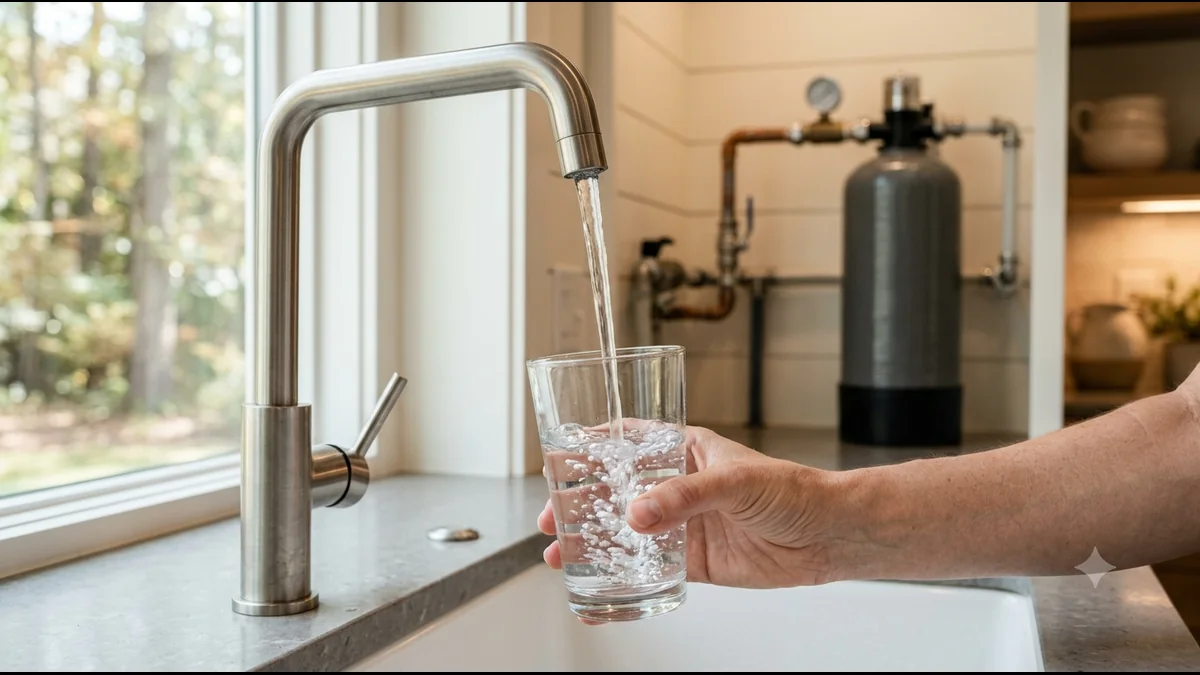
Direct answer: Yes — Cary's water is legally safe: it meets every EPA limit for chlorine and chloramine. But legally safe is a compliance floor, not a guarantee of zero risk — it's not the same as ideal. Taste peaks each year when Cary switches to free chlorine to flush the system. A whole-home carbon system removes the taste and the disinfection byproducts EPA regulates, at every tap, year-round.
Why Does Cary Tap Water Taste So Chlorinated?
Cary treats its water at the Cary/Apex Water Treatment Facility, which draws from Jordan Lake and disinfects with chloramine — a combination of chlorine and ammonia — for most of the year. The Town describes chloramine as producing less taste and odor than straight chlorine, which is exactly why utilities use it as the year-round disinfectant of choice.
Once a year, though, Cary switches to free chlorine only and flushes the distribution system by opening hydrants. The state encourages this step for any utility running chloramine, to clear out bacterial buildup in the pipes that chloramine alone doesn't fully address. That switch has historically run from late February through early March or into April.
Check the Town's own Annual Water Disinfection Change page for the current year's exact dates, since they shift annually. During that window, the chlorine residual runs higher system-wide, and that's when the strong chlorine taste and smell most residents notice actually shows up. If it's bothering you outside that window too, that's worth addressing at the source, not waiting out.
Is Chlorinated Water in Cary Actually Safe to Drink?
Yes. The EPA caps both chlorine and chloramine at a maximum residual disinfectant level (MRDL) of 4 mg/L, and the Cary/Apex plant's own reporting for the shared facility shows residuals well inside that limit — chloramine averaging around 3.2 ppm (range roughly 1.0–4.0 ppm) and chlorine averaging around 2.2 ppm (range roughly 0.8–3.6 ppm) in the Town of Apex's 2024 water quality report, which covers the same treatment plant Cary operates. Both disinfectants exist specifically to keep bacteria out of the water supply — a stronger chlorine taste during the annual switch is a sign the system is doing its flushing job, not a sign of a problem.
That said, "legally compliant" and "tastes great" aren't the same standard. For the fuller contaminant picture beyond chlorination — disinfection byproducts and PFAS tied to the Jordan Lake watershed — see our breakdown on whether Cary water is safe to drink.
What's the Difference Between Chlorine and Chloramine in Cary's Water?
| Chloramine (year-round default) | Free chlorine (annual flush) | |
|---|---|---|
| When it's in your water | Most of the year | A few weeks, typically late Feb–early April |
| Taste/odor | Described by the Town as producing minimal taste and smell | Noticeably stronger, more "pool-like" taste |
| Why it's used | Longer-lasting residual through the distribution system | State-recommended annual flush to clear pipe buildup |
| EPA limit (MRDL) | 4 mg/L as Cl2 | 4 mg/L as Cl2 |
| Removed by carbon filtration | Yes | Yes |
Why Does My Water Taste Chlorinated Even When Cary Uses Chloramine?
A few honest reasons show up outside the annual switch window. Taste sensitivity to chlorine and chloramine varies a lot person to person — some people detect it at levels others don't notice at all. Chloramine residual also isn't a flat number; it moves within the Town's normal operating range depending on where you are in the distribution system and how recently that section of pipe was tested. And if your home has an older water heater or galvanized plumbing, mineral buildup inside the lines can trap and slowly release disinfectant byproducts that make the taste linger even between flushes.
None of that means anything is out of spec — it means the level you're tasting at your specific tap isn't the same as the plant-average number Cary publishes.
Does Boiling or a Pitcher Filter Get Rid of the Chlorine Taste?
Partially, and only in narrow ways. Here's how the common fixes actually compare:
| Method | Removes chlorine taste? | Covers chloramine? | Covers whole home? |
|---|---|---|---|
| Letting water sit uncovered | Reduces free chlorine over time (chlorine off-gasses) | Barely — chloramine is much more stable | No — one glass at a time |
| Boiling | Reduces free chlorine | Barely | No — one pot at a time |
| Pitcher/faucet filter | Yes, at that tap | Yes, if carbon-based | No — one faucet only |
| Whole-home carbon filtration | Yes | Yes | Yes — every tap, shower, and appliance |
Chloramine is more chemically stable than plain chlorine, which is why letting a glass sit out or boiling — tricks that work reasonably well on straight chlorine — do much less for chloramine. Activated carbon is the one method that reliably strips both, which is why it's the fix the Town of Cary itself points residents toward for taste and odor complaints.
How Do I Get Rid of the Chlorine Taste in My Cary Home for Good?
A point-of-entry carbon stage, installed where water enters the house, treats every tap, the shower, the ice maker, and the washing machine at once — instead of one pitcher or one faucet filter that leaves the rest of the house untreated. For Cary homes specifically, pairing that carbon stage with softening resin in one all-in-one system also handles the hardness end of the range Cary sits in (up to moderately hard at the top of what we measure locally) — see our full Cary water softener guide for what that side of the water covers — so you're not running two separate pieces of equipment for two separate complaints. If chlorine taste is the main thing bothering you day to day, our guide on how to get rid of chlorine taste in tap water walks through the mechanics of how a carbon stage does it. For a look specifically at how filtration changes the feel of showers and hair in Cary, see whether a whole house filter removes chlorine and chloramine here.
FAQ
Is it safe to drink Cary tap water straight from the faucet? Yes. Cary's water meets EPA Safe Drinking Water Act limits for chlorine, chloramine, and every other regulated contaminant. A strong chlorine taste, especially during the annual disinfection switch, is a sign the system is being flushed as intended — not a sign of a violation.
I just moved to Cary and the water tastes way more chlorinated than my old city's water — is something wrong? Nothing is out of spec — it's usually a difference in how utilities set disinfectant levels. Cary's annual free-chlorine flush (typically late February through early April) produces a noticeably stronger taste than the chloramine most utilities use year-round. If it's outside that window and still bothering you, the water quiz can help you figure out what's worth filtering at your address.
Why does my neighbor's water taste fine but mine tastes chlorinated? Disinfectant residual varies across the distribution system, and taste sensitivity varies person to person — some people detect chlorine and chloramine at levels others don't notice. Your home's plumbing age and water heater can also affect how long that taste lingers at your tap.
My glasses smell like a pool when I run the dishwasher — is that the same issue? Yes, same source. Chlorine and chloramine carry through the whole plumbing system, including your dishwasher and washing machine, not just drinking water. A whole-home carbon system treats the water at the point it enters the house, so the smell disappears from appliances too, not just the kitchen faucet.
Does a pitcher filter fix this, or do I need something bigger? A pitcher filter can reduce chlorine taste at that one faucet, but it won't touch your shower, ice maker, laundry, or dishwasher. A whole-home carbon system treats every point of use at once.
Will boiling my water remove the chlorine taste before I drink it? It helps a little with free chlorine but does much less for chloramine, since chloramine is more chemically stable and doesn't off-gas the same way. It's not a reliable year-round fix, especially outside the annual chlorine-only window.
Sources
- Town of Cary — Annual Water Disinfection Change
- Town of Apex — Water Quality / Annual Drinking Water Quality Report
- EPA — Chloramines in Drinking Water
Not sure whether chlorine taste, hardness, or both are the issue at your address? Take the 60-second water quiz and get a straight answer before you buy anything.
Answer nine practical questions, then request a written quote or well-water analysis.
Start My Water Analysis