
Is Wake County Tap Water Safe to Drink?
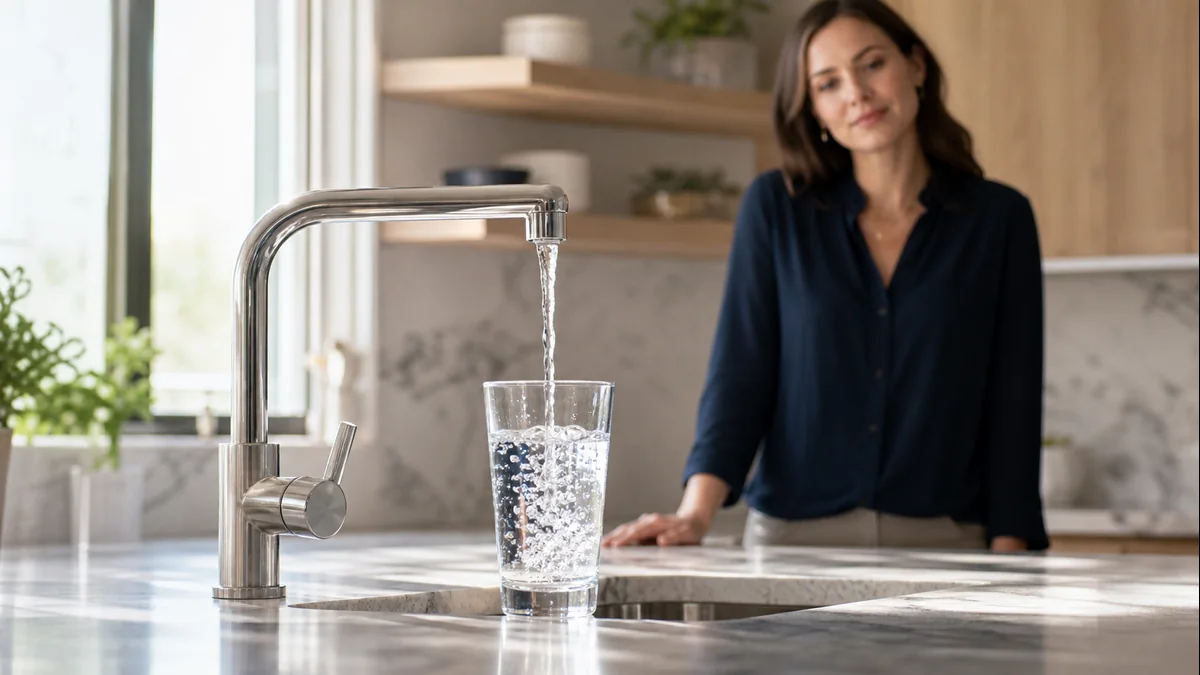
Direct answer: Yes — every water utility serving Wake County (Raleigh Water, the Cary/Apex plant, and Fuquay-Varina's blended supply) is legally compliant with EPA drinking-water standards. But "Wake County water" isn't one water: hardness and disinfection byproducts vary by utility and by ZIP. Our own testing measures 1.6–3.7 gpg, and compliant chlorine byproducts still call for a carbon stage — the fix is a free water analysis away.
Is Wake County tap water actually safe to drink?
Yes. Every public water system operating in Wake County is required to meet the same federal Safe Drinking Water Act limits, and none of the three systems covered here — Raleigh Water, the jointly owned Cary/Apex plant, or Fuquay-Varina's blended supply — reported an MCL violation in its most recent Consumer Confidence Report. That's a real, meaningful bar. It's what keeps acute contamination out of the tap in every one of these systems.
Compliance is a floor, not a finish line. It tells you the water won't make you sick under the rules as written — it says nothing about hardness, taste, or how close a given contaminant sits to that legal ceiling.
Why isn't there one single answer for "Wake County water"?
Because Wake County isn't served by one utility. Raleigh Water treats water for Raleigh, Garner, Knightdale, Rolesville, Wake Forest, Wendell, and Zebulon. Cary and Apex co-own a separate treatment plant on Jordan Lake that also supplies Morrisville. Fuquay-Varina buys finished water from three different sources and blends it.
Three systems, three source waters, three treatment trains, three sets of test results. Asking "is Wake County's water safe" is a bit like asking whether a whole state's restaurants are good — the honest answer depends entirely on which one you're standing in front of.
Is Raleigh Water's supply safe?
Yes, and its 2025 Consumer Confidence Report backs that up in detail. Total trihalomethanes (TTHM) averaged 34.2 ppb, up to 42.8; haloacetic acids (HAA5) averaged 22.0 ppb, up to 33.6 — both comfortably under the 60 ppb HAA5 limit and the federal TTHM limit. Hardness averaged 25.2 ppm across a 21.9–35.3 ppm range, which works out to roughly 1.3–2.1 gpg, slightly hard on the WQA/Hach scale.
Raleigh Water serves Raleigh proper along with Garner, Knightdale, Rolesville, Wake Forest, Wendell, and Zebulon — so this is the figure that applies across most of the county's population, not just the city itself. For a closer look at what that means on a specific street, see our Garner water treatment overview.
Is Cary, Apex, and Morrisville's water safe?
Yes. Cary and Apex jointly operate a treatment plant on Jordan Lake that also supplies Morrisville. Apex's 2024 CCR puts hardness at 33.3 ppm (about 1.9 gpg) and TTHM at 41 ppb, ranging up to 53. Cary's 2025 CCR reports TTHM at 37 ppb (17–43), HAA5 at 17 ppb (9–17), and average PFOA at 1.3 ppt — all within legal limits.
That 53 ppb TTHM figure is worth sitting with. It's roughly double what Raleigh Water's own system reports, and it's still fully compliant — which is exactly the gap between "legal" and "low." If you're on this system specifically, find your nearest Cary water treatment resource.
Is Fuquay-Varina's water safe?
Yes, and it's the most complicated supply in the county to answer honestly. Fuquay-Varina doesn't operate its own treatment plant — it purchases finished water from the City of Raleigh, Harnett County, and Johnston County and blends it before it reaches your tap. Hardness runs around 40 ppm, which the Town itself classifies as "slightly hard" on the same five-tier scale used throughout this article.
A Fuquay-Varina address can be drinking a blend that shifts depending on which source is contributing more that week. Every source is compliant on its own, but that blending is one more reason a plant-average figure only goes so far for a specific household — see our Fuquay-Varina water treatment overview for what that looks like at the address level.
Wake County water systems at a glance
| Utility | Towns served | Source | TTHM (ppb) | HAA5 (ppb) | Hardness |
|---|---|---|---|---|---|
| Raleigh Water | Raleigh, Garner, Knightdale, Rolesville, Wake Forest, Wendell, Zebulon | Falls Lake / Neuse River | 34.2 avg, up to 42.8 | 22.0 avg, up to 33.6 | ~1.3–2.1 gpg |
| Cary/Apex plant | Cary, Apex, Morrisville | Jordan Lake | 37–41 avg, up to 53 | 17–19 | ~1.5–1.9 gpg (town-published) |
| Fuquay-Varina | Fuquay-Varina | Blended: Raleigh, Harnett County, Johnston County | Not separately published | Not separately published | ~40 ppm ≈ 2.3 gpg |
If every system is compliant, why would I still need a system?
Because "compliant" answers a different question than "should I treat my water." Compliance means a utility stayed under a legal ceiling; it says nothing about hardness buildup on your fixtures or whether you can taste chlorine at your own tap. Both of those are real, common, and unaddressed by the fact that a utility passed its testing.
Our own testing across Wake County measures 1.6–3.7 gpg, depending on ZIP — slightly hard to moderately hard on the WQA/Hach scale, and we break down how that varies town by town.
That range sits on top of a legally compliant, disinfected supply, not instead of it. An all-in-one system's softening resin handles the hardness side; its carbon stage — the same kind of filtration covered in our Triangle PFAS explainer — handles the chlorine and byproduct side that softening alone never touches.
What does "legally compliant" actually mean for chlorine and its byproducts?
It means a utility's chlorine or chloramine disinfection produces byproducts — TTHM and HAA5 — that stayed under the EPA's Maximum Contaminant Level. EPA's National Primary Drinking Water Regulations table lists TTHM's potential health effect from long-term exposure above that limit as "Liver, kidney or central nervous system problems; increased risk of cancer," and HAA5's as "Increased risk of cancer."
That MCL is a ceiling set by EPA's own risk tolerance, not a guarantee of zero risk. Every utility in this county stays under it, which is genuinely good — but those are the exact compounds and exact effects EPA had in mind when it drew that line. A carbon stage removes TTHM and HAA5 rather than relying on staying under a legal number.
How do I find out what's actually coming out of my own tap?
A free water analysis is the only way to get a reading specific to your address rather than a utility-wide average. Plant-average figures like the ones above describe water leaving the treatment facility; what reaches a given tap depends on distance through the distribution system, pipe age, and which blended source is dominant that week for a Fuquay-Varina address. That's not a knock on any utility's numbers — it's just what an average is.
The address-level test is what settles hardness and taste questions a countywide figure can't. Take the 60-second water quiz to see how an all-in-one system fits your specific address, or book the free analysis directly.
FAQ
I just moved to Wake County from out of state — is the tap water here actually safe to drink right out of the faucet? Yes. Whichever utility serves your address — Raleigh Water, the Cary/Apex plant, or Fuquay-Varina's blended supply — is required to meet the same EPA Safe Drinking Water Act limits, and each one's most recent report shows no violations. It's still worth having your own address tested, since hardness and taste vary by ZIP in ways a county-wide answer can't capture.
My house is in Wake Forest — does that mean I'm on Raleigh's water or a separate system? Wake Forest is on the Raleigh Water system, so the 2025 CCR figures for TTHM, HAA5, and hardness that apply to Raleigh proper apply to your address too. I'd still recommend a free water test, since hardness runs 1.6–3.7 gpg depending on exact location within the service area.
Why does Fuquay-Varina's water taste different depending on the week? Because Fuquay-Varina blends purchased water from three different sources — Raleigh, Harnett County, and Johnston County — rather than treating its own supply, and the mix isn't fixed. Each source is independently compliant, but the blend shifting is a real, documented reason taste and hardness can vary more there than in a single-source town.
Is Cary or Apex's water worse than Raleigh's since the numbers are higher? Both are fully compliant, so "worse" isn't the right word — but Apex's TTHM figure (41 ppb, up to 53) does run meaningfully higher than Raleigh's (34.2 ppb average). That gap is exactly what a carbon stage is built to close, regardless of which system supplies your address.
Does a county health department test my water separately from the utility? No — for a home connected to a public system like Raleigh Water, Cary/Apex, or Fuquay-Varina, the utility itself handles the required EPA testing and publishes it in its annual report. A private test of your own tap is a separate, optional step, and it's the only way to see what your specific address is getting rather than a system-wide average.
If my water is legally compliant, is a whole-home system actually necessary or just nice to have? It comes down to what "necessary" means to you — compliance guarantees the water won't violate a legal limit, not that it's free of hardness or chlorine taste. Since every utility in the county is compliant and still shows measurable hardness and disinfection byproducts, an all-in-one system is what actually closes the gap between "passed the test" and "nothing left to address."
Sources
- Raleigh Water — 2025 Water Consumer Confidence Report
- Town of Apex — 2024 Annual Drinking Water Quality Report
- Town of Fuquay-Varina — Public Utilities
- EPA — National Primary Drinking Water Regulations
Answer nine practical questions, then request a written quote or well-water analysis.
Start My Water Analysis