
Just Moved to Apex, NC? A New Resident's Water Guide
Direct answer: Apex tap water comes from Jordan Lake, treated at the Cary/Apex plant that Apex co-owns with Cary. It's compliant water with no MCL violations in Apex's 2024 report — and that same report documents TTHM at 41 ppb ranging up to 53, roughly double Raleigh's. Hardness varies by address, running 1.6 to 3.7 grains per gallon in the homes we test. A free analysis tells you your number.
Where does Apex, NC get its water?
From B. Everett Jordan Lake, part of the Cape Fear River Basin, treated at the Cary/Apex Water Treatment Facility — a 56 million-gallon-per-day plant co-owned by Apex and Cary, with Cary as lead agency and operator. Apex is a co-owner, not a customer, and the same facility supplies Cary, Morrisville, RDU and RTP South.
If you moved to Apex from Raleigh, Garner, Knightdale or Wake Forest, you've changed water systems entirely: those towns are on Raleigh Water. Apex's water gets a different source, a different plant, and a different set of numbers — which is why the report you may have skimmed at your last address doesn't describe your new one.
Treatment at the Cary/Apex plant runs powdered activated carbon at the raw water pump station, ozonation for organics and taste-and-odor control, coagulation with alum and polymer, sand-and-carbon filtration, fluoride and corrosion-control chemistry, and finally chlorine and ammonia dosed separately in the clearwell to produce a chloramine residual.
What's actually in Apex, NC tap water?
Apex publishes its own annual drinking water quality report, and the 2024 edition is unusually clear. Every value below is from that report, for data year 2024, and all of them are compliant — the Town recorded no MCL violations.
| Parameter | Apex 2024 value | Range | Limit |
|---|---|---|---|
| Total hardness | 33.3 ppm ≈ 1.9 gpg | — | not regulated |
| TTHM (trihalomethanes) | 41 ppb | 20–53 | MCL 80 |
| HAA5 (haloacetic acids) | 19 ppb | 8–19 | MCL 60 |
| Chloramines (running annual avg) | 3.23 ppm | 1.04–3.98 | MRDL 4.0 |
| Chlorine (running annual avg) | 2.20 ppm | 0.8–3.6 | MRDL 4.0 |
| Bromate | ND | ND–1.8 | MCL 10 |
| Lead (90th percentile, 2022) | ND | ND–3.9 | Action level 15 |
| Copper (90th percentile, 2022) | 0.105 ppm | ND–0.13 | Action level 1.3 |
| PFBA | 3.8 ppt | ND–7.6 | not regulated |
| PFHxA | 3.65 ppt | 3.3–4.0 | not regulated |
| PFOS, PFOA, PFHxS, PFNA, PFBS | ND | — | PFOA/PFOS MCL 4 ppt |
The number a new resident should actually pay attention to is TTHM: 41 ppb, ranging up to 53 — compliant, well under the 80 ppb limit, and roughly double the 21.7 ppb listed for Raleigh's system. Trihalomethanes are disinfection byproducts, formed when disinfectant reacts with natural organic matter in the source water, and they are one of the things activated carbon removes effectively. Our explainer on trihalomethanes in tap water covers what they are in plain language.
Is Apex, NC water hard or soft?
Both, depending on where you are — and that's not a dodge, it's the whole point. Apex's 2024 report gives an average total hardness of 33.3 ppm, or 1.9 grains per gallon, which the Town calls moderately soft on its own scale. That figure describes finished water leaving the treatment plant, averaged across the year.
Our own testing across Apex, Cary and Morrisville measures 1.6 to 3.7 grains per gallon depending on the address. We classify on the Water Quality Association (WQA) scale — the same one the Hach Total Hardness Test Kit (Model 5-B) uses — where at 1.6 gpg that's slightly hard, and at 3.7 gpg it's moderately hard, since 3.7 gpg is about 63 mg/L, just over the WQA's 60 mg/L line between slightly hard and moderately hard. Both figures are real. The Town's is a plant-wide average on its own scale; ours is what we find at individual taps after the water has traveled the distribution system. A test at your own address is the only thing that settles which end of that range describes your house — and it's free.
Worth internalizing either way: low hardness is not the same as mineral-free. Calcium and magnesium are present at every level in that range, and the deposits they leave on glassware, faucet aerators, shower doors and the inside of a water heater accumulate over years of ordinary daily use.
Why does my Apex water taste like a swimming pool sometimes?
Because the Cary/Apex system normally carries chloramine and switches to free chlorine once a year to flush the distribution system — a practice North Carolina encourages for chloramine systems. Chloramine holds a stable residual with very little taste or odor; free chlorine is the version people notice immediately. The dates move year to year, so watch for the Town's own announcement instead of expecting a fixed calendar window. It's normal, it's temporary, and a whole-home carbon stage removes the taste in either mode, all year.
What should a new Apex homeowner do about all this?
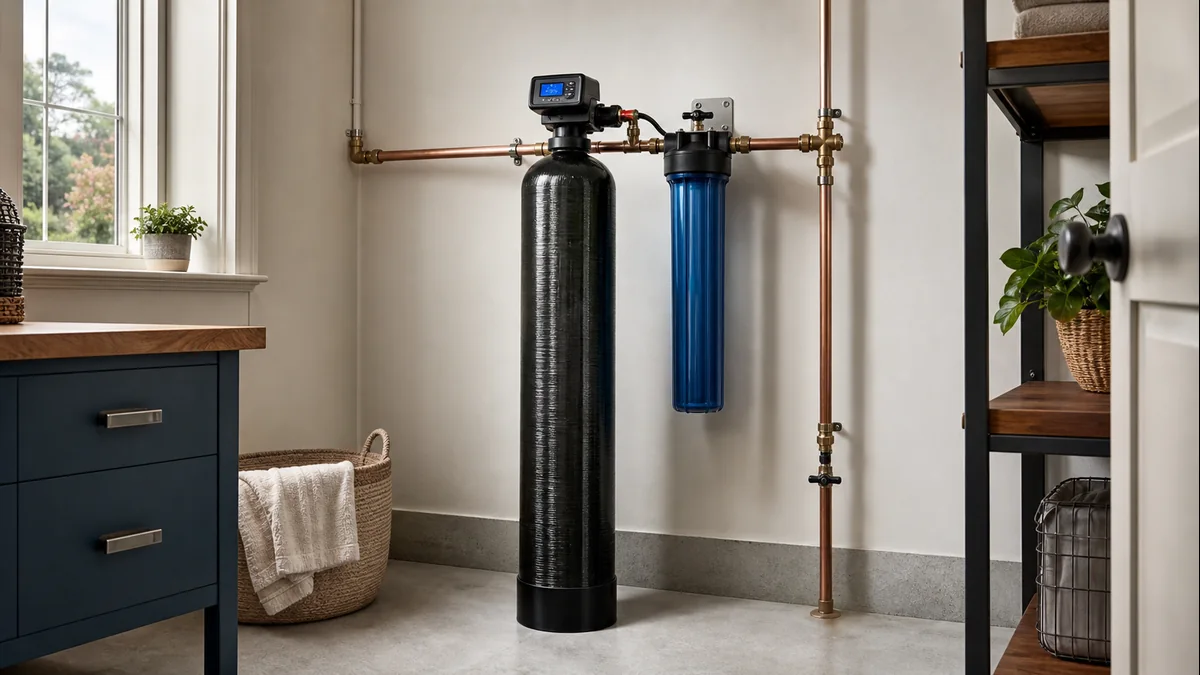
Get the number for your own address, then treat what's actually there. The system we install in Apex homes is an all-in-one: softening resin and activated carbon in a single whole-home unit.
- The softening half targets calcium and magnesium — protecting the water heater, dishwasher, washing machine and plumbing from gradual scale, and putting an end to spotty glassware and soap that won't lather.
- The carbon half targets what softening never touches: chloramine and chlorine taste and odor, and the disinfection byproducts documented in Apex's own report. PFAS reduction requires carbon certified under NSF/ANSI 53 or P473, or reverse osmosis under NSF/ANSI 58 — ask for the specific certified claim, not just the standard number. Our guide to NSF certifications for water filters explains what each one covers.
Installed systems are sized and priced after a free water analysis, well under what national big-brand installers commonly quote ($6,000 to $12,000). Because Apex water starts out low in hardness, the softening side regenerates infrequently and uses very little salt — which makes it inexpensive to operate here.
Get your Apex address tested
Take our 60-second water quiz to see which all-in-one system fits your new home, or book a free water analysis and find out where in the 1.6–3.7 gpg range your house actually falls.
Frequently Asked Questions
I just moved to Apex and my glasses come out spotty — what fixes that? Spotting and cloudy film come from dissolved calcium and magnesium drying on the glass, and they show up across the whole 1.6–3.7 grain-per-gallon range we measure in this area. A softening stage is what removes the minerals at the source; rinse aid and hotter wash cycles only mask it.
Do I need a water filter if Apex's water already passed every test? Compliance and preference are two different things. Apex's water meets every EPA limit, and its own report still documents TTHM at 41 ppb ranging to 53 plus a chloramine residual you can taste — carbon filtration is about what you want in your own house, not about whether the utility did its job.
My old house had a softener and this one doesn't — will I notice? Most people notice within the first few weeks, usually in the shower and the dishwasher: less lather from the same amount of soap, a squeakier feel on skin and hair, and film reappearing on glassware. Whether it's dramatic depends on where your address falls in the hardness range.
Is Apex water the same as Cary's and Morrisville's? Yes — all three receive water from the same jointly operated Cary/Apex plant, so the source and treatment are identical. What differs house to house is hardness at the tap, which varies by ZIP across the distribution system.
Where can I find Apex's official water quality report? The Town of Apex publishes an annual drinking water quality report covering the previous data year, and it's the primary source for every figure in the table above. One caution: the 2024 edition misprints the hardness units, and the arithmetic only works read as ppm and gpg.
Should I test my water even though the town already tests it? Yes, because the two tests answer different questions. The Town measures what it produces system-wide; an analysis measures what arrives at your tap and is what determines how a system gets sized for your household.
Related reading: Water Softener in Apex, NC | Water Softener Cost in Apex, NC | New Build Water Treatment in Apex, NC | Best Whole-Home System for Cary, Apex & Morrisville
Answer nine practical questions, then request a written quote or well-water analysis.
Start My Water Analysis