
Just Moved to Durham, NC — What Should I Know About the Water?
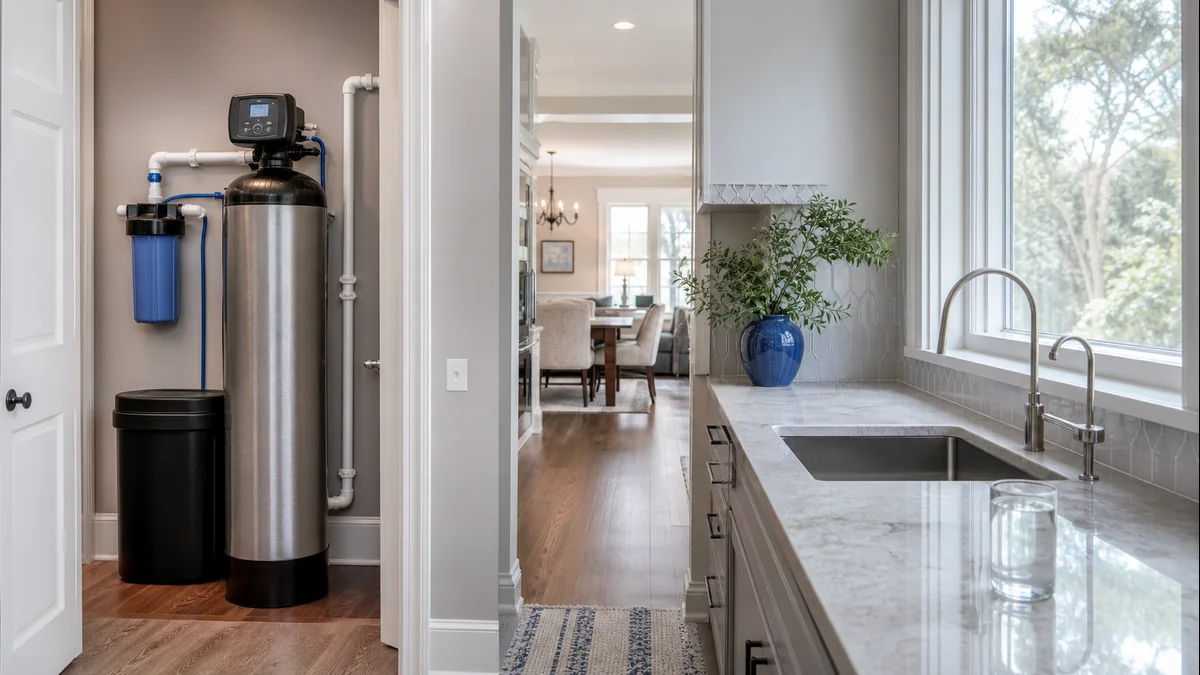
Direct answer: Durham draws from Lake Michie and Little River Reservoir, treated at the Williams and Brown plants, and purchased water from the Town of Cary during the reporting year. It's compliant, but Durham's 2025 report shows the highest verified disinfection byproducts in the Triangle — reason enough for a whole-home carbon-and-softening system. Durham publishes no hardness figure, so a free water analysis is the only way to know yours.
Where Does Durham, NC Tap Water Actually Come From?
From two reservoirs: Lake Michie and the Little River Reservoir, both treated at Durham's Williams and Brown water treatment plants. If you moved from elsewhere in the Triangle, this is a different source than what you likely had before — Raleigh, Garner, and Wake Forest run on Raleigh Water from Falls Lake, while Cary, Apex, and Morrisville draw from Jordan Lake.
Durham's 2025 Annual Drinking Water Quality Report also discloses that Durham purchased water from the Town of Cary during the reporting year, so some Durham addresses may receive a blend depending on where they sit in the distribution system.
Is Durham, NC Water Safe to Drink?
Yes — it's fully compliant with EPA's legal limits, with no MCL violations in the 2025 report. That's the regulatory bar, and Durham's water clears it. But compliant doesn't mean nothing is present: the same report documents real, measurable disinfection byproducts, PFAS, and a chloramine residual, all of which are worth understanding as a new resident rather than assuming away.
Why Does My Water Taste Like Chlorine After Moving to Durham?
This is one of the most common questions new Durham residents ask, and it's a real, recurring complaint — not an isolated one. People who move to Durham from areas with different water often notice a stronger chlorine taste at first, and reactions genuinely vary household to household: some residents adjust quickly, some switch to bottled water or a pitcher filter, and some install whole-house filtration at the main line so every tap in the home is covered.
There's no single "right" reaction here, and none of it means anything is wrong with your home's plumbing. Durham's chlorine residual (RAA 0.63 ppm) and chloramine residual (1.5 ppm) are both fully compliant figures, and taste sensitivity to chlorine-based disinfectants simply differs from person to person. Whole-house filtration at the main line is a genuine, common answer Durham homeowners land on once they decide the taste is worth addressing rather than living with.
How Hard Is Durham's Water?
Unknown until you test it — Durham doesn't publish a hardness figure in its Annual Drinking Water Quality Report, and that's confirmed directly from the current report rather than assumed. That's different from Raleigh, Cary, and Apex, which all publish their own hardness numbers. Without a published figure, the only honest way to know what's coming out of a specific Durham tap is a test at that address, which is free and takes the guesswork out of sizing a system.
What Does Durham's Report Show About PFAS?
Measurable, and fully compliant. Durham's 2025 report shows PFOA up to 5.7 ppt and PFOS up to 7.2 ppt, both documented as compliant results in the report. PFAS reduction specifically requires carbon certified for PFAS (NSF/ANSI 53 or P473) or reverse osmosis (NSF/ANSI 58) — a standard carbon stage alone isn't automatically enough, which is worth knowing before assuming any whole-home filter handles it. See the full PFAS breakdown for Durham for the complete picture.
What About Pesticides and Herbicides in Durham's Water?
Durham's 2025 report carries an explicit table naming atrazine and simazine, both sampled quarterly through 2025, and both came back non-detect. That's a genuine clean result, not a gap in testing — Durham's report specifically names these compounds and reports no detection, which is a more thorough disclosure than towns whose reports simply omit a pesticide row entirely. See the full pesticide and herbicide breakdown for Durham.
What Do Durham's Disinfection Byproducts Actually Look Like?
This is where Durham's numbers stand out. The 2025 report shows total trihalomethanes (TTHM) at a highest locational running annual average (LRAA) of 56 ppb, against an 80 ppb legal limit, and haloacetic acids (HAA5) at a highest LRAA of 49 ppb, against a 60 ppb limit. Both are the highest verified disinfection byproduct readings anywhere in the Triangle service area we track.
EPA's National Primary Drinking Water Regulations table lists TTHM's potential long-term health effect above the legal limit as "Liver, kidney or central nervous system problems; increased risk of cancer," and HAA5's as "Increased risk of cancer." Durham's water is legally compliant — every result stays under both limits.
"Compliant" describes a ceiling EPA set at the edge of its own acceptable risk, not a guarantee of zero exposure to the exact compounds that ceiling was written around. A carbon filtration stage removes TTHM and HAA5 directly from the water reaching your fixtures, rather than relying on staying under a legal number.
What a New Durham Homeowner's Water Actually Contains
| What's in the report | Durham's 2025 figure | Addressed by carbon? | Addressed by softening? |
|---|---|---|---|
| TTHM | Highest LRAA 56 ppb (limit 80) | Yes | No |
| HAA5 | Highest LRAA 49 ppb (limit 60) | Yes | No |
| PFOA / PFOS | Up to 5.7 / 7.2 ppt | Yes, with PFAS-certified media | No |
| Atrazine, simazine | Non-detect, both sampled quarterly | Yes, if ever detected | No |
| Chlorine / chloramine taste | RAA 0.63 ppm / 1.5 ppm | Yes | No |
| Hardness | Not published — test your address | No | Yes |
What Should a New Durham Homeowner Actually Do About It?
Test first, then decide. A free water analysis measures hardness at your specific address, since Durham's own report doesn't publish one. From there, an all-in-one whole-home system pairs softening resin — for whatever hardness your address turns up — with a carbon stage sized for Durham's documented TTHM, HAA5, and PFAS levels, in one unit rather than separate equipment. Learn more about water softeners and treatment options in Durham.
FAQ
I just moved to Durham from a house with well water and I'm not used to any chlorine taste at all — is something wrong? No. Municipal systems disinfect with chlorine-based compounds that a private well never carries, so a stronger taste than you're used to is expected, not a sign of a problem. It's a common enough adjustment that whole-house filtration at the main line is a normal step Durham homeowners take once they decide to address it.
My neighbor says Durham's water is fine and I shouldn't worry about it — should I still get it tested? Reactions to Durham's water genuinely vary household to household, and your neighbor's experience doesn't tell you what's coming out of your own tap, especially since Durham publishes no hardness figure at all. A free water analysis gives you your own numbers instead of someone else's impression.
Does Durham's water contain PFAS, and is that something to actually worry about? Durham's 2025 report shows PFOA up to 5.7 ppt and PFOS up to 7.2 ppt — measurable, documented levels. PFAS reduction requires carbon certified specifically for PFAS or reverse osmosis, not just any carbon filter, which is why a system built for it matters more than filtration in general.
Why can't I find a hardness number for Durham anywhere? Because Durham's Annual Drinking Water Quality Report doesn't publish one — that's confirmed directly from the current report, not an oversight on your part. A free water analysis at your specific address is the only way to get an actual hardness reading for a Durham home right now.
Is it true Durham sometimes gets water from Cary? Yes — Durham's 2025 report discloses that Durham purchased water from the Town of Cary during the reporting year, so some addresses may receive water sourced differently than others in the same city, depending on the distribution system.
How do I know if what I'm tasting is a real water quality issue or just an adjustment period? A free water analysis is the fastest way to tell the difference, since it measures what's actually in your water rather than relying on taste alone. If chlorine or chloramine taste is part of what's showing up, that's exactly what the carbon stage of an all-in-one system is built to remove.
Find Out What Your New Durham Address Is Actually Delivering
Durham's own report shows the highest disinfection byproducts we track anywhere in the Triangle, and there's no published hardness number to fall back on. Take the 60-second water quiz to see which all-in-one system fits your Durham home, or book a free water analysis for your own address's actual numbers.
Sources
- City of Durham — 2025 Annual Drinking Water Quality Report
- EPA — National Primary Drinking Water Regulations
Related reading: Water Softeners in Durham, NC | Why Does Durham, NC Water Taste Like Chlorine? | PFAS and Forever Chemicals in Durham, NC Water | Does Durham, NC Tap Water Have Pesticides in It? | How to Read Your Water Quality Report in Durham, NC
Answer nine practical questions, then request a written quote or well-water analysis.
Start My Water Analysis