
Why Does Laundry Come Out Softer on Soft Water?
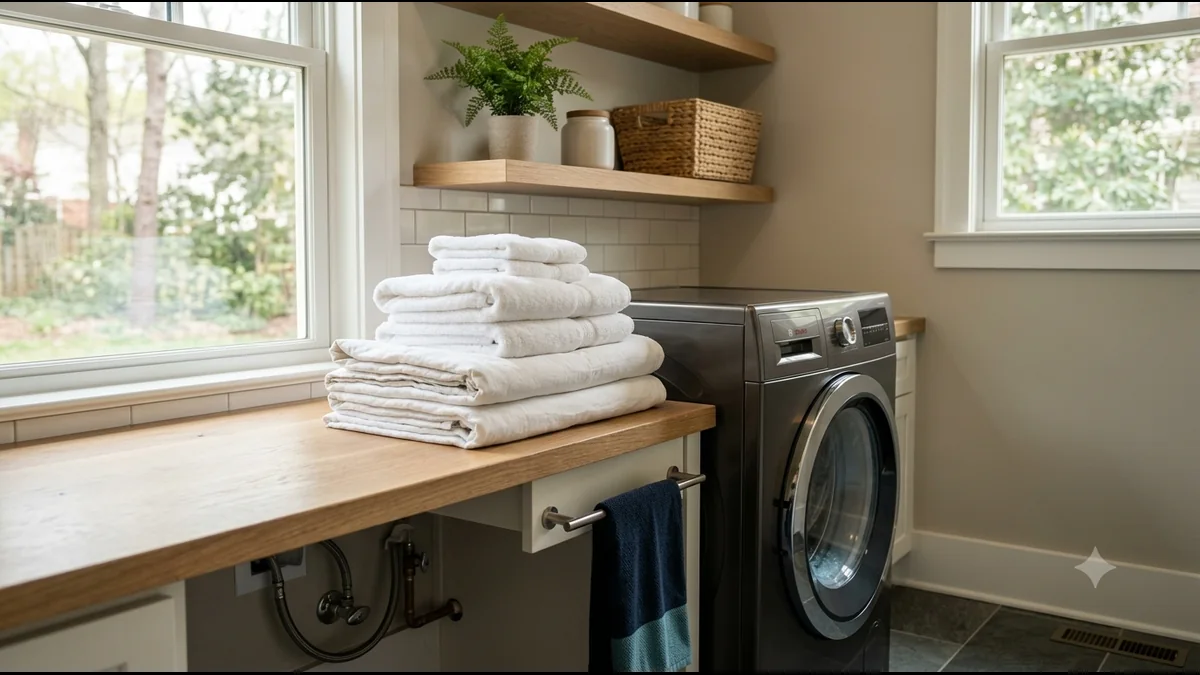
Direct answer: Laundry comes out softer and brighter on soft water because calcium and magnesium in hard water react with detergent to form an insoluble curd that resists rinsing out of fabric, requiring more detergent and leaving residue behind in the fibers. Softening removes those minerals at the source, so detergent lathers, cleans, and rinses out completely — the softening half of Triangle Waterworks' all-in-one system, paired with a carbon stage for what softening alone can't touch.
Why does hard water need more detergent to get laundry clean?
USGS explains that hardness is dissolved calcium and magnesium, and those minerals react with soap to form an insoluble curd rather than letting it clean freely. The same reaction happens with laundry detergent: more detergent is needed to get clothes clean in hard water, and the soap or detergent is harder to work into a full lather to begin with. USGS also notes that more water is needed afterward to rinse the leftover curd away — a step a washing machine's rinse cycle has to work harder to accomplish.
Why do towels feel stiff and whites go dingy over time?
That's the same curd reaction settling into fabric instead of rinsing out of it. When calcium and magnesium react with detergent during the wash, some of the resulting insoluble residue doesn't fully rinse away — it stays in the weave of the fabric. Repeated wash cycles compound that residue, which is consistent with towels feeling stiffer and whites looking duller over time, since the buildup sits on top of and inside the fibers rather than washing out completely.
What changes about detergent dosing on softened water?
With calcium and magnesium removed before the water ever reaches the machine, detergent doesn't have minerals to react with, so:
- Less detergent is needed to reach the same cleaning result.
- Detergent lathers and disperses through the wash more fully.
- Rinsing clears detergent and soil completely instead of leaving curd behind.
- Fabric comes out of the rinse cycle without mineral residue trapped in the fibers.
- Whites and colors keep their original brightness longer, since residue isn't accumulating wash over wash.
Does hard water affect the washing machine itself, not just the laundry?
Yes, by the same general mechanism the Department of Energy's Building America program documents for water heaters: scale from dissolved calcium and magnesium deposits on any surface where hard water sits or heats, acting as an insulating layer and a source of buildup on wetted components. In a water heater, DOE describes that buildup collecting on the heating element and reducing how effectively heat transfers to the water, and lime-scale buildup capable of clogging valves. The same wetted-component principle applies to any appliance that heats or moves hard water through valves and hoses — mineral deposits accumulate wherever hard water sits or heats, not just inside a water heater tank. Preventing that buildup at the source, by softening the water before it reaches the appliance, is the DOE's stated better strategy than cleaning scale out after it has formed.
Where the difference actually shows up
| In the wash | What's happening | On softened water |
|---|---|---|
| Need more detergent for the same load | Calcium and magnesium react with detergent, forming curd | Minerals removed, detergent cleans as designed |
| Towels feel stiff over time | Curd residue settles into fabric fibers, wash after wash | Detergent and residue rinse out completely |
| Whites look dingy | Same residue accumulating on and in fibers | No residue buildup to dull fabric |
| Using more detergent than the box recommends | Extra detergent consumed by the mineral reaction | Standard dosing goes further |
| Mineral deposits on wetted machine components | Same scale mechanism DOE describes for water heaters | Minerals removed before reaching the machine |
Does Triangle's local hardness make a real difference in the laundry room?
It does, proportionally. Raleigh Water tests at roughly 1.6 gpg — slightly hard on the WQA scale, at the low end of the range — so the curd effect on laundry there is real but modest. Cary, Apex, and Morrisville span a wider range, 1.6–3.7 gpg, with the top of that range moving into moderately hard territory. That's a genuine hardness case, and it's exactly where softened water makes the biggest difference in detergent dosing and how laundry feels coming out of the dryer.
What doesn't softening change about my laundry water?
Softening resin exchanges calcium and magnesium — nothing else. It has no effect on chlorine, chloramine, or disinfection byproducts like HAA9 and TTHM, which are a separate class of substance entirely. Those are documented in Triangle water: Raleigh's system shows HAA9 at 19.9 ppb and TTHM at 21.7 ppb, while Cary's system runs higher, at HAA9 27.5 ppb and TTHM 38.2 ppb tied to its Jordan Lake source. All of these figures are legally compliant with EPA limits, referenced here against EWG's stricter, non-regulatory guideline as a separate benchmark. That gap is why Triangle Waterworks builds a carbon filtration stage into the same all-in-one system as the softening resin, rather than selling a standalone softener — the softening side handles the laundry and detergent benefits above, and the carbon side handles what softening structurally can't.
Frequently Asked Questions
I just switched detergents because my towels felt stiff, but they're still stiff — what else could it be? Changing detergent doesn't remove the calcium and magnesium causing the reaction, so a new detergent brand will run into the same curd formation as the old one. USGS's mechanism points to the water itself, not the detergent, as the variable worth addressing first.
My whites keep looking dingy no matter how much bleach I use — is that a hardness issue? It can be. If curd residue from calcium and magnesium is accumulating in the fabric wash after wash, bleach addresses staining but doesn't remove that mineral buildup. Softening the water removes the minerals causing the residue at the source.
Do I need to use less detergent once I have a softener, or should I keep dosing the same? Once calcium and magnesium are removed, detergent isn't being consumed by the mineral reaction anymore, so the same dose goes further. Many households find they can dial back from the amount they used on hard water and still get a full lather and clean rinse.
I have hard water spots on my glassware and now I'm wondering if my washing machine has the same problem — does it? The same mineral-deposit mechanism the Department of Energy describes for water heaters applies to any appliance with components exposed to hard water, since scale forms wherever hard water sits or heats. Softening addresses both the glassware and the washing machine by removing the minerals before they reach either one.
Will a water softener also fix the chlorine smell that clings to my towels after washing? No. A softener only removes calcium and magnesium — it has no effect on chlorine, chloramine, or disinfection byproducts. That requires a carbon filtration stage, which is why the all-in-one system includes both rather than softening resin alone.
Is it worth softening if I'm only really trying to fix my laundry, not my skin or dishes? Softening treats the whole household's water at the point of entry, so the same mechanism that changes detergent performance in the laundry room also affects dishes, fixtures, and appliances throughout the house. The all-in-one system covers laundry along with everything else the softening and carbon stages address.
See what your water needs
Take the 60-second water quiz to see what system fits your home if you're on city water, or request a free water analysis if you're on a well, since hardness varies enough well to well that sizing is based on actual test results rather than a general estimate.
Related reading: What Size Water Softener Do I Need? | Is a Water Softener Worth It in NC? | Water Softener Salt Cost Per Year | What Hard Water Costs You in Appliance Damage | Water Softeners in North Carolina
Answer nine practical questions, then request a written quote or well-water analysis.
Start My Water Analysis