
New Construction Water Treatment in Morrisville, NC
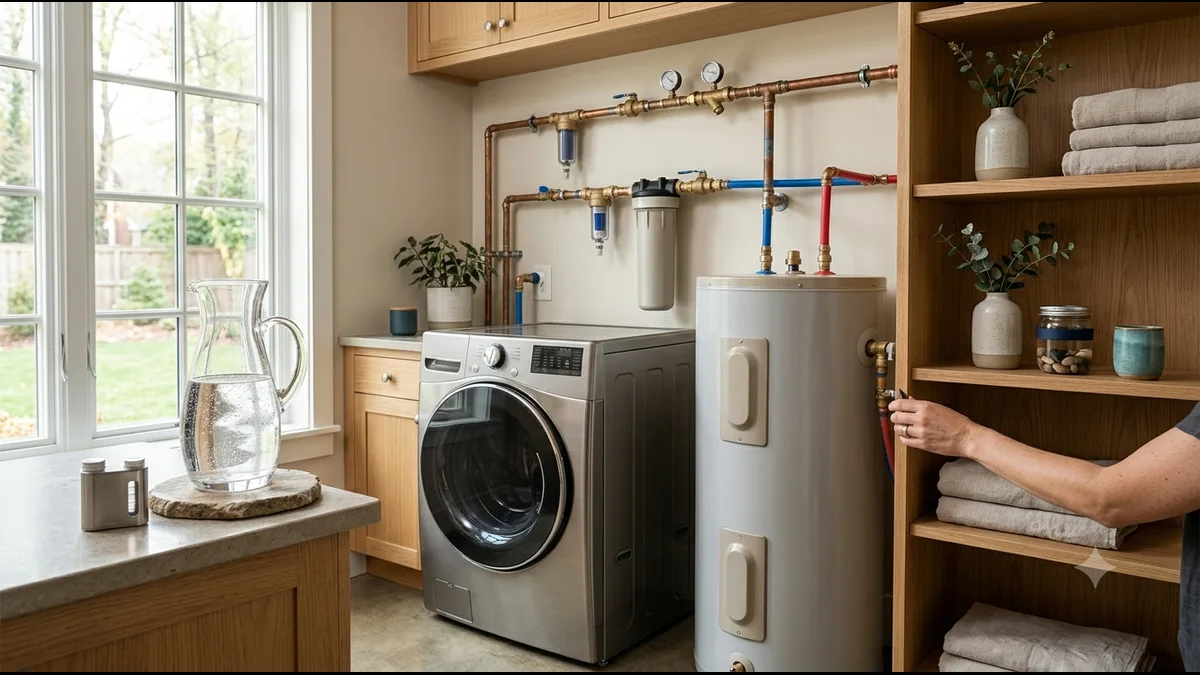
Direct answer: A new Morrisville home is the cheapest and easiest moment to install whole-home water treatment, because the plumbing is accessible and nothing has started accumulating yet. Morrisville receives Cary's treated Jordan Lake water, which carries a chloramine residual and measurable disinfection byproducts, and hardness that runs 1.6 to 3.7 grains per gallon by address. An all-in-one softening plus carbon system protects new appliances from year one.
Why install water treatment in a brand-new Morrisville home?
Because everything a whole-home system protects is brand new right now, and mineral buildup is cumulative from the first day the water is turned on. A new build arrives with a factory-fresh water heater, an unscaled dishwasher, an unmarked glass shower enclosure, and untouched fixtures. Every one of those has a service life that gets measured in years of water passing through it. The deposits that eventually show up as a crusty aerator, a filmy shower door, or a sediment layer at the bottom of a water heater don't arrive in a single bad week — they accumulate quietly, from day one, on every home on municipal water.
There's also a practical reason specific to new construction: the plumbing is the most accessible it will ever be. Installing a whole-home system into a new build or a recently completed home is a clean, planned job rather than a retrofit around finished walls, stored boxes, and a garage that's already full.
What water does a new Morrisville home actually receive?
Cary's finished water, from the plant Cary and Apex jointly own. Morrisville does not operate its own water utility — the Town of Cary has run Morrisville's water and sewer system since April 2006 — so a Morrisville tap delivers the same treated water as a Cary or Apex tap. That water comes from B. Everett Jordan Lake, in the Cape Fear River Basin, and is treated at the Cary/Apex Water Treatment Facility, a 56 million-gallon-per-day plant that Cary operates as lead agency and that also serves RDU and RTP South.
The treatment train is thorough: powdered activated carbon dosed into the raw lake water at the pump station, ozonation to handle organics and taste-and-odor compounds, coagulation with alum and polymer, filtration through sand and carbon, fluoride and corrosion-control chemistry, and finally chlorine and ammonia combined in the clearwell to form a chloramine residual that holds all the way to your house.
One consequence of Morrisville's arrangement matters for anyone researching a new address: Morrisville publishes no water quality figures of its own. If you've searched for a Morrisville water report and found nothing, that's not a missing document — the nearest published data comes from Apex and Cary, because it's the same water.
What's actually in that water that a new home should be treating?
Two separate things, which is why the system has two halves.
- Disinfection byproducts and disinfectant taste. Apex's 2024 water quality report, covering the shared system, lists TTHM at 41 ppb, ranging up to 53, and HAA5 at 19 ppb — compliant with EPA limits, and roughly double Raleigh's 21.7 ppb TTHM. It also found PFBA at 3.8 ppt and PFHxA at 3.65 ppt, with PFOS, PFOA, PFHxS, PFNA and PFBS non-detect. Duke researchers have measured combined PFAS above 200 ppt in raw Jordan Lake source water, which is a watershed characteristic rather than a plant failure. Activated carbon is the stage that addresses byproducts and disinfectant taste; PFAS reduction specifically requires carbon certified under NSF/ANSI 53 or P473, or reverse osmosis under NSF/ANSI 58.
- Hardness minerals. Our own testing across Cary, Apex, and Morrisville measures 1.6 to 3.7 grains per gallon depending on the address — slightly hard at the low end and moderately hard at the top, since 3.7 gpg is about 63 mg/L and the WQA line between slightly hard and moderately hard sits at 60 mg/L. Cary's published figure for finished water is 25–30 ppm, and Apex's 2024 report gives 33.3 ppm (1.9 gpg); those describe an average leaving the plant, not what reaches a particular tap. Softening resin is the stage that handles minerals.
| Timing of the install | What's already happened | Install complexity | What you protect |
|---|---|---|---|
| During or right after the build | Nothing — plumbing and appliances are new | Simplest; clean access | Full service life of every appliance and fixture |
| A few years in | Early deposits on fixtures and in the heater | Standard retrofit | Most of the remaining service life |
| After a water heater fails | Scale has accumulated inside the tank | Standard retrofit, plus a heater replacement | The replacement heater and everything downstream |
Does a new home's builder-installed plumbing already handle this?
No — builder plumbing delivers water, it doesn't treat it. A new build's supply lines, water heater, and fixtures are all sized and installed to code, and none of that changes what's dissolved in the municipal water running through them. Some new homes are plumbed with a loop or dedicated space for a future softener, which makes the install tidier, but the loop itself does nothing until equipment is connected to it. If you're closing on a Morrisville new build, it's worth asking the builder whether a softener loop was roughed in — and worth knowing that the answer doesn't change what the water is doing.
What does new construction water treatment cost in Morrisville?
Locally installed all-in-one systems are sized and priced after a free water analysis, well under what national big-brand installers commonly quote ($6,000 to $12,000) for comparable whole-home coverage. What you're quoted reflects household water usage and what your test actually finds, which is why the analysis comes before the quote — not after it. Our Morrisville water softener cost breakdown goes through the numbers in more detail.
Operating cost is where Morrisville homeowners get a genuine break. Because the water starts out low in hardness, a softener here regenerates infrequently and uses very little salt compared with a system in a truly hard-water region. Low hardness makes the system cheap to run — that's a reason to install, not a reason to hesitate.
Get your new Morrisville home's number
Take our 60-second water quiz to see which all-in-one system fits your home, or book a free water analysis — the only way to know what your specific new address is delivering, since Morrisville publishes no figure of its own.
Frequently Asked Questions
I just closed on a new build in Morrisville — is it too early to think about water treatment? It's the ideal time. Everything the system protects is new, the plumbing is easy to access, and mineral deposits accumulate from the first day the water runs, so installing early captures the full service life of your water heater, dishwasher, and fixtures.
My builder said the water here is soft, so do I still get anything out of a system? Yes, and both things can be true at once — it's a scale difference. On the informal terms most builders use, the published plant averages are low. On the WQA scale our Hach test kit uses, those same numbers read as slightly hard to moderately hard, not soft, and our testing still measures up to 3.7 grains per gallon at some addresses — plus softening does nothing about the chloramine residual or the TTHM levels documented in the shared system's own report, which is the carbon half's job.
Can a system be installed before I move in? Usually, yes, and it's often the smoothest scheduling window since the house is empty and the garage is clear. It starts with the free water analysis at the address, which can typically be done once the water is on.
Does a new home warranty or builder warranty cover scale damage to appliances? Warranty terms vary by builder and by manufacturer, so read your own paperwork rather than assuming. What's consistent is that mineral accumulation is gradual wear rather than a defect, which is generally not the kind of thing a defect warranty is written to cover.
Is a softener loop the same as having a water softener? No — a loop is just pre-plumbed pipework that makes a future installation easier. It's a nice head start, but until equipment is connected, the water flowing past it is untreated.
Do I need a different system than my neighbors in Cary or Apex? Not by town, no — Morrisville receives the same treated water from the same plant. What differs is your address's measured hardness and your household's water usage, which is exactly what the free analysis sizes the system around.
Related reading: Who Installs Water Treatment in Morrisville, NC | Water Softener in Morrisville, NC | New Construction Water Softener in Cary, NC | Best Whole-Home System for Cary, Apex & Morrisville
Answer nine practical questions, then request a written quote or well-water analysis.
Start My Water Analysis