
Why Does Morrisville, NC Water Smell Like Chlorine in Spring?
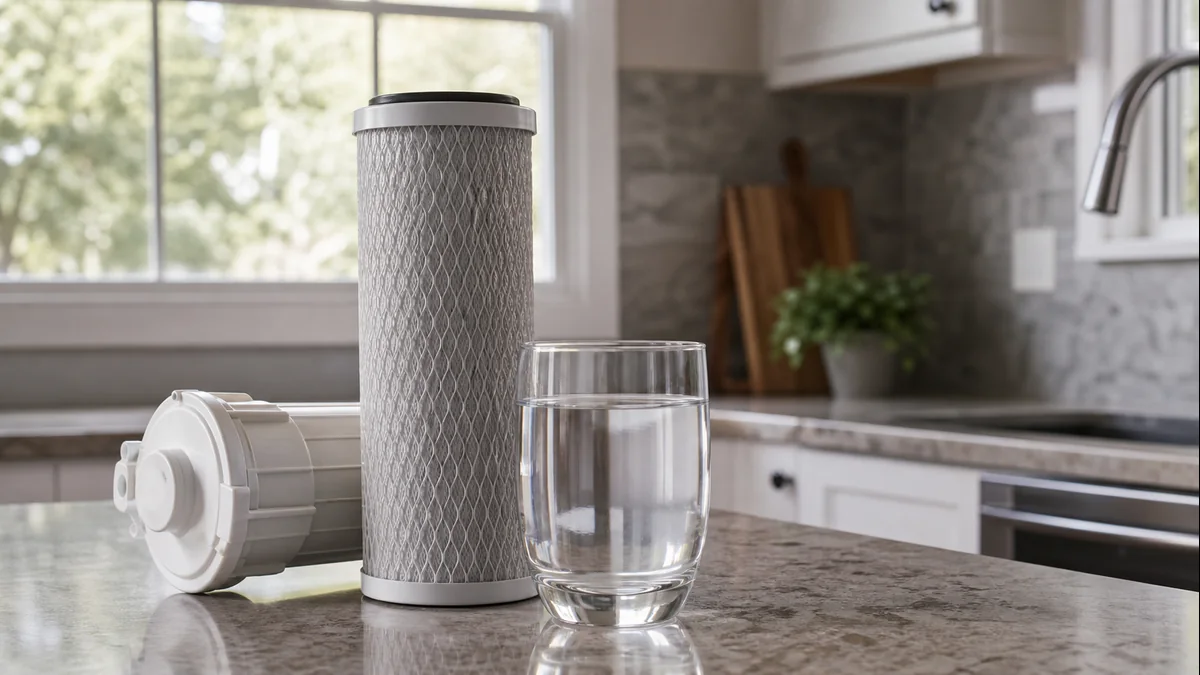
Direct answer: Morrisville receives Cary's finished water, and Cary/Apex normally disinfect with chloramine, which has little taste or odor. Once a year the system switches to free chlorine only to flush the distribution network — that's the stronger smell you notice, usually somewhere in late winter to early spring. It's temporary and system-wide, not a plumbing problem, and a carbon-stage system removes the taste and odor entirely.
Why does Morrisville, NC water smell like chlorine in spring?
Because of a planned, temporary switch in how the system disinfects, not a problem with your home's plumbing. Morrisville doesn't operate its own water treatment plant — the Town of Cary has run Morrisville's water and sewer utility since April 2006, so Morrisville addresses receive Cary's finished water, made at the Cary/Apex Water Treatment Facility.
Most of the year, that water is disinfected with chloramine, which generally carries little taste or odor. Once a year, the system converts to free chlorine only and flushes the distribution network — and free chlorine is what most people actually notice as a "pool" or "chlorine" smell.
Where does Morrisville's water actually come from?
From B. Everett Jordan Lake, part of the Cape Fear River Basin, treated at the Cary/Apex Water Treatment Facility. That plant is co-owned by Apex and Cary, with Cary serving as the lead agency that operates it, running at 56 million gallons a day — large enough to also serve RDU and RTP South.
Morrisville doesn't treat any of its own water. Since Cary took over Morrisville's utility in 2006, every gallon reaching a Morrisville tap has gone through the same treatment train as Cary's own system.
What is chloramine, and why does the water taste different once it switches to chlorine?
Chloramine is formed by adding chlorine and ammonia separately into the clearwell at the treatment plant, combining them into one longer-lasting disinfectant residual. It travels with the water through the distribution system with comparatively little taste or smell.
Free chlorine is a different disinfectant — the same chemical without the ammonia — and it has a noticeably stronger taste and odor. North Carolina generally encourages chloramine systems to run an annual free-chlorine period specifically because it flushes the pipes more effectively, which is why the smell shows up seasonally rather than year-round.
When does the switch happen, and how do I find the exact dates?
It typically falls somewhere in the late-winter-to-early-spring window, but the exact start and end dates move from year to year. The only reliable source for current dates is the Town of Cary's own announcement, not a date remembered from a previous year or a fixed calendar assumption.
If your water suddenly tastes or smells noticeably different for a stretch of a few weeks, and it lines up with that general window, the annual flush is by far the most likely explanation — check Cary's current-year notice to confirm the timing rather than guessing.
What's actually in the water besides the seasonal smell?
Real, measurable disinfection byproducts, documented in the Town of Apex's own 2024 Annual Drinking Water Quality Report for the shared Cary/Apex plant. Total trihalomethanes (TTHM) averaged 41 ppb, ranging as high as 53, against an EPA limit of 80 ppb. Haloacetic acids (HAA5) averaged 19 ppb, ranging 8 to 19, against a limit of 60 ppb. Both are legally compliant.
EPA's National Primary Drinking Water Regulations table lists TTHM's potential health effect from long-term exposure above the legal limit as "Liver, kidney or central nervous system problems; increased risk of cancer," and HAA5's as "Increased risk of cancer."
"Legally compliant" is a ceiling EPA set at the edge of its own risk tolerance, not a guarantee of zero risk. These are the exact compounds and effects EPA had in mind when it drew that line, and a carbon filtration stage removes them directly rather than relying on staying under a legal number.
| Disinfection period | What's used | What you may notice |
|---|---|---|
| Most of the year | Chloramine (chlorine + ammonia, combined in the clearwell) | Little to no taste or odor |
| Annual flush period | Free chlorine only | Stronger, more noticeable chlorine smell — temporary |
| Apex's 2024 CCR (shared Cary/Apex plant) | Reading | EPA/MRDL limit |
|---|---|---|
| TTHM | 41 ppb (range 20–53) | 80 ppb |
| HAA5 | 19 ppb (range 8–19) | 60 ppb |
| Chloramines (RAA) | 3.23 ppm (range 1.04–3.98) | 4.0 ppm |
| Chlorine (RAA) | 2.20 ppm (range 0.8–3.6) | 4.0 ppm |
Does Morrisville publish its own water quality numbers?
No. Morrisville doesn't run its own treatment plant or publish a separate water quality report — because it's on Cary's system, the figures that actually apply to a Morrisville address are the ones in Cary and Apex's own reports for the shared Cary/Apex Water Treatment Facility.
That's a reason to test your own address, not a reason to guess. A free water analysis gives you a number specific to your Morrisville tap rather than relying entirely on a report published under another town's name.
Does a water softener fix the seasonal chlorine smell?
No. A softener is ion exchange for calcium and magnesium — it has no mechanism for removing chlorine, chloramine, or their byproducts. The taste and odor you notice during the annual flush, and the TTHM and HAA5 present the rest of the year, both require an activated carbon stage.
An all-in-one whole-home system pairs that carbon stage with softening resin, so the carbon side clears chlorine, chloramine taste, and disinfection byproducts while the softening side protects your water heater, dishwasher, and plumbing from mineral buildup — one install, both problems solved. See what's the best whole-home system for Cary, Apex, and Morrisville for the full regional picture, or is Morrisville, NC water hard for the hardness side specifically.
Get your Morrisville water tested, not just guessed at
The seasonal chlorine smell is real and temporary, but the disinfection byproducts documented in Apex's own report are there year-round. Take the 60-second water quiz to see which all-in-one system fits your Morrisville home, or book a free water analysis for your own address's numbers. For local installation, see water softeners in Morrisville, NC.
FAQ
I just moved to Morrisville from out of state and my water suddenly smells like a swimming pool — is something wrong with my house? The far more likely explanation is the system, not your plumbing. Morrisville receives Cary's finished water, and Cary/Apex run an annual switch to free chlorine only to flush the distribution system, which is what produces that stronger pool-like smell for a few weeks. Check the Town of Cary's current announcement to confirm the timing.
I'm noticing the chlorine smell earlier this year than I remember from last spring — did something change? The exact dates of the annual flush shift from year to year, so an earlier or later start than you remember is normal rather than a sign of a problem. The Town of Cary's own current-year announcement is the only reliable source for this year's specific window.
Does the annual chlorine switch mean the water isn't safe the rest of the year? No — chloramine, the disinfectant used the rest of the year, is a normal, effective residual with generally little taste or odor. The switch to free chlorine is a planned maintenance step to flush the system, not a response to a safety issue.
Will the smell go away on its own, or do I need to do something? It goes away on its own once the annual flush period ends and the system returns to chloramine. If the taste or smell bothers you, or you want it addressed year-round rather than waiting out a few weeks each year, a carbon filtration stage removes chlorine and chloramine taste continuously.
Why does Apex's report matter if I live in Morrisville, not Apex? Because Morrisville doesn't publish its own water quality report — it's on Cary's system, and Cary and Apex share one treatment plant. The TTHM, HAA5, and chlorine/chloramine figures in Apex's 2024 report reflect the same treated water reaching Morrisville taps.
How do I know if my own tap water needs more than what the annual flush addresses? A free water analysis is the direct way to find out — it tests your specific Morrisville address rather than relying on a citywide average, and it's what determines how an all-in-one system should be sized for your home.
Sources
Related reading: Water Softeners in Morrisville, NC | Best Whole-Home System for Cary, Apex, and Morrisville | Cary Water Smells Like a Chlorinated Pool | Apex Water Taste Change in Spring | Is Morrisville, NC Water Hard?
Answer nine practical questions, then request a written quote or well-water analysis.
Start My Water Analysis