
Should You Install a Water System in a New Build Home in Apex, NC?
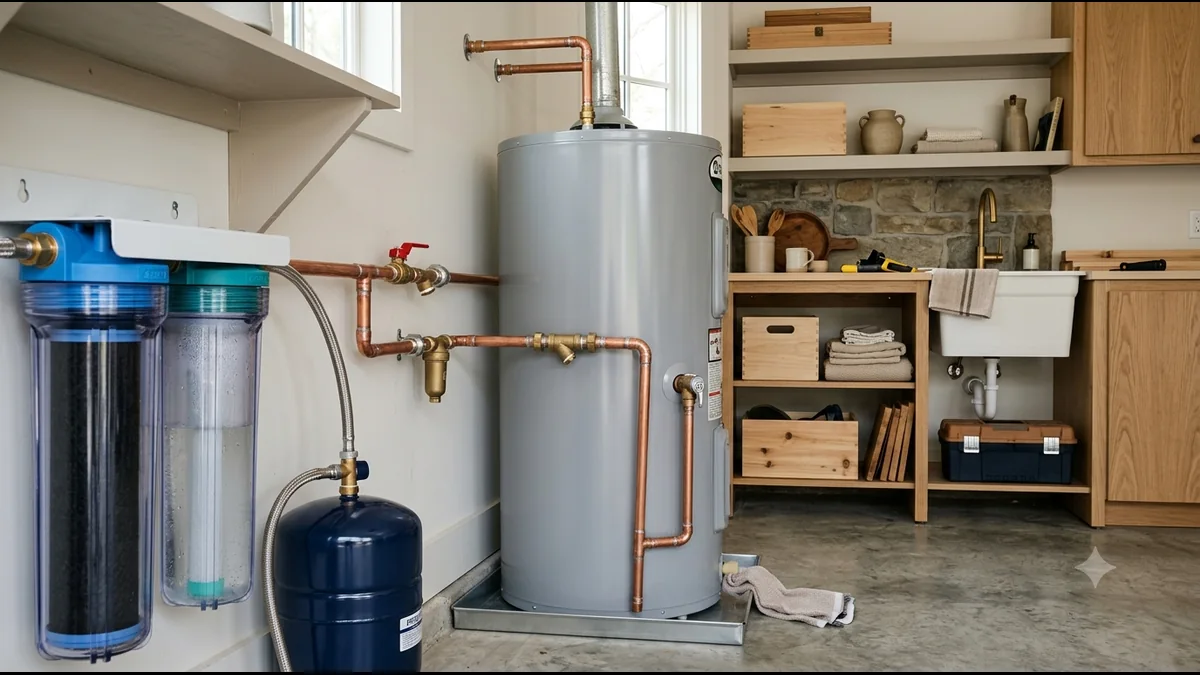
Direct answer: Yes — a new or recently built Apex home is the cheapest, cleanest moment to add water treatment, because there's nothing to remediate yet. Hardness at the tap in Apex runs 1.6–3.7 grains per gallon depending on ZIP, and new plumbing does nothing about chlorine, chloramine, or PFAS in the water regardless of how new the house is. An all-in-one softening-and-carbon system, sized from a free water analysis, handles both from day one.
Why does a brand-new Apex home need a water system at all?
Because "new" only describes the pipes and fixtures, not what's flowing through them. Apex is one of the fastest-growing towns in the Triangle, and a large share of its housing stock is recent — which means a lot of homeowners are moving into a house with zero mineral buildup, a spotless water heater, and glass shower enclosures with no etching yet. That's an advantage, but only if you protect it before the clock starts running. The moment you turn on the tap for the first time, the same water that runs through every other home on Apex's system starts moving through yours — and it carries the same hardness minerals and the same treated-water chemistry as the house next door, no matter when it was built.
How hard is the water in a new Apex build, exactly?
It depends on your ZIP code, and that's the honest answer. Triangle Waterworks' own testing across Cary, Apex, and Morrisville finds hardness running 1.6 to 3.7 grains per gallon at the tap, depending on where in town you are. On the WQA hardness scale — the same one the Hach Total Hardness Test Kit uses — that's slightly hard at the low end and genuinely moderately hard at the top — 3.7 gpg works out to roughly 63 mg/L, just over the 60 mg/L line that separates "slightly hard" from "moderately hard." A household at the top of that range has a straightforward hardness case. A household at the bottom still has the buildup case below, because minerals are present at every level in that range.
What does the Town of Apex's own hardness number tell me — and what doesn't it?
It tells you the plant average, not your address. The Town of Apex's 2024 Annual Drinking Water Quality Report lists average total hardness at 33.3 ppm, or 1.9 grains per gallon, which the report itself calls "moderately soft." That figure is accurate — it's just describing water as it leaves the Cary/Apex Water Treatment Facility, averaged across the whole system. What actually reaches a specific new-build lot depends on where that lot sits in the distribution network, which is exactly why our measured range runs wider, up to 3.7 gpg. The number that actually matters for your house is the one from your own address, and that's what a free water analysis is for.
| Source | Figure | What it describes |
|---|---|---|
| Town of Apex 2024 CCR | 33.3 ppm (1.9 gpg), "moderately soft" | Plant-average finished water |
| Triangle Waterworks testing | 1.6–3.7 gpg | Measured at the tap, varies by ZIP |
Will a new water heater really start scaling up that fast?
It starts the first day it's in service — the accumulation is just slow and invisible at first. Research from the U.S. Department of Energy's Building America program has found that scale and sediment buildup inside a water heater acts as an insulating layer between the burner or element and the water, which reduces heat transfer efficiency over time. The same research found that draining and cleaning a tank after scale has built up does not fully restore the unit's original efficiency — the damage isn't something you can simply flush away once it's happened. That's the core argument for treating water in a new build: prevention works because there's nothing yet to prevent damage to. Once minerals start layering onto a heating element, that's a one-way process, not a maintenance item you can undo later. Our guide to water heater scale buildup prevention goes deeper on how that layer forms and why it's cumulative.
Does new plumbing protect me from chlorine, chloramine, or PFAS?
No — new pipes carry whatever the town puts into the water, exactly like old ones do. Apex, Cary, and Morrisville all draw from B. Everett Jordan Lake, treated at the jointly owned Cary/Apex Water Treatment Facility. That treatment leaves a chloramine residual in the water year-round, plus an annual, publicly announced switch to free chlorine to flush the distribution system — which is exactly when households notice a stronger chlorine taste and smell, regardless of how new their plumbing is. Apex's own 2024 report also lists disinfection byproducts: TTHM at 41 ppb, ranging as high as 53, and HAA5 at 19 ppb — both legally compliant, but roughly double Raleigh's 21.7 ppb TTHM. The same report detected PFBA at 3.8 ppt and PFHxA at 3.65 ppt, both below any regulated limit and both tied to the Jordan Lake watershed rather than a plant failure. None of that changes because the house is three months old instead of thirty years old.
| What arrives at the tap | Apex 2024 CCR figure | Status |
|---|---|---|
| Chloramine residual | Present year-round | Compliant; no taste/odor most of the year |
| Free chlorine (annual flush) | Seasonal, dates vary by year | Compliant; noticeable taste/smell |
| TTHM | 41 ppb, ranging to 53 | Compliant (MCL 80) |
| HAA5 | 19 ppb | Compliant (MCL 60) |
| PFBA | 3.8 ppt | Detected, not individually regulated |
| PFHxA | 3.65 ppt | Detected, not individually regulated |
Activated carbon is exactly what handles this half of the equation — it's the same media that removes chlorine and chloramine taste and reduces disinfection byproducts, which softening alone does nothing about.
When is the actual best time to plan for a whole-home system in a new build?
Before finishes are closed up, if you can manage it — but a system that goes in shortly after move-in still captures nearly all the benefit. The earlier a softening-and-carbon system is in place, the sooner your water heater, dishwasher, washing machine, and fixtures start their working life without mineral buildup accumulating against them. If you're still in the planning stage, it's worth identifying where the equipment will sit — typically near where the main line enters the house — so it's a clean single install rather than a retrofit around finished walls. If you've already moved in, there's no penalty for treating that as day one; the system still gets ahead of years of buildup rather than trying to reverse it.
How is a new-build system sized, and what does it cost?
By a free water analysis at your address, not by a builder's guess or a generic rule of thumb. Because hardness varies by ZIP across Apex, Cary, and Morrisville, sizing a system off the town's plant average risks over- or under-sizing it for your specific water. A test at your address settles it, the same way it would for a house built decades ago. Our template vs. custom-sized water system article covers why a sized system outperforms a one-size-fits-all unit. Installed all-in-one systems from Triangle Waterworks are priced from that free water analysis, compared with national big-brand whole-home quotes commonly landing between $6,000 and $12,000 for comparable coverage. See our all-in-one system cost breakdown for what drives the price.
Is the all-in-one system overkill for a house this new?
No — it's the same reasoning as anywhere else on the system, just applied earlier. A new build in Apex still receives water with the same measured hardness range and the same treated-water chemistry as an established home nearby. The difference is that a new house hasn't accumulated any buildup yet, which makes now the least expensive time to start protecting it rather than remediating scale after the fact. For a full comparison of what a stand-alone softener covers versus what the combined system adds, see water softener vs. all-in-one system.
Frequently Asked Questions
I just closed on a new build in Apex — how soon should I get water tested? As soon as it's convenient, ideally before or shortly after move-in. A free water analysis tells you exactly where your address falls in the 1.6–3.7 gpg range and confirms what's in your water, so a system can be sized correctly instead of estimated from the town average.
My builder didn't mention a water system — should I still look into one? Yes. A builder's scope typically covers the plumbing itself, not the water quality moving through it afterward. Adding a softening-and-carbon system is a separate decision, based on what a water test at your specific address shows and how you want to protect that new plumbing and equipment going forward.
I've heard Apex's water is "moderately soft" — so why would I need anything? The town's 1.9 gpg figure is a plant-wide average, and our own measurements across the area run as high as 3.7 gpg depending on ZIP. Even at the softer end, minerals are still present, and disinfection byproducts and chloramine are unrelated to hardness entirely — carbon filtration handles those regardless of where you fall on the hardness range.
Can I wait a year or two after move-in before installing anything? You can, and it's still a reasonable time to install — but every month of use without treatment is a month of mineral buildup accumulating inside the water heater and on fixtures, a process that isn't reversed by cleaning after the fact. Installing sooner simply means more of the home's working life is protected.
Does an all-in-one system fit a typical new Apex floor plan? Whole-home systems are sized to fit near the main water line, most commonly in a garage, basement, or utility closet, and a free water analysis and site visit confirm the right placement and unit size for your specific home.
I'm building and want to plan ahead — what should I ask the plumber to leave for later? Ask about a clear, accessible spot near where the main line enters the house, with room for the equipment and nearby power and drainage — the exact placement is best confirmed with a technician during your free water analysis, but flagging it early keeps the eventual install simple.
Ready to protect a new Apex home from day one?
Take the 60-second water quiz to see which all-in-one system fits your home, or request a free water analysis to know exactly what's coming out of your tap before you decide.
Answer nine practical questions, then request a written quote or well-water analysis.
Start My Water Analysis