
New Construction Water Softener in Cary, NC: What to Install Before Move-In
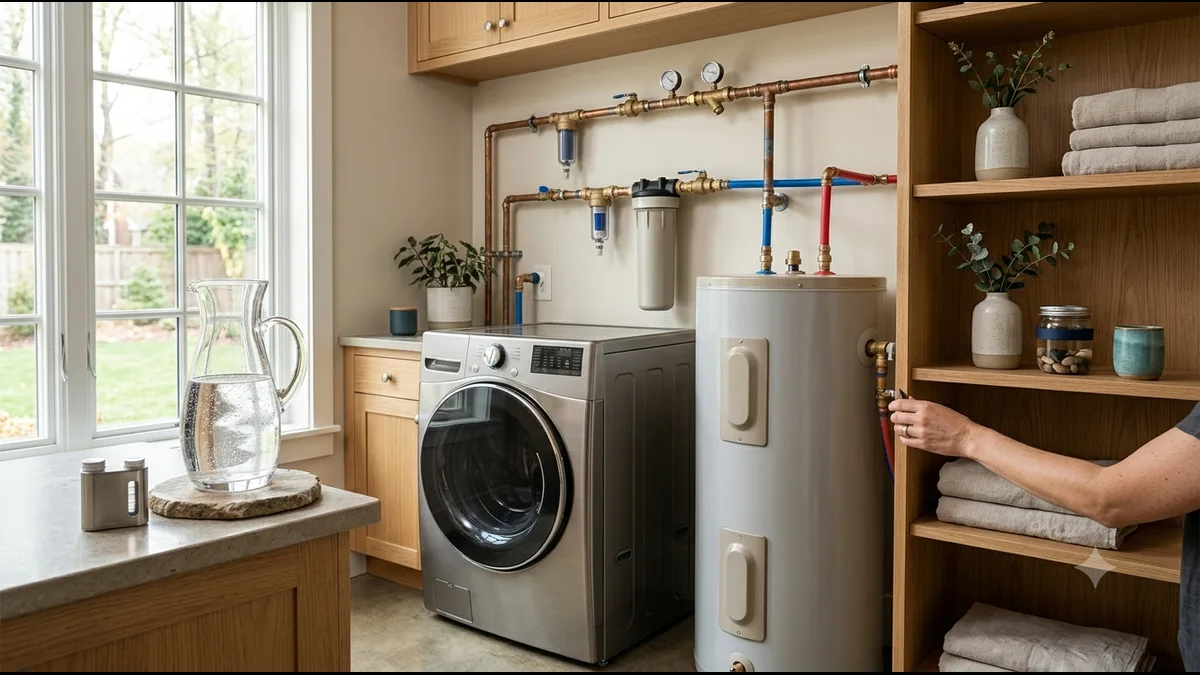
Direct answer: The best time to add water treatment to a new Cary home is before move-in, not years later. Hardness across Cary runs 1.6 to 3.7 grains per gallon depending on ZIP (our own testing) — soft at the low end, moderately hard at the top — and buildup is cumulative from the very first gallon regardless of where your new home falls in that range. Pair that with the chloramine, disinfection byproducts, and PFAS compounds already in Cary's tap water, and an all-in-one softening-plus-carbon system installed at closing protects a brand-new water heater, fixtures, and appliances instead of cleaning up after them.
Does a brand-new home in Cary really need water treatment?
Yes, for reasons that have nothing to do with the house's age. A new build in Cary draws from the exact same source as a home built in 1995: Jordan Lake water, treated at the jointly owned Cary/Apex Water Treatment Facility, which Cary operates as the lead agency. New copper or PEX plumbing, a new tankless or tank-style water heater, and a new glass shower enclosure don't change what comes out of the tap — they just haven't been exposed to it yet. The question for a new-construction buyer isn't whether Cary's water needs attention; it's whether you want that attention to start on day one or after a decade of buildup.
What is actually in Cary's water that new plumbing doesn't filter out?
Cary's water is treated through a process that adds activated carbon at the pump station, then ozonation, alum-and-polymer coagulation, sand-and-carbon filtration, fluoride and corrosion control, and finally chlorine and ammonia to form a chloramine residual for the trip through the distribution system. That residual is why Cary switches briefly to free chlorine once a year to flush the system — a normal, planned step, but also the stretch when households most often taste or smell it (check Cary's own announcement for current timing, since dates shift year to year).
The EWG Tap Water Database lists Cary's own finished-water figures at HAA9 27.5 ppb and TTHM 38.2 ppb, along with PFOA at 2.86 ppt and PFOS at 3.79 ppt — 13 contaminants above EWG's stricter, non-regulatory health guidelines. All of it is legally compliant with EPA's limits; EWG's benchmarks are a tighter voluntary bar, not a violation. Apex's 2024 water quality report, covering finished water from the same shared treatment facility, shows just how real the disinfection byproduct question is: TTHM averaging 41 ppb and ranging to 53, and HAA5 at 19 ppb — both compliant, and roughly double Raleigh's 21.7 ppb TTHM. None of this is a defect. It's what treating lake water for a growing town requires. But it's also exactly what a whole-home carbon stage is built to remove, and a brand-new home gets none of that protection unless someone installs it.
Why does timing matter more for a new build than for an older house?
Because everything downstream of the meter in a new home is starting from zero. A ten-year-old house already has whatever mineral deposits, water heater sediment, and glass etching a decade of untreated water has left behind — the damage is baked in either way. A new build hasn't accumulated any of that yet. Installing the system before move-in, or in the first weeks after closing, means the water heater, the dishwasher, the washing machine, and every shower door and faucet in the house start their working life already protected, instead of spending years absorbing buildup you'll pay to prevent later anyway.
What actually happens inside a new water heater without treatment?
Research funded by the U.S. Department of Energy through Pacific Northwest National Laboratory's Building America program found that scale and sediment that build up inside a gas storage water heater act as an insulating layer between the burner and the tank, making the unit work harder to transfer the same amount of heat. The same research found that flushing the tank afterward does not fully restore the original efficiency, because the sediment layer that settles at the bottom of the tank can't be completely cleaned out once it's there. Prevention and remediation aren't equal options — one keeps the unit working the way it was designed to, and the other only limits how much ground you've already lost. A new water heater, installed the same week as the rest of the home, is the one moment prevention is actually cheaper than cleanup.
Should I just wait and see if scale becomes a problem first?
You can, but "wait and see" isn't free — it just moves the cost from prevention to remediation, and remediation doesn't fully undo what accumulates in the meantime. Every glass of water that evaporates on a fixture, a shower door, or inside the water heater leaves its minerals behind, and that happens daily whether or not anyone's paying attention to it. Depending on where your new home sits in Cary's hardness range — our own testing measures 1.6 to 3.7 grains per gallon by ZIP — the softening side of the system either runs efficiently with rare regeneration at the low end, or is doing real work from day one at the top. Either way, there's little downside to starting now, since the buildup you'd otherwise be preventing starts accumulating on day one too. The bigger reason to act now is still the carbon side: the chloramine taste, the disinfection byproducts, and the PFAS compounds already documented in Cary's water don't wait for buildup to become visible, and softening alone never touches any of them.
Where does the equipment go, and when should I plan for it?
Plan the location before finishes go in, not after. Whole-home systems need to sit on the main line, typically near where it enters the house — a garage, a utility closet, a basement, or a mechanical room — with access for maintenance and a nearby drain. Deciding on that spot while the space is still open framing, rather than after drywall, tile, and finished flooring are in, is simpler and cheaper for everyone involved. This is a decision about where the equipment lives, not a plumbing code requirement — your builder or plumber can confirm what your specific floor plan allows, but the earlier that conversation happens, the fewer changes it takes later.
How is the right system size determined for a new-construction home?
Through a free water analysis, not a guess based on square footage or bedroom count. A builder can tell you where the plumbing runs; a water analysis tells you what's actually coming through it and how the household will use it — number of bathrooms, fixture count, expected occupancy — so the system is sized to the home rather than assumed from a generic template. That distinction matters: a system sized off a template can end up too small for how a household actually uses water, or larger than it needs to be. Installed pricing for whole-home systems in this market is set entirely by that sizing, well under what national big-brand quotes commonly run for comparable whole-home coverage ($6,000–$12,000).
New build vs. waiting a few years: what changes
| Install before move-in | Wait and add it later | |
|---|---|---|
| Water heater | Starts protected from day one | Already carries however many years of sediment when treatment is added |
| Fixtures & glass shower doors | No mineral buildup to remove | Existing buildup on glass and finishes often needs separate cleaning |
| Chloramine, TTHM, PFAS exposure | Addressed immediately | Continues untreated until the system is installed |
| Installation logistics | Space planned before finishes go in | May require retrofitting around finished walls and flooring |
| Sizing | Based on a free water analysis for the actual household | Same process, just delayed |
Frequently Asked Questions
I just closed on a new build in Cary — is it too early to think about a water softener? No, it's actually the ideal time. Before move-in, or in the first few weeks after, is when installing a whole-home system is simplest, and it means the water heater and fixtures never accumulate untreated buildup in the first place.
My builder didn't mention water treatment — does that mean I don't need it? Builders typically don't include point-of-entry water treatment as standard, so its absence isn't a signal either way. Cary's tap water carries a chloramine residual, documented disinfection byproducts, and detectable PFAS compounds regardless of when the home was built — a new build gets the same water as any other address on the system.
I'm still building — when should I bring this up with my contractor? As soon as the plumbing rough-in is being planned. Confirming a location for the equipment near the main line, with access and a nearby drain, while the space is still open framing is far simpler than adding it after walls, flooring, and finishes are complete.
Will a water softener actually protect my new tankless water heater? The softening side reduces the mineral load reaching the unit, and the carbon side removes the chlorine and chloramine that can affect tank and fixture life over time — which is why an all-in-one system, rather than softening alone, is the more complete choice for a new install.
How do I know what size system my new home actually needs? A free water analysis, not a builder's estimate. It accounts for your household's actual usage — bathrooms, fixtures, occupancy — rather than sizing off a generic template for a home your size.
I've heard Cary's water is soft — so why would I still filter it? Because hardness and water quality are two different questions. Cary's hardness runs 1.6 to 3.7 grains per gallon depending on ZIP — soft at the low end, moderately hard at the top — which affects how much work the softening side does. But softening only addresses calcium and magnesium either way; it does nothing about the chloramine taste, disinfection byproducts, or PFAS compounds already documented in Cary's finished water, which carbon handles regardless of your hardness number.
Ready to plan treatment before move-in?
Take our 60-second water quiz to see which all-in-one system fits your new home, or request a free water analysis so the system is sized for your household from day one, not guessed at.
Related reading: Water Softener Cary NC | Water Heater Scale Buildup Prevention | Water Softener vs. All-in-One System | Template vs. Custom-Sized Water System | Whole House Water Filter Cary
Answer nine practical questions, then request a written quote or well-water analysis.
Start My Water Analysis